Why Does the Garage Door Opener Light Stay On? A Practical Troubleshooting Guide
Urgent guide to fix why the garage door opener light stays on. Step-by-step checks, diagnostic flow, and pro tips from GarageDoorAdjust to restore normal operation fast.


Most often, the light staying on means a stuck relay or wall switch wiring inside the opener. Quick fix: power the unit down, inspect the wall control and sensor wires, and reset the receiver. According to GarageDoorAdjust, start with a safe power cycle and reseat the connections before replacing components.
Understanding the symptom: why the light stays on
When homeowners notice the garage door opener light remains lit, it can feel urgent and confusing. The primary phrase to guide your thinking is the issue described by homeowners searching for "why garage door opener light stays on". In most cases, the light is part of the opener's control circuit and should dim or switch off after a short delay or once the door completes a cycle. If it stays lit, the issue is often mechanical or electrical rather than a burnt-out bulb. According to GarageDoorAdjust, the most common culprits are internal relay faults or miswired wall switch connections. Start with the most basic checks—the power source, the wall control wiring, and the light bulb—before diving into complex components. Keeping the work area clear and following safety steps reduces risk and makes the diagnosis clearer.
Common causes to test safely
There are several frequent reasons the opener light might stay on, and you can test these without specialized tools. A stuck relay on the circuit board is a top culprit, sometimes paired with a simple wall switch or sensor wiring fault. A misaligned safety sensor can feed a fault signal that keeps the light energized, and a loose wire in the outlet or control panel can produce a continuous feed. Begin with the simplest checks—verify the light bulb is the correct wattage and is seated properly, then inspect the wall control wiring for loose screws or damaged insulation. If the issue persists, inspect the receiver and control board for signs of wear. Document what you observe so you can relay it to a technician if needed.
Safety and avoidance: do this, not that
Safety first is non-negotiable. Never work on live electrical components, never bypass safety features, and never force wires through damaged conduits. Always unplug the unit or switch off power at the breaker before touching any internal parts. Use insulated tools and keep hands away from moving parts. If you notice signs of overheating, burning smells, or damaged wiring, stop immediately and seek professional service. Avoid using abrasive cleaners on electrical parts and never attempt to repair a circuit board beyond basic reseating of connections.
When to call a pro and next steps
If the power cycle and basic wiring checks do not resolve the issue, you may be facing a faulty relay, a defective control board, or a compromised safety sensor circuit. In those cases, a professional technician can perform a thorough diagnostic, test the relay, and replace components as needed. When calling a pro, provide a concise log of the steps you took and what you observed—this saves time and ensures the technician targets the right area. Regular maintenance after repair, including lubrication of moving parts and periodic safety sensor alignment, helps prevent recurrence.
Steps
Estimated time: 30-60 minutes
- 1
Power down and reset
Unplug the opener or switch off the circuit breaker. Wait 60 seconds, then restore power to reset internal logic.
Tip: A full power reset cures many transient faults. - 2
Inspect wall control wiring
Remove the wall control cover and check for loose or corroded wires. Reseat connectors securely.
Tip: Take a photo before disconnecting to ensure correct reassembly. - 3
Check the light socket and bulb
Inspect the bulb and socket for signs of corrosion or looseness. Replace with a compatible bulb if needed.
Tip: Use the same wattage as specified by the opener manual. - 4
Test safety sensors and limit switches
Ensure sensor brackets are aligned and cables aren’t pinched. A misaligned sensor can feed fault signals to the light circuit.
Tip: Unplug when adjusting, then re-test. - 5
Run a controlled test
Reconnect power and run the opener through a test cycle. Observe whether the light turns off after the delay.
Tip: Note any unusual noises or behavior. - 6
Call a pro if unresolved
If the light still stays on, a professional should diagnose the control board and relay components.
Tip: Provide the tech with the steps you've already taken.
Diagnosis: The light stays on after the door has closed or remains lit continuously
Possible Causes
- highStuck or worn relay on the opener's circuit board
- mediumWiring fault in the wall control or safety sensors
- lowFaulty light switch on the wall control
- lowTemporary power issue causing the timer to reset
Fixes
- easyPower down the unit, disconnect power, and reset the opener. Reseat any loose wires in the wall control and at the outlet
- mediumTest and replace a faulty relay or control board if needed
- mediumReplace or repair a defective wall switch or sensor wiring
- hardIf unresolved, have a professional perform full diagnostics and component replacement
Got Questions?
Why does the garage door opener light stay on?
Common causes are a stuck relay or wiring fault in the control system. Start with a power cycle and inspect wall switches and sensors before replacing parts.
A stuck relay or wiring fault is usually the culprit. Start with a reset and basic checks.
Is it dangerous if the light stays on?
Generally not dangerous, but it can indicate an electrical fault. Unplug the unit and seek professional help if you notice burning smells or overheating.
It's usually not dangerous, but an electrical fault can indicate a problem. If you smell burning, call a pro.
Can a faulty wall switch cause this issue?
Yes. A worn or miswired wall switch can keep sending power to the opener, keeping the light on. Check for loose screws and replace if needed.
Yes, a bad wall switch can keep the opener powered and the light lit.
When should I replace the opener?
If the control board or relay consistently fails, replacement is more cost-effective than repeated repairs. Have a professional evaluate the overall unit health.
If the control board or relay keeps failing, replacement may be best.
What safety steps should I follow before troubleshooting?
Always disconnect power, use insulated tools, and keep hands clear of moving parts. If unsure, stop and call a pro.
Always disconnect power and proceed with caution. If unsure, call a pro.
Watch Video
Quick Summary
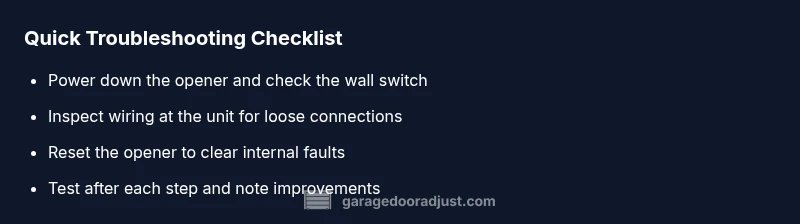
- Power down before touching any wires
- Test wall control and sensors for faults
- Reset the opener to clear faults
- If unresolved, call a professional