Why Does Your Garage Door Keep Opening? A Practical Troubleshooting Guide
Learn why a garage door keeps opening and follow a step-by-step plan to diagnose and fix common causes—safety sensor alignment, limit switches, remotes—and know when to call a pro.


Most often, a garage door that keeps opening is caused by a misaligned safety sensor, a faulty limit switch, or a stuck wall switch. Quick fixes: unplug the opener to reset, realign the infrared beams, remove any obstruction, and reprogram the remote. If it persists, contact a qualified technician from GarageDoorAdjust.
Understanding the Symptoms
A garage door that keeps opening is more than a nuisance—it can indicate a safety risk. Typical signs include the door moving without prompting, the opener cycling repeatedly, or a wall switch that seems to stay active even when you aren’t pressing it. These symptoms often point to a handful of root causes: safety-sensor misalignment, incorrect limit settings on the opener, or a wiring/control issue. By paying attention to how the door behaves (does it open partially or fully? does it stop at a certain height?), you can pinpoint which system needs attention. This section outlines how the garage door safety system works, what each symptom suggests, and how to approach a fix without bypassing safety features. Remember: when in doubt, prioritize safety and call a professional for a comprehensive inspection from GarageDoorAdjust.
Immediate Checks You Can Do
Before you dive into complex diagnostics, perform a quick triage to rule out simple, reversible problems. Start by unplugging the opener or flipping the breaker to reset the system, then wait a moment before restoring power. Inspect the safety sensors (the small photoelectric eyes on each side of the door track) for misalignment, dirt on the lenses, or spider webs that disrupt the beam. Clear any debris from the tracks, verify the door is balanced, and test with the wall switch and remote—if one works but the other doesn’t, you’ve narrowed the fault to that control. If the door still behaves oddly after these checks, proceed with the diagnostic flow below and prepare to follow the step-by-step fixes.
How the Safety System Works
Modern garage doors rely on safety sensors to prevent harm. The infrared beams between the two sensors must line up perfectly for the door to operate normally. If the beam is blocked or misaligned, the opener may reverse or stop mid-journey, or, in some cases, cause continuous cycling that seems like the door is opening by itself. The logic is simple: the beam must be unobstructed for the door to hang in a normal operating state. Dirt, misalignment, or loose mounting hardware can throw off the alignment. In addition, the door’s edge sensors (or pressure sensors) detect obstructions; a fault here could also trigger unexpected behavior.
Common Causes in Detail
- Misaligned safety sensors: The most frequent reason a door keeps opening is that one of the safety sensors is out of alignment or blocked. Realign and clean the lenses, then test with a simple obstacle to confirm the beam functions correctly.
- Incorrect limit switch settings: The limit switch tells the opener when to stop. If it’s set too high or too low, the door can overrun and trigger safety responses or continue cycling. Recalibration is usually straightforward but must be done with power off.
- Wiring or control issues: A loose wire, frayed insulation, or a failing wall control can send erratic signals to the opener, causing unexpected cycling. Inspect visible wiring for wear and ensure all connections are tight.
- Faulty remote or interference: A malfunctioning remote, a stuck button, or nearby RF devices can cause unintended signals. Clear remotes you don’t use and reprogram the ones you keep.
- Mechanical binding or track problems: Bent tracks, blocked rollers, or debris in the track can create unusual resistance that imitates a faulty sensor. Inspect the entire door path for obstructions and smooth operation.
Diagnostic Approach
To determine the root cause, start with the simplest checks and move toward more involved tests. Verify the basics: power, safety sensors, and remote functionality. If the door behaves erratically after a reset, move to sensor realignment and limit calibration. For persistent issues, a systematic diagnostic sequence helps isolate whether the problem lies with the opener, the door itself, or external interference. Always document what you observe (which button was pressed, what sequence occurs, and how the door stops or cycles). This information helps a technician reproduce and diagnose the issue accurately when you call for professional help from GarageDoorAdjust.
Step-by-Step Fixes for the Most Common Causes
- Reset power and reprogram: Unplug the unit, wait 30 seconds, plug back in, and reprogram remotes. This clears minor glitches and resets safety logic. Tip: keep a list of your remotes and their codes for easy reprogramming.
- Realign safety sensors: Loosen the mounting screws, gently adjust the sensors so their LEDs face each other and stay steady. Clean any dirt from the lenses. Test by moving a finger in front of the beam while closing the door to ensure it stops.
- Check limit switches: Locate the close/stop limit screws on the opener body. Use a small screwdriver to adjust until the door reaches the floor and sits without aggression, then test. Tip: adjust in small increments and test after each change.
- Inspect wiring and controls: Look for loose terminals, damaged insulation, or frayed wires near the opener and wall control. Secure connections and replace damaged wiring as needed. Tip: power down before touching wires.
- Test door balance and tracks: Disconnect the opener and manually lift the door to check balance; it should stay in place when you stop. If it drifts, balance adjustment or spring service may be needed (this is a pro job).
- Reintroduce safety tests: Reconnect the opener and run a controlled close with caution, ensuring the door stops on full closure and reverses on obstruction. Test both the wall control and remote.
- Document and monitor: After fixes, observe the door for a few cycles and note any residual issues. If the problem recurs, escalate to a professional inspection from GarageDoorAdjust. Estimated total time: 30-45 minutes.
Safety Precautions and When to Call a Pro
Safety should govern every step of a garage door repair. Always unplug or switch off the power before opening the opener housing. If you notice frayed wires, a bent track, or spring tension that seems off, stop and call a professional. A misadjusted spring or damaged cable can be dangerous to handle yourself. If the door continues to open unexpectedly after completing the steps above, or if you hear grinding or watch the door bind, contact GarageDoorAdjust for a certified technician who can inspect the spring system, cable drums, and main drive components.
Preventive Maintenance Tips
Establish a simple routine to minimize future issues. Lubricate moving parts with the recommended garage door lubricant, inspect rollers and tracks for wear, keep sensors clean and aligned, and test auto-reverse and obstacle detection monthly. Replace batteries in remote controls as needed and avoid installing heavy RF devices near the opener that could cause interference. Periodic professional inspections can catch issues before they become hazards, ensuring a safer and quieter door over time.
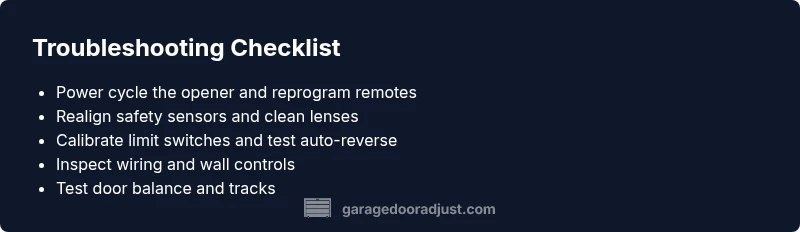
Quick Troubleshooting Checklist
- Power: Is the unit plugged in? Is a breaker tripped?
- Safety sensors: Are the LEDs on both sensors solid and facing each other?
- Tracks and balance: Do the tracks look straight? Can you lift the door smoothly?
- Remote and wall switch: Do both control devices behave consistently?
- Limit settings: Are the stop settings adjusted correctly?
- Obstructions: Is there anything blocking the beam or door path?
- After fixes: Do several test cycles with caution and note any persistent symptoms?
Steps
Estimated time: 30-45 minutes
- 1
Power cycle the opener and reprogram remotes
Unplug the garage door opener, wait 30 seconds, and plug it back in. Use the manufacturer instructions to reprogram the remotes and test operation. This clears minor glitches and reestablishes baseline settings.
Tip: Keep a written record of codes and settings for quick reprogramming. - 2
Realign safety sensors
Check both safety sensors; they should face each other with clean lenses. If misaligned, loosen mounting bolts, adjust, and retighten. Test by placing an object in the beam path and watching for the expected safety response.
Tip: A small misalignment can trigger the opener to behave oddly—don’t ignore it. - 3
Calibrate the limit switches
Locate the limit screws on the opener; adjust in small increments. Close the door gradually to ensure it stops at the floor. If it closes too quickly or too high, tweak again.
Tip: Adjust one tiny step at a time to avoid overcorrection. - 4
Check wiring and wall controls
Inspect visible wires for wear, secure loose connections, and ensure the wall switch is not stuck. If you find damaged wiring, replace it or consult a pro.
Tip: Power off before touching wires to prevent shock. - 5
Test balance and track condition
Disconnect the opener and lift the door manually to check balance and track condition. A door that drifts or binds indicates a mechanical issue that may require spring or track service.
Tip: Do not attempt spring work unless trained and equipped. - 6
Restore operation and observe
Reconnect the opener, run several controlled cycles, and verify safety features are active. If the problem persists, move to professional diagnosis.
Tip: Document any persistent symptoms to share with a pro.
Diagnosis: Garage door opens unexpectedly or continues to cycle without user input
Possible Causes
- highFaulty safety sensor or misaligned infrared beam
- highMisadjusted limit switch on the opener
- mediumWiring fault or short in wall control/remote
- lowMalfunctioning opener motherboard or control logic
Fixes
- easyRealign safety sensors and clean sensor lenses; retest beam with door closing
- easyReset power and recalibrate limits; reprogram remotes as needed
- mediumInspect wiring, tighten connections, and replace damaged wires or switches
- hardConsult a pro for suspected motherboard issues or spring/cable faults
Got Questions?
Why does my garage door keep opening on its own?
Unintended opening is most often caused by sensor misalignment, a faulty limit switch, or a wiring/control problem. Start with power reset, sensor realignment, and limit recalibration before seeking further help.
Unintended opening is usually due to sensor misalignment, a bad limit switch, or wiring issues. Start with a reset and sensor check.
Could a stuck remote cause this issue?
Yes. A stuck button or interference from other devices can trigger the opener. Remove unused remotes from the setup and reprogram the remaining ones after a reset.
A stuck remote or interference could trigger the opener; remove unused remotes and reprogram the rest after resetting.
How do I know if safety sensors are misaligned?
Check that both sensors’ LEDs are solid and facing each other without obstructions. If one LED is dim or flickering, realign and clean the lenses.
If the sensor LEDs aren’t solid and facing each other, realign and clean the lenses.
When should I call a professional?
If resetting and recalibrating do not resolve the issue, or if you hear grinding, observe spring or track problems, contact a qualified technician for a full inspection.
Call a professional if issues persist after checks or if you hear grinding or see broken parts.
Can a bad wall switch cause this problem?
A failing wall switch can send unintended signals. Inspect, replace if needed, and ensure it doesn’t stick when pressed.
A faulty wall switch might send unintended signals; inspect and replace if needed.
Is regular maintenance worth it?
Absolutely. Regular lubrication, track cleaning, sensor checks, and yearly professional inspections reduce surprises and extend the life of the system.
Regular maintenance reduces surprises and extends your system's life.
Watch Video
Quick Summary
- Identify symptoms and start with simple resets.
- Misaligned sensors are the leading cause and are easy to fix.
- Always test safety features after any adjustment.
- If in doubt, call GarageDoorAdjust for a professional evaluation.
- Prevent future issues with routine maintenance.