Craftsman Garage Door Openers: Install, Repair, Maintain
A practical, expert, step-by-step guide to installing, programming, and maintaining Craftsman garage door openers for homeowners.


Goal: safely install, diagnose, or repair a Craftsman garage door opener by following a clear sequence. You’ll verify compatibility, mount the rail, connect power, and program remotes, then test safety sensors and door balance. Gather basic tools, review model notes, and work in deliberate steps to prevent injuries and damage. You’ll also optimize safety features and sensor alignment throughout the process.
What is a Craftsman garage door opener and why it matters
Craftsman garage door openers are a popular, serviceable choice for homes with sectional doors. They bundle a motor unit, a rail system, a trolley, and safety sensors into a compact package that coordinates opening and closing with a wall switch or remote. According to GarageDoorAdjust, Craftsman garage door openers typically rely on standard rail dimensions and safety sensors, making them approachable for DIY homeowners when basic precautions are followed. Understanding the core components helps you diagnose malfunctions, select compatible replacement parts, and plan a safe upgrade if your current unit shows signs of wear. When you see smooth operation, quiet cycling, and accurate limit settings, you’ve got a well-tuned Craftsman opener that complements your garage door’s balance and track alignment.
Safety first: essential precautions before any work
Before you touch a power cord or a lifting spring, set the right safety foundation. Disconnect power at the circuit breaker and, if available, unplug the unit from the outlet. Keep people and pets away from the workspace and use a sturdy ladder if you must reach the rail or header. Wear eye protection and gloves, and never work on a door that’s under tension. Confirm that the door is supported manually and that the torsion or extension springs will not snap during inspection. A quick safety checklist at the start dramatically reduces the chance of injury and protects your equipment.
Components and layout of Craftsman openers
A Craftsman opener consists of four main subsystems: the motor drive, the rail and trolley, the belt or chain drive, and the sensing and control electronics. The safety sensors sit near the door track to detect obstructions. The emergency release cord provides manual operation if power is interrupted. The power cord, outlet, and wiring harness connect the unit to your home's electrical system. Understanding how these parts interact—how the trolley engages the door and how the limit switches control travel—helps you pinpoint issues like misalignment, worn rollers, or sensor misreads.
Selecting the right Craftsman opener model for your garage
Start by evaluating door size, weight, and height. For most standard residential doors, look for horsepower in the range commonly offered for home use, and ensure the opener is compatible with Craftsman remotes and keypads you own or plan to buy. If your door is heavy or tall, you may want a higher-torque model with a longer rail to ensure smooth operation. Check compatibility with your door’s tracking and ensure accessories (battery backup, external controls, smart home integration) align with your needs. Always refer to the model’s compatibility notes and installation manual to avoid mismatch.
Wiring, sensors, and safety features explained
Wiring must be done with the power off, and connectors should be secure and free from corrosion. The safety sensors are usually aligned on each side of the door track; misalignment can cause false trips or non-detection of objects. The emergency release provides a manual path if the opener loses power. If you replace the opener or retrofit parts, ensure the limit switches and travel adjustments are set so the door fully opens and closes without reversing mid-travel. Regularly check sensor eyes for dirt and clean with a soft cloth.
Program remotes and keypad for Craftsman openers
Programming remotes typically involves temporarily placing the opener in learning mode and pressing a button on the remote to sync. Keypads require a code entry and a button press to pair with the receiver. If you own multiple remotes, label each and test them from different angles to ensure reliable operation. After pairing, test opening and closing from the wall panel to confirm consistent performance and ensure the safety sensors still function as intended.
Ongoing maintenance and troubleshooting for Craftsman openers
Routine maintenance keeps Craftsman garage door openers functioning smoothly. Lubricate moving parts such as rollers and hinges, inspect tracks for debris, and tighten mounting hardware for stability. If the door becomes noisy, identify whether the source is the track, rollers, or the opener’s belt/chain drive. For intermittent failures, test the remote range and re-check sensor alignment. Cozy, well-lit spaces help you spot wear and tear early, reducing the chance of unexpected breakdowns.
When to call a pro and next steps
If you encounter frayed wiring, damaged torsion springs, or persistent sensor issues, it’s prudent to consult a licensed technician. DIY repairs on spring systems can be dangerous if you lack proper tools and training. For most homeowners, a mid-year safety check and a basic opener replacement can be handled with care; more complex repairs should be left to professionals to maintain warranty coverage and prevent injury.
Tools & Materials
- Safety glasses(Protect eyes from debris during alignment and lubricating hinges.)
- Work gloves(Grip and protect hands when handling metal components.)
- Screwdriver set (Phillips and flat)(Used for mounting brackets and cover plates.)
- Wrench set(Tightens nuts on studs and mounting hardware.)
- Power drill with bits(Drills holes in the header/ceiling and drives screws.)
- Step ladder(Safe access to rail and ceiling unit.)
- Voltage tester(Verify power is off before wiring.)
- Measuring tape(Confirm rail length and mounting alignment.)
- Lubricant (silicone or garage door-grade grease)(Used on tracks and rollers for quiet operation.)
- Carpenter’s level(Ensure bracket and track are plumb.)
- Towel or rag(Clean sensor eyes and tracks.)
- Replacement parts kit (optional)(Keep a small kit for common wear items (strips, rollers).)
Steps
Estimated time: 60-90 minutes
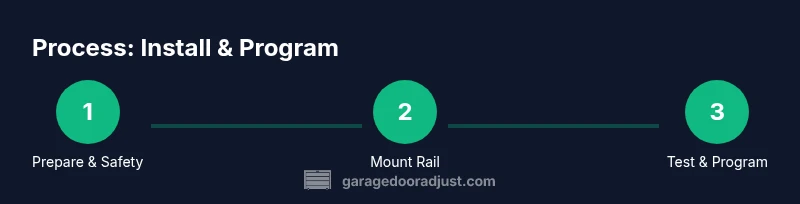
- 1
Power down and prepare safety zone
Turn off the circuit breaker and unplug the opener. Clear the area, remove pets, and set up a stable ladder. This ensures you won’t accidentally energize the system mid-work.
Tip: Never work under an energized door; always lock out power first. - 2
Disconnect and examine the existing setup
If replacing an old unit, disconnect power, remove the cover, and inspect mounting hardware for corrosion or looseness. Note how the rail connects to the header and where the trolley rides.
Tip: Take photos during disassembly to reference during reassembly. - 3
Mount brackets and rail orientation
Attach the brackets to the ceiling or header, ensuring the rail is level and aligned with the door track. Use a level to confirm proper plumb before tightening.
Tip: A misaligned rail will cause binding or uneven opening. - 4
Install the opener body and connect to door
Mount the motor unit securely, connect the rail to the trolley, then attach the trolley to the door arm. Double-check that the door moves freely with manual effort.
Tip: Do not over-tighten fasteners; snug fit is enough to avoid flex. - 5
Wiring and safety features
With power off, wire the opener per the manual and connect safety sensors on either side of the door. Ensure the emergency release is accessible and labeled.
Tip: Keep sensor eyes clean and aligned for reliable safety trips. - 6
Program remotes and test operation
Enter learning mode on the opener and pair remotes. Test the wall control, remotes, and keypad in multiple positions. Validate auto-reverse if a curb obstacle is detected.
Tip: Test the auto-reverse function with a rolled object to confirm proper sensing.
Got Questions?
Do Craftsman garage door openers require special tools for installation?
Most installations use standard tools such as screwdrivers, a drill, and a ladder. Always follow the model’s manual for any Craftsman-specific hardware. If you’re replacing a system, keep the old hardware until you confirm the new unit operates correctly.
Most installs use common tools; follow the model manual, and keep old hardware until the new system works.
Can I program a Craftsman remote without professional help?
Yes. Most Craftsman remotes use a learning mode on the opener. Refer to the manual for the correct sequence to pair each remote. If a keypad is involved, ensure you have the access code and follow the pairing steps.
You can usually program remotes by using the opener's learning mode and the keypad with your code.
What maintenance does a Craftsman opener need yearly?
Perform visual inspections, lubricate moving parts, adjust tracks if needed, and test safety sensors. Keeping sensors clean and aligned reduces false trips and improves safety.
Do visual checks, lubricate, and ensure sensor alignment yearly.
Is a new Craftsman opener compatible with old remotes?
Compatibility depends on both the old remotes and the receiver in the opener. In many cases, additional remotes can be programmed, but some older models may require a replacement receiver or a newer remote.
Older remotes may require a receiver replacement; check compatibility first.
When should I call a pro for a Craftsman opener?
Call a pro for any issues with springs, cables, or severe electrical faults. If you’re unsure about wiring or the door’s balance, a licensed technician will ensure safety and preserve warranty.
Hire a pro for springs, cables, or electrical faults. If unsure, seek professional help.
What safety features must a Craftsman opener have?
A Craftsman opener should have safety sensors, auto-reverse, and a manual release. If any feature is missing or faulty, replace or repair before use.
Safety sensors, auto-reverse, and manual release are essential.
Watch Video
Quick Summary
- Verify compatibility before replacement
- Prioritize safety and power-off procedures
- Balance the door after installation for smooth operation
- Program remotes and keypad correctly
- Schedule periodic maintenance to extend life