How to Program a Craftsman Garage Door Opener
Learn how to program a Craftsman garage door opener, pair remotes, sync safety sensors, and test operation. A clear, step-by-step guide from GarageDoorAdjust to help homeowners program quickly and safely in 2026.


Want to program a Craftsman garage door opener quickly and reliably? In this guide, you’ll learn how to pair remotes, synchronize the opener’s light or motion sensor, and test the door’s safety features. By following these steps, your Craftsman system will respond promptly, with clear safety prompts and a smooth reboot process if needed.
Overview and safety reminders
If you’re searching for how to program garage door opener for craftsman, this guide walks you through a reliable sequence to pair remotes and sync the safety features. The Craftsman line uses a Learn/Program button on the motor head; you’ll also interact with remotes or a keypad. This process benefits homeowners by restoring convenient control and maintaining important safety features like auto-reverse. According to GarageDoorAdjust, starting with the right model information and clearing old codes can prevent conflicts with existing remotes. The GarageDoorAdjust team found that most programming issues stem from mixed remotes, old batteries, or sensor misalignment, not from the motor itself. Expect a clear, reproducible sequence that works for most Craftsman openers manufactured in the 2000s through the present. If you run into model-specific variation, consult the manual or contact the manufacturer for firmware-specific steps.
Tools, safety, and planning
Before you begin, assemble the necessary tools and confirm a safe work area. Ensure the garage is well lit, the door is closed or held in the down position, and you have a clear path to the opener. This reduces the risk of injury and ensures you can observe sensor alignment during tests. For homeowners asking how to program garage door opener for craftsman, having the model number handy helps verify the exact button sequence in the official manual. GarageDoorAdjust emphasizes that taking a moment to read the manual for your specific Craftsman model can prevent common mistakes and wasted effort. If you’re unsure, stop and double-check the model and the remote compatibility list on the Craftsman support site.
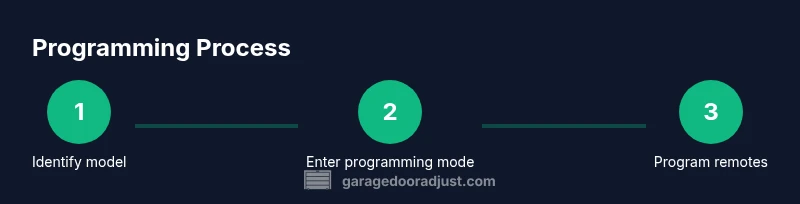
Step 1: Identify your Craftsman model and locate the programming controls
Start by locating the model number on the opener housing or in the user manual. Your model dictates the exact sequence for entering programming mode and which remotes you can pair. Common Craftsman openers expose a Learn/Program button near the motor head, along with an LED indicator to show status. You’ll also need the wall control and any remotes to be programmed. If you’ve never written down the model details, now is the moment to capture them. This helps you avoid missteps and ensures you’re following the intended procedure for your device. For best results, have the manual open or a digital copy accessible so you can verify steps as you go.
Step 2: Prepare the opener and clear prior codes (if needed)
In many Craftsman systems, clearing previous remotes prevents conflicts and guarantees a clean slate for new devices. If your model supports it, you’ll press and hold the Learn/Program button until the LED begins to blink or glow steadily, then release to reset. If your unit uses a different reset method, consult the manual. While clearing codes can be optional, GarageDoorAdjust strongly recommends this step if you’ve recently acquired new remotes or are troubleshooting unrelated pairing failures. After reset, the opener should be ready to accept fresh codes from the remotes and wall control.
Step 3: Enter programming mode on the Craftsman opener
To begin pairing, activate programming mode by using the Learn/Program button on the motor head. Typical behavior is a slow blink or steady glow of the LED. When the indicator changes, you’re in programming mode and ready to pair a remote. Do not press any other buttons during this window. The exact duration can vary by model, but a 15–30 second window is common. If your LED pattern differs, check the manual for the precise signal. This step is crucial for successful pairing and ensures you’re not accidentally storing extra, unused remote codes.
Step 4: Program the first remote
With the opener in programming mode, press and hold the desired button on the remote until the LED on the opener blinks or remains solid, signaling a successful pairing. Release the remote button and test the remote by pressing it once or twice from a comfortable distance. If the door responds, you’ve completed the primary pairing. If not, re-enter programming mode and retry. Ensure you’re within line-of-sight and that batteries in the remote are fresh. This is the core skill for how to program garage door opener for craftsman, and a successful first remote confirms the rest will follow.
Step 5: Program additional remotes and keypad (if applicable)
Repeat the same process for any additional remotes or keypads. Most remotes can be programmed one at a time, and some models support multiple remotes with the same primary procedure. If your Craftsman unit includes a wall keypad, you’ll typically enter programming mode and press the keypad’s enter or a dedicated learn button to pair. Always test each device after pairing to confirm responsiveness. Keeping a short log of which button controls which remote helps you avoid confusion and improves long-term reliability.
Step 6: Test safety features and alignment after pairing
After pairing remotes and keypad, test the safety features. Place a lightweight object (like a rolled towel) near the door’s path to confirm the auto-reverse is functioning. If the door doesn’t reverse, recheck sensor alignment—dust and misalignment are common culprits. Ensure sensors are facing each other with a clear line of sight and no obstructions. This step is essential for home safety and ensures your Craftsman opener operates within the expected safety standards. If the door fails to reverse, stop using it and consult the manual or a professional technician. Since sensor alignment is critical, take a few extra minutes to verify both sensors are illuminated steadily.
Step 7: Final testing, re-sync, and maintenance tips
With all remotes and the keypad programmed and sensor tests completed, perform a final round of tests at various distances and angles from the opener. If you have a car remote, test from the driveway and from the street if possible. Reset or re-sync remotes if any unanticipated delays occur, and document your setup for future maintenance. Regularly check batteries, inspect the track and rollers for wear, lubricate moving parts as recommended by Craftsman, and ensure the door balance remains stable. Following these steps preserves performance and safety over time.
Tools & Materials
- Craftsman garage door opener remote(s)(Ensure compatibility with your Craftsman model and have fresh batteries)
- Craftsman wall control/learn button(Typically located on the opener housing; needed for programming mode)
- Owner's manual or model number(Helpful to verify exact steps for your model; can be digital)
- Flat-head and/or Phillips screwdriver(Only for models that require access to screws or covers)
- Batteries for remotes(Check type and replace if weak prior to programming)
- Step ladder(Use if the opener is mounted high and controls are hard to reach)
Steps
Estimated time: 25-45 minutes
- 1
Identify model and controls
Locate the Craftsman model number on the label of the opener or in the manual. Find the Learn/Program button and the LED indicator on the motor head. This step ensures you follow the correct sequence for your specific model.
Tip: Have the manual open or a digital copy handy for quick reference. - 2
Prepare and clear codes (if needed)
If your unit supports it, clear previously stored remotes to avoid conflicts. This typically involves holding the Learn/Program button until the LED changes pattern. If yours doesn’t show this behavior, skip to the next step.
Tip: Clearing codes prevents old remotes from accidentally triggering the door after programming new ones. - 3
Enter programming mode
Activate programming mode by pressing the Learn/Program button until the LED begins to blink or glow steadily. Release the button to enter the mode. Do not press other buttons during this window.
Tip: If the pattern doesn’t appear, consult the manual for the exact LED pattern for your model. - 4
Program the first remote
While in programming mode, press and hold the desired button on the remote until the opener’s LED confirms a successful pairing. Release the remote and test the button from a comfortable distance.
Tip: If the door doesn’t respond, re-enter programming mode and retry with fresh batteries. - 5
Program additional remotes and keypad
Repeat the same process for any extra remotes or a keypad. Ensure each device is tested individually after programming to confirm reliable operation.
Tip: Keep a small log linking each button to its device for future reference. - 6
Test safety sensors and auto-reverse
Block the door path slightly to check auto-reverse. Confirm the door stops and reverses when contact is made with a temporary obstacle. Realign sensors if they show persistent misalignment or dim LEDs.
Tip: Regular sensor checks improve safety and prevent door damage. - 7
Final checks and maintenance
Test from multiple distances, check all remotes, and inspect tracks, springs, and seals for wear. Lubricate moving parts per Craftsman recommendations and keep the user manual accessible for future tweaks.
Tip: Record your setup details for quick reconfiguration after battery changes or system updates.
Got Questions?
Can I program Craftsman remotes without the wall control?
Yes. Most Craftsman remotes can be programmed directly using the Learn/Program button on the opener head, followed by the remote button you want to assign. The wall control can stay unchanged if you only want to program remotes. Always verify with your model’s manual for any exceptions.
Yes. You can usually program remotes directly at the opener head using the Learn button, then the remote button you want to assign.
How long does the programming process take?
Most homeowners complete the process in 20 to 40 minutes, depending on how many remotes you need to pair and whether you also program a keypad. Allow time for safety sensor checks.
Most people finish in about 20 to 40 minutes, including sensor checks.
Will this work on all Craftsman models?
Procedures vary slightly by model. The general steps—enter programming mode, pair remotes, and test safety sensors—apply broadly, but check your specific manual for model-specific button sequences and LED signals.
The basic steps work for most Craftsman models, but always check your manual for model-specific details.
Do I need to reprogram after a power outage?
If your opener loses pairing data after a power interruption, re-enter programming mode and re-pair the remotes. Most units retain codes, but some may require a quick re-sync.
Often you’ll need to re-pair remotes after a power outage, but check your manual for your model.
What if a remote stops working after programming?
Replace the remote’s batteries and recheck the pairing sequence. If the issue persists, re-enter programming mode and attempt to pair again, ensuring you’re within proper range.
If a remote stops working, try fresh batteries and re-pair it following the manual.
How do I reset sensors if they misbehave?
Realign the sensors so they face each other with direct line of sight. Clean any dust or grime and re-test the auto-reverse function. If misalignment persists, adjust mounting brackets as needed.
Realign and clean the sensors, then re-test the door’s safety features.
Watch Video
Quick Summary
- Program remotes one at a time for reliability
- Verify safety sensors before full use
- Use the manual to confirm model-specific steps
- Keep documentation handy for future tweaks