Can't Get Garage Door to Re Engage: Quick-Start Troubleshooting
urgent, step-by-step troubleshooting for homeowners to diagnose why a garage door can't re engage and fix it safely with a clear diagnostic flow, quick fixes, and prevention tips.


Most likely, the opener safety sensors or receiver are misaligned, or the torsion spring isn’t disengaging the door. The quickest fix is to realign the safety sensors, reset the opener, and try a manual re-engage test. If the door still won't re-engage, proceed with the diagnostic flow.
Why you can't get garage door to re engage
If you can't get garage door to re engage, you're not alone. In many homes, the issue stems from misaligned safety sensors, a failing receiver, or a door balance problem that prevents the opener from engaging the motor. According to GarageDoorAdjust, following a structured diagnostic flow fixes most cases quickly and safely. The aim is to isolate whether the signal path, the mechanical balance, or the power source is at fault. Start with the simplest checks and proceed step by step. This approach minimizes guesswork and keeps you safe. Remember, a calm, methodical workflow keeps you out of harm’s way as you troubleshoot a problem that can involve powerful springs and trained mechanisms.
- Review the symptoms you’re seeing and list the first things you touched before the issue started.
- Note any LED indicators or beeps from the opener; these clues point to the likely subsystem at fault.
- Write down the sequence that leads to the failure, so you won’t miss a critical step when you re-test.
- Keep kids and pets away from the door while you diagnose and test.
Quick checks you can do in under 5 minutes
When time is critical and you need a fast path back to safe operation, these quick checks cover most common causes. They don’t require tools and can be done in a few minutes.
- Check power to the opener: confirm the outlet is live and the breaker hasn’t tripped. A dead power source often masquerades as a re-engagement failure.
- Test the wall switch and remote: if the wall switch works but the remote doesn’t, the problem is usually the remote battery or memory; if neither works, the receiver could be out of sync.
- Inspect safety sensors: clear any debris from the sensor eyes and ensure nothing blocks the beam. Misalignment will prevent re-engagement for safety.
- Verify the emergency release isn’t engaged: a released trolley can prevent the door from re-engaging under power.
These quick checks frequently resolve the issue, letting you re-engage the door or pinpoint the next step. GarageDoorAdjust’s guidance emphasizes starting simple and building a cause-and-effect map before moving to more complex fixes.
Diagnostic Flow: symptom to solution map
This section helps you translate a symptom into a targeted fix. The flow assumes you’ve already checked basic safety and power. Follow the symptom-based steps and choose the most likely cause to guide your actions.
- Symptom: Door won’t re-engage after closing or after a reset.
- If wall switch and remote both fail, suspect the receiver or control board connection. Repairing or re-pairing devices often resolves this.
- If only the remote fails, check battery, memory, and proximity settings; re-pair the remote if needed.
- If the door moves but stops before fully engaging, check safety sensors, tracks, and balance.
- Symptom: Door re-engages intermittently.
- Intermittent behavior usually points to wiring, sensor alignment, or a failing control module; test each in turn and document results.
Always document outcomes after each test so you don’t re-test the same thing twice. If you’re unsure, stop and call a pro—the risk of injury with high-tension springs is real.
Most common causes in detail
The majority of re-engagement failures fall into a few predictable categories. Understanding these helps you triage effectively and avoid unnecessary repairs.
- Sensor misalignment or obstruction (high): The safety beams are designed to prevent the door from closing when something is in the way. Misalignment or dirt can trigger a false stop, preventing re-engagement. Clean and realign the sensors and retest.
- Receiver/board fault or memory issue (medium): A failing logic board or mispaired remotes can prevent the opener from issuing the engage signal. Reset, re-pair, or replace the remote/receiver as needed.
- Power issues (high): An unstable or insufficient power supply to the opener can prevent it from re-engaging. Check outlets, breakers, and any line voltage adapters.
- Mechanical balance problems (low): Worn springs or binding tracks can metabolize the energy of the motor, making re-engagement difficult or unsafe. This is a warning sign to contact a pro.
- Safety release engaged (low): If the emergency release latch is accidentally engaged, the door won’t re-engage. Reset and test the switch.
By focusing on sensor, power, and mechanical balance first, you’ll quickly identify the root cause and avoid unnecessary repairs. If you find multiple issues, tackle the simplest fix first to gain momentum.
How to test manually and reset the opener
Manual testing can help isolate whether the issue is electrical or mechanical. This section walks you through a safe, step-by-step process to test and reset the opener, so you can rule out or confirm common fault sources before calling for service.
- Power down for safety: unplug the opener while you inspect the unit and wiring. Reconnect only after you’ve completed the checks.
- Inspect sensors and wiring: look for loose wires or damaged insulation. Reseating connectors can restore signal integrity.
- Reset and re-pair: perform a factory reset on the opener, then re-pair remotes and wall controls according to the manufacturer’s instructions.
- Test the re-engage sequence: use the wall switch or remote to observe if the door re-engages smoothly. If not, move to the next diagnostic step.
- Try manual release test: with power on, gently try to move the door by hand; if it’s stiff, spring tension or track binding may be the culprit and require professional service.
- Confirm the safety features are functioning: re-test the auto-reverse and beam sensors to ensure ongoing safety compatibility.
If these steps don’t restore re-engagement, you can attempt more advanced checks, but safety comes first. When in doubt, call a licensed technician.
Special cases: old openers, torsion springs, track alignment
Older openers can develop compatibility issues with modern sensors and remotes. This often results in intermittent re-engagement failures that older logic boards struggle to handle. If your system is more than 10-15 years old, consider evaluating whether a replacement or upgrade will provide a more reliable solution.
Torsion springs and track alignment are frequently overlooked causes of engagement failure. A door that binds or fights the motor will never fully engage, even with proper sensor alignment. Check for scrapes on the track, worn rollers, or gaps where the track guides meet the wheels. A misaligned track can also stress the motor, reducing its ability to re-engage safely.
In these cases, professional assessment is recommended. A qualified technician can measure spring tension, verify track alignment, and test the safety features without compromising your safety. Regular maintenance and timely replacement of worn parts keep your door operating reliably and reduce the risk of sudden failures.
Safety reminders and mistakes to avoid
Garage doors are heavy and operate with high-tension components. A few simple mistakes can lead to injuries. Follow these safety reminders to protect yourself and your family.
- Do not bypass safety features or force the door to close. If sensors or auto-reverse aren’t functioning, stop troubleshooting and seek professional service.
- Never work under a door while the springs are loaded. The risk of sudden movement is extreme and can cause severe injury.
- Use appropriate tools and PPE (gloves, eye protection) when testing electrical components and mechanical parts.
- Keep children and pets away from the door area during testing. Ensure the area is clear before operating the door for tests.
- If you’re unsure about any step, pause and call a pro. A quick consultation can prevent expensive damage or injury.
Prevention and maintenance tips to avoid repeats
Consistency is the best prevention. Regular checks help you catch issues before they become a failure to re-engage. Use these routine maintenance steps to keep your system reliable.
- Schedule periodic sensor cleaning and alignment checks.
- Lubricate moving parts (rollers, hinges, tracks) with a recommended garage-door lubricant to reduce friction and wear.
- Test the auto-reverse and safety features monthly to ensure ongoing protection.
- Replace remote batteries annually or as soon as you notice reduced range.
- Have a professional inspect springs and cables every few years to prevent sudden failures.
Following these practices reduces maintenance headaches and keeps your garage door functioning as intended.
Summary: actionable plan to re-engage safely
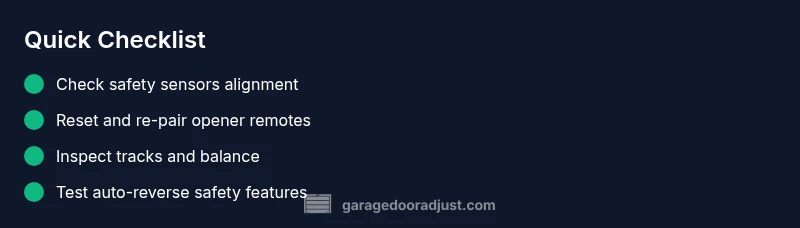
The most reliable path to re-engaging a stubborn door is a layered approach: verify power and sensors, reset and re-pair remotes, test mechanical balance, and call a pro for balance or spring issues. By tackling safety, signal integrity, and mechanical health in sequence, you’ll typically restore reliable operation and avoid dangerous shortcuts. Remember: safety first, and whenever in doubt, consult a professional.
Steps
Estimated time: 45-60 minutes
- 1
Power down safely
Unplug the opener and inspect wiring for signs of damage. Reconnect only after you complete checks to avoid electric shock.
Tip: Use a battery-powered light to illuminate dark areas. - 2
Inspect safety sensors
Look at both sensor eyes for dirt, misalignment, or obstructions. Clean gently and ensure the beams are aligned.
Tip: Keep the sensor eyes at eye level and free of obstructions. - 3
Realign and test sensors
Adjust the alignment screws until both LEDs are steady. Run a test by closing slowly to confirm the beam is functioning.
Tip: If LEDs blink, re-check alignment. - 4
Reset and re-pair
Reset the opener to factory defaults and re-pair remotes and wall switch. Follow the manufacturer’s pairing sequence precisely.
Tip: Keep the original remote close during pairing. - 5
Check remote and wall switch signals
Test both inputs; if one works and the other doesn’t, the faulty device needs replacement or reprogramming.
Tip: Note the distance at which signals fail to help diagnose range issues. - 6
Assess mechanical balance
With power on, manually move the door to observe movement. If it binds, inspect tracks, rollers, and springs.
Tip: Never attempt spring work yourself; call a pro if you notice imbalance. - 7
Test the safety features again
Run auto-reverse and beam tests to ensure ongoing safety compliance.
Tip: Annual safety checks help prevent injuries. - 8
Call a pro for stubborn issues
If the door still won’t re-engage or if springs/track look damaged, professional service is required.
Tip: Professional help reduces risk of injury and longer-term damage.
Diagnosis: Garage door won't re-engage after closing or after a reset
Possible Causes
- highSafety sensor misalignment or obstruction
- mediumReceiver/control board fault or memory issue
- highPower supply interruption or weak outlet
- lowDoor balance issues or worn springs
- lowEmergency release engaged or mis-seated manual latch
Fixes
- easyRealign safety sensors and clear sensor eyes; ensure no obstruction
- easyReset opener and re-pair remotes/wall switch
- easyCheck outlet power, circuit breaker, and transformer supply
- hardTest door balance; lubricate and assess track; contact pro if springs seem weak
- easyEnsure emergency release is disengaged and re-engage trolley if needed
Got Questions?
Why won't my garage door re-engage after I reset the opener?
Resetting the opener is a common first step, but re-engagement often fails due to sensor misalignment or a faulty receiver. Recheck the safety beams and re-pair remotes after resetting.
Reset the opener, then recheck the safety beams and re-pair remotes to fix re-engagement issues.
How can I test if safety sensors are causing the issue?
Check sensor LED indicators and ensure both eyes are aligned and unobstructed. If the LEDs blink or stay off, adjust alignment until steady.
Check the sensor LEDs and align both eyes until they stay steady.
Can a faulty track or misaligned rollers stop re-engagement?
Yes. Debris, rust, or misalignment can cause binding that prevents the door from re-engaging. Inspect tracks and rollers and clean or replace as needed.
Yes—bind from tracks or rollers can stop re-engagement; clean or replace parts as needed.
Is it safe to manually re-engage the door if springs feel loose?
No. Loose or damaged springs require professional service. Do not attempt to adjust springs yourself.
Don't try to re-engage if springs feel loose; call a pro.
Should I replace the opener receiver or the remote when re-engagement fails?
Test both. If the wall switch works but the remote does not, the remote battery or pairing is the issue. If neither works, the receiver or control board may be faulty.
Test both; remote battery or pairing issues vs. receiver problems.
Why does the door re-engage inconsistently?
Intermittent failures usually point to sensor wiring, alignment, or a failing control board. Systematically test each area to identify the culprit.
Intermittent failures usually point to wiring, sensors, or control board.
Watch Video
Quick Summary
- Identify the real cause before fixing: sensors, power, or balance.
- Reset and re-pair remotes as a quick, often effective step.
- Test safety features consistently to prevent injuries.
- Call a pro for springs, balance, or track issues.