Can Garage Door Sensors Go Bad? Quick Troubleshooting Guide
Learn how to diagnose, test, and fix faulty garage door sensors quickly. Quick-start checks, safe fixes, and when to call a pro for persistent sensor problems.


Most garage door sensor issues stem from misalignment, dirty lenses, or loose wiring. Start by ensuring the safety sensors face each other within 6 inches, clean lenses with a soft cloth, and check the mounting brackets for stability. If the beam still breaks, inspect the opener's logic and consider professional calibration.
Why garage door sensors go bad (and how GarageDoorAdjust sees it)
According to GarageDoorAdjust, most sensor faults are caused by simple, preventable issues like misalignment, dirty lenses, or loose wiring. When the safety beam between the photoelectric sensors isn't uninterrupted, the opener stops and the door might reverse or fail to close. You’ll often see a red LED on one sensor or a chronic 'blocked beam' error in the opener's status light. Other culprits include weather-driven bracket shifts, accidental bumps during maintenance, or long-term wear on sensor wiring. GarageDoorAdjust's data from 2026 shows misalignment and dirty lenses account for the majority of sensor faults in the average home garage. Recognizing these patterns helps homeowners diagnose quickly and avoid unnecessary replacements. This quick insight also helps set expectations when you start testing and makes it easier to communicate with a technician if you need one.
Diagnostic mindset: quick checks you can perform safely
Before you reach for tools, adopt a simple, repeatable checklist. Start with the obvious and inexpensive fixes—alignment, lens cleanliness, and wiring integrity. A systematic approach reduces guesswork and speeds up resolution. As you work, keep notes on what you observe and test, so you can share precise details with a technician if needed. In many cases, a 10–15 minute, careful inspection resolves the issue, and you can avoid more invasive repairs. If you encounter any uncertainty or risk, stop and consult a professional. Safety remains the top priority throughout this process.
Step-by-step fixes for the top culprits
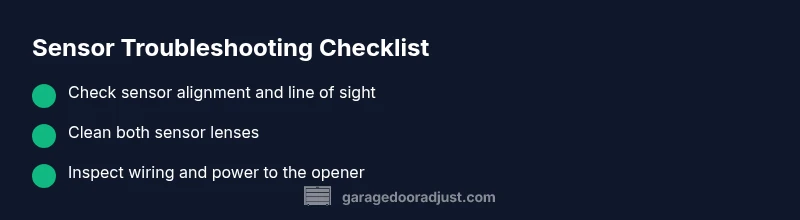
The most frequent culprits fall into three categories: misalignment, dirty lenses, and wiring/power problems. For misalignment, loosen the mounting screws slightly, re-center the sensors so their faces align and the beam-line is unobstructed, then re-tighten. For dirty lenses, wipe both sensor faces with a soft, lint-free cloth—avoid solvents that could damage plastics. For wiring issues, check that both sensor cables are firmly connected to the opener and to the sensors, looking for frayed insulation or loose terminals. After each fix, perform a quick test by closing the door from the wall control to verify the safety beam responds correctly. If the problem persists after these steps, a professional re-sync or sensor replacement may be necessary, and you should not bypass safety features. The GarageDoorAdjust Team emphasizes not bypassing safety devices under any circumstances—replacements should be handled properly to preserve door safety.
When to call a professional
If you notice persistent sensor faults after checking alignment, cleaning, and wiring, or if you encounter electrical smells, exposed wires, or blinking LEDs that don’t resolve with basic resets, contact a licensed technician. A pro can re-align the sensors with precision, test the entire safety circuit, and confirm compatibility with your opener. If your door operates erratically or suddenly reverses without a clear reason, professional evaluation is essential to prevent injury or property damage. GarageDoorAdjust recommends scheduling a diagnostic visit if you’re unsure about any step, and keeping emergency release handles accessible for safety.
Steps
Estimated time: 20-40 minutes
- 1
Power down and prepare
Unplug the garage door opener or switch off the circuit breaker to ensure you work safely. Clear the area, and unplug any accessories that may interfere with testing. This prevents accidental door movement while you’re testing the sensors.
Tip: Always use a dedicated, grounded outlet and avoid wet conditions. - 2
Check alignment
Visually inspect the sensor brackets; they should face each other directly across the doorway with a clear line of sight. If they’re skewed, loosen mounting screws slightly, adjust, and retighten. A crooked beam is a common cause of false obstructions.
Tip: Use a level to confirm the sensors are perfectly vertical. - 3
Clean the sensor lenses
Wipe both sensor faces with a soft, lint-free cloth. Remove any smudges or dust that can scatter light and trigger false readings. Do not use solvents that could degrade plastic faces.
Tip: Do not spray cleaner directly on the sensors; apply to cloth first. - 4
Test the beam with a simple obstruction
Hold a small object (like a pencil) in the beam path to simulate an obstruction and observe if the door responds as expected. If the door still won’t close or keeps reversing, the issue may be wiring or a faulty sensor.
Tip: If the beam remains unbroken with a small obstruction, the sensor may be defective. - 5
Inspect wiring and power
Check the sensor wires at both ends for loose connectors, frayed insulation, or corrosion. Make sure the terminal screws are tight and the wire routing isn’t pinched. Restore power and re-test the system.
Tip: If you see exposed conductors, pause and call a pro. - 6
Re-sync and test
Follow the manufacturer’s procedure to re-sync the sensors after any adjustment or replacement. Test multiple times from both the interior wall switch and the remote control to ensure the safety beam consistently prevents the door from closing when blocked.
Tip: Document the resync steps for future reference.
Diagnosis: Garage door safety sensors indicate obstruction or fail to detect beam.
Possible Causes
- highMisalignment of sensor brackets or mounting drift
- highDirt, dust, or smudges on sensor lenses blocking the beam
- mediumLoose or damaged wiring between sensors and opener
- lowDefective sensor units or failed LED indicators
Fixes
- easyRealign sensor brackets so the beams are parallel and the distance between sensors is consistent (usually 6 inches).
- easyClean both sensor lenses with a soft, lint-free cloth and inspect for scratches.
- mediumTighten or replace sensor wiring and connectors at both ends; ensure power to the opener is stable.
- hardReplace faulty sensors and re-sync the system with the opener’s reset procedure.
Got Questions?
Can garage door sensors go bad?
Yes. Sensors can fail due to misalignment, dirty lenses, wiring faults, or sensor wear over time. Regular checks help catch issues early.
Yes, sensors can go bad from misalignment or dirty lenses. Regular checks help catch issues early.
How do I test if my sensors are aligned properly?
Hold a straight edge between the sensors and confirm they face each other directly. If the beam isn’t continuous, adjust until a clear line is detected by both LEDs.
Check that the two sensors face each other directly and have a continuous beam.
What should I do if the sensor LED is off or blinking?
A off or blinking LED usually indicates misalignment, obstruction, or wiring problems. Recheck alignment, clean lenses, and inspect wires. If unresolved, replace or test the unit.
If the LED is off or blinking, re-check alignment and wiring or consider replacing the sensor.
Is it safe to adjust sensors myself?
Basic alignment and cleaning are safe for homeowners. Avoid aggressive wiring work or altering electrical components—call a professional if you’re unsure.
Basic checks are okay, but don’t tamper with electrical parts if you’re unsure.
When should I replace sensors rather than repair?
If replacing a sensor is more cost-effective than multiple repairs, or if the sensor remains faulty after proper re-alignment and cleaning, replacement is recommended.
If repairs don’t fix the issue, replacement is the safer option.
Watch Video
Quick Summary
- Check alignment first and re-tighten brackets.
- Clean sensor lenses to restore accurate sensing.
- Test with simple obstructions to verify proper response.
- If fixes fail, consult GarageDoorAdjust Team for professional service.