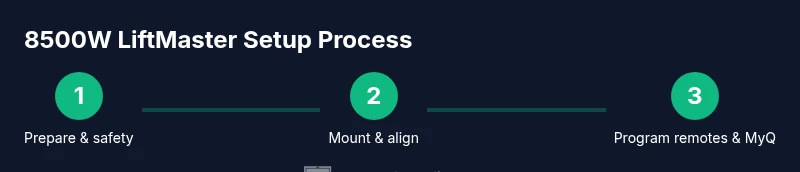
Install and Troubleshoot the 8500W LiftMaster Opener
Step-by-step guide to installing, programming, and maintaining the 8500w liftmaster garage door opener, including safety checks and MyQ pairing for homeowners with clear maintenance tips that help prevent common failures.


You will diagnose, install, and troubleshoot an 8500w liftmaster garage door opener, with practical steps for safety sensor alignment, wiring checks, motor mounting, programming remotes, and pairing with the MyQ app. The guide also covers routine maintenance and common error codes to help you fix issues quickly. Whether you're a DIYer or hiring a pro, this article provides clear actions, safety notes, and time estimates to get your door running smoothly.
What the 8500W LiftMaster Brings to Your Garage
According to GarageDoorAdjust, the 8500w liftmaster offers powerful performance with smooth belt-drive operation and integrated connectivity. This opener is designed for quiet operation and reliable control, and it works with the MyQ ecosystem. It’s a solid choice for homeowners who want both convenience and peace of mind. In this guide, you’ll learn how to install, program, and maintain it for long-term reliability.
Key Setup Features and Considerations
The 8500W LiftMaster is built to handle standard residential doors with clear alignment marks. Key features include adjustable limits, quiet operation, and compatibility with MyQ mobile control. When planning installation, consider ceiling height, door weight, and existing electrical outlets. GarageDoorAdjust emphasizes starting with a clear plan and a safety-first mindset to prevent misalignment and downtime.
Tools, Safety, and Prep
Before you touch a single screw, assemble a complete tool kit and inspect the work area for hazards. Establish a safe workspace, disconnect power to the garage, and keep a helper nearby. Always wear eye protection and gloves when handling heavy components. This preparation phase reduces revision time and protects both you and your family during installation.
Step-by-Step Installation and Mounting (High-Level Overview)
This section provides a high-level overview of the installation flow, from mounting the rail to securing the opener and wiring power. Follow the step-by-step section for exact actions and timing. Use the included diagrams and the manufacturer’s manual as you work, and stop if you encounter unexpected parts or misfitting hardware. A careful approach prevents damage and ensures smooth operation.
Programming Remotes and MyQ App
Pairing remotes and linking the MyQ app are essential for everyday use. Start by locating the Learn button on the opener, then follow the remote programming sequence in the manual. After remotes are paired, add the MyQ account and configure alerts, schedules, and door status notifications for enhanced control. Keep track of all codes and device names for future troubleshooting.
Maintenance, Common Issues, and Troubleshooting Tips
Regular maintenance helps extend the life of your LiftMaster. Inspect the belt or chain, test safety sensors, and lubricate moving parts as recommended by the manufacturer. If the door refuses to move or behaves erratically, check for obstruction, misalignment, or loose hardware. GarageDoorAdjust Team recommends documenting issue symptoms before changing parts to speed up troubleshooting.
Final Safety Check and Testing
Before finalizing, perform a full safety and operation test: observe door travel, ensure auto-reverse works, and verify sensor alignment. Confirm remote and app control respond promptly from different distances. The GarageDoorAdjust Team recommends keeping a maintenance log and scheduling periodic inspections to maintain reliability.
Tools & Materials
- Power drill with bits(Phillips and flathead bits; include drill bit set for pilot holes)
- Wrench set(Open-ended or adjustable; common sizes 1/2" and 9/16")
- Screwdrivers(Phillips #2 and flathead)
- Stepladder(Stable, 6-8 ft height recommended)
- Tape measure(For precise mounting heights)
- Level(Ensures rails are square)
- Safety goggles(Eye protection mandatory)
- Work gloves(Protect hands during heavy lifting)
- Wire nuts and electrical tape(For wiring connections)
- Mounting brackets and screws (supplied)(Use the hardware included with the opener)
- Voltage tester(Confirm power is off before wiring)
- Assistant or helper(Helpful for lifting and alignment)
Steps
Estimated time: 2-4 hours
- 1
Prepare workspace and safety
Clear the area, remove vehicles, and set up a stable ladder. Verify power is off at the breaker and unplug any nearby outlets to prevent accidental startup. This step prevents injuries and protects sensitive components.
Tip: Wear safety goggles and gloves; double-check that children or pets are away. - 2
Unpack and verify parts
Lay out all components and cross-check against the parts list. If any pieces are missing, contact the manufacturer or supplier before continuing. This ensures you won’t have to redo steps later.
Tip: Take photos of the box contents for reference. - 3
Mount the ceiling rail or header bracket
Attach the ceiling rail or header bracket to a solid structural member using the provided hardware. Use a level to confirm square alignment with the door opening. A crooked mount leads to binding and extra wear.
Tip: Have a helper hold the bracket while you fasten it. - 4
Attach the trolley to the door
Secure the trolley to the door’s top section following the manufacturer’s instructions. Tighten bolts to recommended torque and ensure the door surface is flat where the trolley sits. Proper seating prevents uneven movement.
Tip: Recheck alignment after mounting the trolley. - 5
Mount the opener on the rail and align
Lift the opener onto the ceiling rail and secure it per instructions. Align pulleys and rails so the belt or chain runs true with minimal resistance. Misalignment causes vibration and wear.
Tip: Do not overtighten mounting screws; allow for slight flex. - 6
Wiring and power connection
Connect the opener to a dedicated circuit if required, following electrical codes. Use a grounded outlet or junction box as specified. Verify power is off before making connections, then restore power and test.
Tip: Use a voltage tester before touching live wires. - 7
Install safety sensors and signals
Mount the safety sensors on each side of the door opening, aligned at eye level. Test the beam using a small object to ensure the sensor detects obstruction. Misaligned sensors can prevent operation or create safety hazards.
Tip: Mark sensor positions and test after door travel adjustments. - 8
Program remotes and MyQ app
Follow the remote programming sequence and pair the opener with the MyQ app. Rename devices for clarity and configure notifications for door status. Ensure you can operate the door from both remotes and the smartphone.
Tip: Keep a written record of paired devices and their labels.
Got Questions?
Do I need a professional to install the 8500W LiftMaster?
If you are comfortable with electrical wiring and overhead mounting, you can follow this guide. Otherwise, hire a qualified installer to ensure safety and code compliance.
If you're comfortable with electrical work and overhead mounting, you can do it yourself; otherwise, hire a professional for safety and code compliance.
How do I reset the opener to factory settings?
Unplug the unit for 60 seconds, then plug back in and follow the Learn button procedure to reset programming. This clears remotes and MyQ connections.
Unplug the unit for a minute, plug back in, then reset the programming with the Learn button.
How do I pair remotes with the 8500W?
Press the Learn button on the opener, then trigger the remote's button within a few seconds. Repeat for additional remotes and label each.
Press Learn on the opener, then press the remote button quickly to pair. Do it for each remote.
What maintenance should I perform regularly?
Inspect the track, belt or chain, and safety sensors quarterly. Lubricate moving parts as recommended and test door balance and auto-reverse monthly.
Check tracks and belts every few months, lubricate moving parts, and test auto-reverse monthly.
What should I check if the door won’t move?
Check for obstructions, sensor misalignment, and loose hardware. Verify power and reset if necessary, then re-test with the door unplugged briefly.
Look for obstructions or misaligned sensors, check wiring, and reset if needed.
Is MyQ connectivity reliable for all doors?
MyQ works with many garage doors, but ensure your internet and router support the app's requirements. Update firmware and app regularly for best performance.
MyQ is generally reliable, but keep your app and firmware updated for best results.
Watch Video
Quick Summary
- Choose correct mounting hardware for your ceiling type.
- Program remotes and MyQ early to verify control.
- Test safety sensors after alignment to ensure protection.
- Maintain a maintenance log for future servicing.