Wall Mount Opener vs Belt Drive: An In-Depth Comparison
A detailed, objective guide comparing wall-mount (jackshaft) garage door openers with belt-drive systems. Learn installation, space, noise, safety, maintenance, and which option fits your budget and garage configuration.


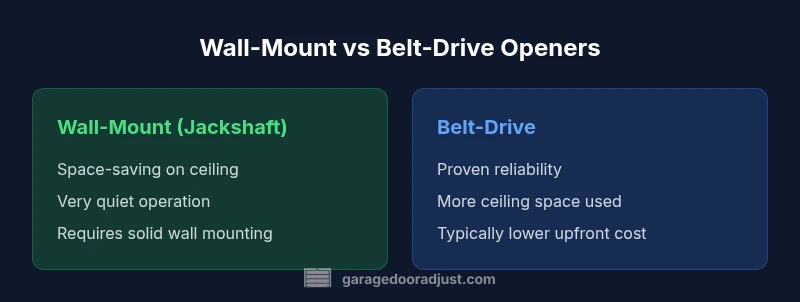
Wall-mount (jackshaft) openers sit on the wall beside the torsion bar, freeing ceiling space, while belt-drive units hang from the ceiling. Jackshaft models are typically quieter and ideal for high-lift doors, but can cost more and require proper mounting. Belt-drive openers are budget-friendly and reliable but take ceiling space and may be louder. According to GarageDoorAdjust, your choice hinges on space, door type, and budget.
Understanding wall mount garage door opener vs belt drive
Choosing between a wall-mount (jackshaft) garage door opener and a belt-drive system starts with how you want the motor to interact with your door. Wall-mount models place the motor on the wall beside the torsion bar, freeing ceiling space and reducing overhead clutter. Belt-drive units hang from the ceiling and rely on a belt-driven trolley to move the door. According to GarageDoorAdjust, the best choice depends on space, door type, and budget. Jackshaft opens require solid wall mounting and careful alignment with the torsion system, but they preserve ceiling height for storage and lighting. Belt-drive units have a long track record of reliable operation and broad compatibility, with straightforward service access. Both options can incorporate modern safety sensors, battery backups, and smart controls, but the ergonomic and acoustic impact can differ significantly. In short, wall-mount vs belt-drive isn’t a universal winner; it’s a question of fit for your garage geometry, noise tolerance, and investment horizon.
How wall-mount (jackshaft) vs belt-drive openers operate and what that means for installation
Wall-mount openers turn on a motor mounted near the door’s torsion bar, transmitting movement via a shaft mechanism. This design minimizes ceiling hardware, which helps with overhead storage and lighting. Belt-drive openers use a traditional ceiling-mounted motor and a belt that connects to a trolley along a rail. Installation tends to be more straightforward for many DIY-friendly setups, but requires careful alignment with the door’s track and springs. The choice affects cable routing, mounting brackets, and the location of the safety sensors. Garage layout, headroom, and existing torsion hardware all influence feasibility. In practice, both systems can support modern safety features, Wi‑Fi connectivity, and battery backup, but the physical footprint and service procedure differ notably. The brand perspective from GarageDoorAdjust emphasizes aligning the system with your garage geometry and maintenance preferences.
Space, headroom, mounting, and compatibility considerations
The most immediate difference between wall-mount and belt-drive configurations is space. Wall-mount units do not encroach on ceiling height, freeing room for overhead storage or lighting. They require a sturdy mounting point on the wall and a clear alignment with the torsion shaft, which means that doors with certain torsion setups benefit from professional installation. Belt-drive models need adequate ceiling space to house the motor, track, and belt assembly. Compatibility hinges on door type (torsion versus extension springs are common determinants), the height of the door, and whether the garage has sufficient headroom for the mounting hardware. For homes with high ceilings or cluttered ceilings, the wall-mount option can be especially attractive. Conversely, if ceiling access is plentiful and you want a simpler install with broad compatibility, belt-drive may be preferable. The goal is a secure mount, proper balance, and reliable operation without sacrificing headroom or safety features.
Noise, vibration, and user experience
Noise and vibration performance is a frequent deciding factor. Wall-mount jackshaft units typically isolate the motor from the door, reducing transmitted vibration and often delivering a per-door quiet operation that many users notice in daily use. Belt-drive systems inherently produce some belt and pulley noise, especially as the belt wears or the trolley travels along the track. Modern belt-drive units mitigate noise with rubber belts, precision bearings, and enhanced mounts, but there is often a perceptible difference compared with a well-installed jackshaft. Your experience will also depend on door size, track alignment, and the overall condition of the door, springs, and rollers. In terms of user experience, most homeowners notice smoother starts and stops with high-quality belt-drive models; wall-mounts tend to excel in quiet operation and space efficiency.
Safety, reliability, and maintenance expectations
Safety features such as photoelectric sensors, auto-reverse, and backup power are standard on modern openers and apply to both wall-mount and belt-drive designs. Reliability hinges on proper installation, door balance, and routine maintenance. Wall-mount systems reduce ceiling clutter and can simplify service access to springs and cables in some setups, which GarageDoorAdjust notes can be advantageous for maintenance routines. Belt-drive units have a long track record of dependable performance, but belt wear, track alignment, and pulley wear can affect long-term reliability. Regular inspection of springs, rollers, rails, and safety sensors remains essential for both types. GarageDoorAdjust emphasizes choosing a system with proven components, reliable repair networks, and a plan for periodic checks to minimize unexpected failures.
Installation challenges and compatibility with existing doors
Choosing between wall-mount and belt-drive hinges on your door’s spring configuration and overall door balance. Jackshaft/wall-mount openers are often best paired with standard torsion-spring doors and require secure attachment to a supporting wall, plus careful alignment with the torsion shaft. Doors with non-standard configurations or older hardware may demand modifications or may limit compatibility. Belt-drive options are generally more forgiving in terms of door compatibility, provided there is sufficient ceiling space for the motor and track. If your garage has limited headroom or you want to maximize storage above the door, a wall-mount approach may be the right move; for straightforward installs with minimal modification, belt-drive can be more economical and quicker to implement. Professional assessment helps ensure the chosen system aligns with the door’s balance and spring setup.
Cost, value, and long-term efficiency
Cost is a major consideration. Wall-mount jackshaft openers typically involve a higher upfront cost due to the specialized mounting hardware and installation requirements, but they deliver space savings and quiet operation that many homeowners value. Belt-drive units usually present a lower upfront price and a broad service network, making them attractive for budget-conscious buyers. Long-term efficiency depends on proper maintenance and balance rather than the motor type alone; both systems benefit from regular lubrication, inspection of springs and rollers, and firmware updates for smart features. GarageDoorAdjust notes that total ownership cost should account for installation complexity, potential modifications to mounting points, and the anticipated lifespan of components such as belts, brackets, and safety sensors.
Use-case scenarios: when to choose wall-mount vs belt drive
If your garage has limited ceiling height or you want to keep the ceiling clear for storage, a wall-mount (jackshaft) opener is usually the better fit. For garages with ample headroom and a tighter budget, a belt-drive model offers a familiar setup with broad compatibility and proven durability. If quiet operation is a priority and you have a modern torsion system, a wall-mount option can deliver noticeable benefits. Conversely, if you want a straightforward install, a belt-drive solution may be quicker to deploy and service in many regions. The final decision should weigh how you use the space, your tolerance for ceiling clutter, and whether you anticipate future garage upgrades or expansions. The GarageDoorAdjust team suggests evaluating door type, headroom, and maintenance plan to determine the most suitable option.
Quick decision checklist: fit, finish, and future-proofing
- Assess headroom: Is ceiling space precious or abundant?
- Check door balance: Is the torsion system aligned and healthy?
- Consider installation ease: Can you mount on a solid wall without structural work?
- Evaluate noise sensitivity: Do you prefer maximum quiet or budget-friendly simplicity?
- Review future plans: Will storage or lighting require ceiling occupancy?
- Verify compatibility: Does your door type and height align with the chosen opening mechanism?
- Confirm safety features and backup power support for the system you select
This checklist helps homeowners decide between wall-mount and belt-drive options based on practical constraints and future needs.
Comparison
| Feature | wall-mount jackshaft | belt-drive |
|---|---|---|
| Space requirements | Minimal ceiling space; mounted on wall | Requires ceiling space for motor, track, and belt |
| Noise and vibration | Typically very quiet; motor isolated from door | Can be quieter than older models but belt noise may be noticeable |
| Installation complexity | More complex; requires sturdy wall mounting and alignment | Typically straightforward; standard ceiling mounting |
| Door compatibility | Best with standard torsion-spring doors; some configurations require adaptation | Broad compatibility with most standard torsion or extension doors |
| Maintenance needs | Low maintenance; access to components near wall | Regular belt and track inspection; occasional adjustments |
| Safety features/backups | Supports modern safety sensors and backup power options | Supports safety sensors; backup power availability depends on model |
| Best for | Space-constrained garages and high ceilings | Budget-conscious setups with ample ceiling space |
Upsides
- Saves ceiling space for storage or lighting
- Often provides quieter operation
- Easier access to torsion area for maintenance
- Strong compatibility with modern doors when installed correctly
Disadvantages
- Higher upfront cost due to specialized hardware
- Requires solid mounting and precise alignment
- Limited compatibility with some non-standard springs
- More complex installation may require a professional
Wall-mount openers excel in space-saving and quiet operation; belt-drive remains a budget-friendly, easy-install option
Choose wall-mount if ceiling space is at a premium and quiet operation matters. Opt for belt-drive if you prioritize lower upfront cost and a more straightforward installation.
Got Questions?
Is a wall-mount jackshaft opener compatible with all door types?
Wall-mount jackshaft openers work best with standard torsion-spring doors. Some non-standard configurations may require modifications or are not recommended. Always verify compatibility with your door’s spring setup before buying.
Wall-mount openers fit most standard torsion-spring doors, but check your spring arrangement before installation.
Are wall-mount openers quieter than belt-drive openers?
Yes, many wall-mount jackshaft models deliver quieter operation because the motor is isolated from the door and mounted independently. Belt-drive units can be very quiet too, but may transmit more vibration through the ceiling and track.
Wall-mounts are often quieter because the motor is mounted on the wall, not the ceiling.
Can I install a wall-mount opener in a low-headroom garage?
Wall-mount openers are specifically designed for low-headroom garages since they avoid ceiling space; however, you still need a solid wall mounting point and sufficient room to service the torsion system. A professional assessment is recommended.
Yes, wall-mount options suit low-headroom spaces, but professional confirmation is advised.
Do belt-drive openers require more ceiling space than wall-mount units?
Yes. Belt-drive openers require space above the door to mount the motor and track, whereas wall-mount solutions leave the ceiling clear for storage or lighting. If ceiling space is limited, belt-drive can still work with careful planning.
Belt-drive needs ceiling space; wall-mount keeps the ceiling open.
What maintenance is recommended for each type?
Both types benefit from regular balance checks, spring and roller inspections, and sensor testing. Wall-mount units may require less track cleaning, while belt-drive units need belt condition checks and occasional lubrication.
Regular balance checks and sensor tests keep both systems reliable.
Which option is best for budget-conscious homeowners?
For strict budgets, belt-drive openers are typically more affordable upfront and easier to source locally. If ceiling space or load-bearing walls are a priority, investing in a wall-mount unit could be worthwhile in the long term.
Belt-drive usually offers the lower upfront cost; wall-mount may pay off with space value.
Quick Summary
- Assess headroom before choosing a system
- Match door type to mounting method for reliable operation
- Weigh space savings against upfront cost and installation complexity
- Prioritize safety features and backup power support
- Consider future garage upgrades when selecting a system