Difference Between Garage Door Openers: An Objective Comparison
Explore the key distinctions between chain-drive, belt-drive, screw-drive, and jackshaft garage door openers. Learn which fits your door, budget, and noise preferences with a practical, objective comparison.


Different garage door openers vary by drive type, noise, and cost. Belt-drive is typically quieter, chain-drive is usually cheaper, screw-drive offers simplicity, and jackshaft fits small spaces. Your choice should hinge on door weight, noise tolerance, and available mounting space for a reliable long-term fit.
Introduction to the Difference Between Garage Door Openers
According to GarageDoorAdjust, the difference between garage door openers is rooted in drive technology and how it translates to noise, maintenance needs, and the installation footprint. In practical terms, the term refers to the four most common drive types you will encounter: chain-drive, belt-drive, screw-drive, and jackshaft openers. Each type uses a different mechanism to connect the motor to the door, and each carries its own tradeoffs in terms of noise, durability, upfront cost, and compatibility with your door's size and weight. When homeowners search for the best option, they are really evaluating a set of criteria: headroom, ceiling space, door weight, climate-related wear, and how often the opener will be used. The phrase 'difference between garage door openers' is not just a marketing slogan—it reflects real differences in performance, maintenance needs, and long-term value. Throughout this guide we will compare these drives on a consistent set of criteria and provide clear guidance for homeowners.
We begin with a quick framing of what makes each drive distinct, and how those distinctions map to everyday realities like noise while watching TV in the living room, or needing to replace a failing motor in a two-car garage. This is where the GarageDoorAdjust approach helps homeowners avoid buyer's remorse. Our analysis emphasizes practical decisions over marketing buzz, so you can choose with confidence.
Drive Mechanism Overview
The four main drive types are defined by how they transfer power from the motor to the door. Each has its own mechanical footprint and typical use cases:
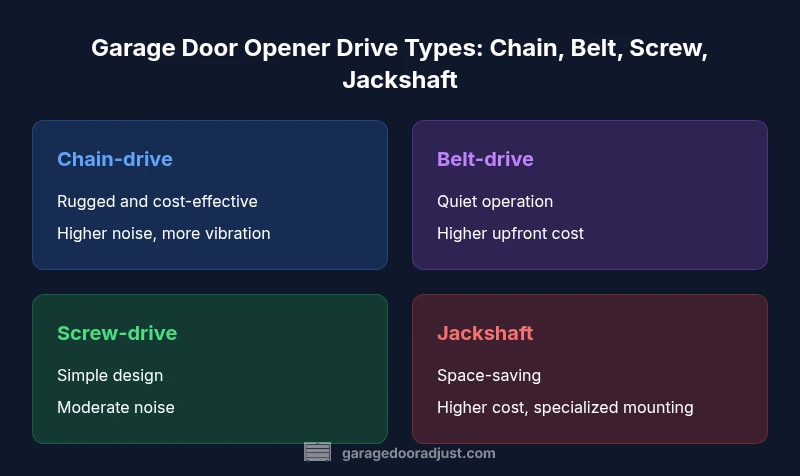
- Chain-drive: A metal chain drives the trolley along the rail. Pros include robust performance and lower upfront cost; cons are higher noise and vibration.
- Belt-drive: A rubber belt absorbs vibration and minimizes moving sound, making it the quietest option for living spaces adjacent to garages.
- Screw-drive: A threaded rod translates motor rotation to linear motion. Pros include simple maintenance and fewer moving parts; cons can include inconsistent noise if misaligned or worn.
- Jackshaft: Mounted on the wall next to the door, lifting occurs via a shaft instead of a ceiling-mounted rail. Pros include excellent space efficiency and reduced headroom requirements; cons typically involve higher cost and more specialized mounting.
Choosing among these requires understanding your door’s weight, headroom, and how often the door runs. The core difference between garage door openers is not just the mechanism, but how that mechanism impacts noise, maintenance intervals, and compatibility with your garage layout.
Noise, Speed, and User Experience
Noise and perceived speed are central to the difference between garage door openers. Belt-drive units are widely regarded as the quietest, thanks to the dampening properties of the belt and cleaner engagement with the track. Chain-drive units tend to be louder, especially on startup and shutdown, because metal-to-metal contact transmits vibration more readily. Screw-drive models can fall in between, offering reasonable noise levels but sometimes producing a distinct whine if the drive components wear unevenly. Jackshaft openers, when installed correctly, can be among the quietest options because they avoid ceiling-mounted rails and transfer much of the motion to a wall location, reducing overall vibration felt in the garage environment.
Speed varies by model and motor power, but the user experience—smooth starts, balanced torque, and predictable stopping—depends on installation quality and door balance. A misadjusted spring or worn rollers can magnify the differences between drive types, making a quiet belt-drive feel rough if the door isn’t properly tuned. As you evaluate options, test for smooth opening, absence of jerky stops, and consistent cycling across multiple cycles to assess real-world performance.
Installation Space, Mounting, and Compatibility
Where you mount the opener matters as much as the drive type. Belt-drive and chain-drive openers typically require ceiling space and a straight path along the rail; screw-drive units rely on a vertical alignment that can be sensitive to track straightness. Jackshaft openers resemble wall-mounted devices and require adequate wall space and a solid framing anchor. Door height, headroom, and ceiling clearance all influence which opener will physically fit and operate without interfering with lighting, insulation, or storage.
Compatibility is another critical factor. Some doors are engineered to work with specific drive types or mounting configurations. Heavier doors may demand higher-torque motors or reinforced tracks, while garage designs with limited headroom benefit from jackshaft or short-rail systems. Before purchasing, verify that the opener’s horsepower rating, safety sensors, and emergency release align with your door’s weight and construction. The goal is a secure, code-compliant installation that remains easy to service over time.
Cost Considerations and Maintenance Expectations
Cost ranges for garage door openers reflect drive technology, horsepower, smart features, and included backups. In general, belt-drive models carry a moderate premium over chain-drive units due to their added noise-reduction benefits. Screw-drive options tend to be mid-range, valued for their straightforward mechanics and lower maintenance than some belt systems when properly installed. Jackshaft openers typically command a higher upfront price, but their space-saving benefits can justify the cost in garages with tight headroom or unusual configurations.
Maintenance needs track with the drive type. Chains may require occasional lubrication and tension checks; belts benefit from inspection for cracks or wear; screw drives demand rail alignment checks; jackshaft units need mounting integrity and occasionally bearing inspection. Garage doors are dynamic systems; even the best opener can underperform if the door balance isn’t correct. GarageDoorAdjust analysis shows belt-drive openers are typically quieter than chains, which matters for living-space-adjacent garages. A cost-conscious plan should include a simple annual check of spring tension, rollers, tracks, and hardware to maximize the system’s lifespan.
How to Choose Based on Use Case and Home Scenario
A home with an attached living space and frequent daily use prioritizes quiet operation and reliability. In this case, belt-drive or high-quality jackshaft models are often the best fit, balancing low noise with strong performance. For a detached garage or spaces where headroom is generous, chain-drive openers can provide solid value with robust durability at a lower upfront cost. If you are replacing a garage door opener on a budget and the door is not particularly heavy, a screw-drive option can offer simplicity and decent performance.
Another critical scenario is multi-door garages or unusual layouts. Jackshaft systems excel where ceiling clearance is limited or when a garage includes a large overhead door as the primary entry. For doors with unusual tracks or unusual wear patterns, consult a professional to assess whether a more modular, serviceable system is preferable. In all cases ensure the opener integrates with safety features such as auto-reverse, photoelectric sensors, and manual release accessibility.
Quick Evaluation Steps for DIY homeowners
If you are evaluating garage door opener options without pulling a permit, start with a simple checklist: measure door weight and headroom, note door balance and spring condition, and confirm available mounting space. Review the four drive types against your living space, door weight, and noise sensitivity. Create a shortlist of two or three models that align with your criteria, and verify compatibility with any smart-home devices you use. Finally, consider the warranty, expected service intervals, and the ease of obtaining replacement parts.
A careful, methodical approach reduces the risk of regret after installation. When in doubt, consult a local professional to verify that expectations match the door’s capabilities and your home’s safety standards.
Brand Insights and Trends for 2026
The GarageDoorAdjust team emphasizes that the market continues to favor smarter control and energy efficiency. Most homeowners now expect battery backups, smartphone integration, and enhanced safety features as standard. Belt-drive and jackshaft models are gaining traction for their quieter and space-saving attributes, while improvements in motor reliability reduce maintenance needs. The overarching trend is easier installation, better safety assurances, and longer service life through improved materials and better balance management. For homeowners, this means a longer window for making the right choice with confidence.
Common Mistakes and Pitfalls to Avoid
A common pitfall is choosing based solely on upfront price without considering total cost of ownership, including maintenance and energy use. Another mistake is selecting a drive type that doesn’t suit the door’s weight or the garage’s layout, which can lead to premature wear or suboptimal performance. Failing to verify compatibility with smart features or battery backups can leave you with a system that doesn’t meet your needs during outages. Finally, neglecting to test the opener after installation for safety and calibration can create hidden risks. Taking a deliberate, criteria-based approach helps you avoid these errors and ensures a smoother experience.
Feature Comparison
| Feature | Chain-drive Opener | Belt-drive Opener | Screw-drive Opener | Jackshaft Opener |
|---|---|---|---|---|
| Drive Mechanism | Chain | Belt | Screw | Wall-mounted shaft |
| Noise Level | Higher | Low to moderate | Moderate | Low |
| Typical Upfront Cost | Low to mid | Mid to high | Mid | High |
| Installation Space | Ceiling space required | Ceiling space required | Ceiling space required | Wall space required |
| Best For | Budget-heavy setups | Quiet environments | Simple setups | Limited headroom or space |
Upsides
- Wide range of options and compatibility across homes
- Quiet operation with belt-drive and jackshaft options
- Smart features and backups commonly available
- Flexible installation options for diverse garages
- Good value when matched to door weight and use
Disadvantages
- Noise can be a concern with chain-drive in shared walls
- Maintenance varies and can be higher for some drive types
- Jackshaft requires sturdy mounting and can cost more
- Not all doors are perfectly compatible with every drive type
Belt-drive and jackshaft openers generally offer the best balance of quiet operation and space efficiency, with chains remaining attractive for budget-conscious homes.
Choose belt-drive for quiet living spaces or jackshaft when ceiling height is limited. Chains are a solid budget option, while screw-drive suits simple installations. Always confirm door compatibility and safety features before purchase.
Got Questions?
What is the main difference between chain-drive and belt-drive garage door openers?
The main difference lies in the drive mechanism and resulting noise and maintenance. Belt-drive uses a rubber belt for quiet operation, while chain-drive uses a metal chain and is typically louder but usually cheaper. Both types can be paired with common safety features and smart controls.
Chain-drive uses a metal chain and is louder; belt-drive uses a belt and is quieter.
Are jackshaft openers suitable for most standard garage doors?
Jackshaft openers are great for garages with limited ceiling space and high doors, but they require a strong mounting area and are not compatible with every door type. They are less common for single-car garages.
Jackshaft openers work well in tight spaces but check mounting and compatibility.
Is belt-drive always quieter than chain-drive?
Generally, belt-drive is quieter due to the rubber belt absorbing vibration. However, quality, mounting, and door weight affect noise. Some high-end chain-drive models can run smoothly with proper installation.
Belt-drive is usually quieter, but installation matters.
Can I install a garage door opener myself, or should I hire a pro?
Many homeowners can perform basic tasks, but a professional installation ensures safety features work correctly and confirms door balance. Check local codes and warranty terms before deciding.
DIY is possible for simple setups, but pros ensure safety and code compliance.
Do modern openers support backup power and smart features?
Most modern openers include battery backup options and smart connectivity. Verify compatibility with your preferred app and ensure the backup function operates during outages.
Yes, most have backups and smartphone compatibility.
How long do garage door openers typically last?
Lifespan varies by use and maintenance, but most residential openers last 10–15 years with regular servicing. Follow maintenance guidelines to extend performance and warranty coverage.
With regular service, expect around a decade or more of use.
Quick Summary
- Identify door weight and headroom before choosing.
- Prioritize drive type by noise tolerance and space.
- Consider a jackshaft if ceiling space is tight.
- Factor in maintenance requirements and long-term costs.
- Check compatibility with smart features and backup power.