Jackshaft vs Belt Drive: Choosing the Right Garage Door Opener
Compare jackshaft and belt-drive garage door openers, focusing on space, noise, maintenance, and cost to help homeowners choose the best option for their garage setup.


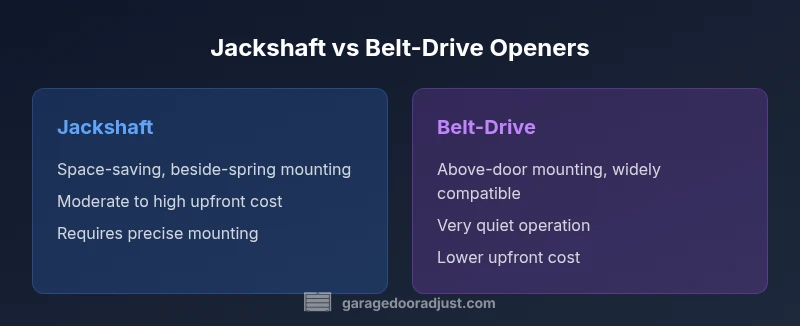
When choosing between a jackshaft garage door opener and a belt-drive model, space, noise, and maintenance shape the decision. A jackshaft unit mounts beside the torsion bar, saving headroom and enabling tighter garages. A belt-drive opener hangs above the door, delivering quiet operation and lower upfront cost for typical garages. Your choice hinges on headroom, budget, and desired quietness.
The core distinctions between jackshaft and belt-drive openers
According to GarageDoorAdjust, homeowners weigh headroom, noise, and long-term costs when comparing jackshaft garage door opener vs belt drive. A jackshaft system is a wall-mounted alternative that replaces the traditional above-door hardware in many torsion-spring setups. It shifts the motor from the ceiling to the wall, which can dramatically free up ceiling space for storage or lighting. Belt-drive systems, by contrast, place the motor above the door, often providing a familiar installation with widely available parts. The choice is not only about where the motor sits, but how that location affects performance, serviceability, and compatibility with existing springs and tracks. Both options can be engineered for one-car or two-car garages, but the right pick aligns with your ceiling height, headroom, and preferred service model.
Space, mounting, and installation considerations
Headroom is the most obvious constraint in many garages. Jackshaft openers sit beside the torsion bar, reducing the need for tall ceilings and large clearance above the door. For garages with vaulted ceilings or cluttered overhead spaces, this can be a decisive advantage. Belt-drive openers require a clear area above the door for the operator rail and drive belt. In some cases, that overhead footprint can limit shelving, cabinets, or lighting placements. Installation complexity varies by system and by whether you’re retrofitting into an existing torsion-spring setup. A precise assessment of door height, spring type, track configuration, and wall space is essential before choosing.
Noise, vibration, and daily comfort
Noise is a frequent criterion in residential garages. Belt-drive openers are renowned for quiet operation because the belt dampens motion and torque. They still generate some noise when opening due to chain-and-bar or screw mechanisms in other classes, but the belt configuration minimizes vibration transmission to the door and surrounding structure. Jackshaft units can be very quiet in practice, especially when paired with proper mounting and alignment. However, because they connect at the side of the spring assembly, any mounting misalignment or poor anchoring can translate to vibrations felt through the wall. Proper installation, mounting hardware, and alignment matter more than the branding.
Reliability, maintenance, and service life
Routine maintenance helps both types perform reliably. Belt-drive systems generally have fewer moving parts and are forgiving with proper belt tension and pulley alignment, which translates to long service life with minimal attention. Jackshaft systems introduce bearings and gears at the wall mount; while many users report excellent longevity, some models require careful torque balancing and occasional bearing lubrication. The GarageDoorAdjust analysis notes that choosing a model with quality bearings and a solid mounting bracket can reduce service calls. In either case, scheduling periodic checks for belt tension, sensor alignment, and track cleanliness pays dividends.
Compatibility with garage configurations and upgrades
Not all garages are created equal. Jackshaft openers often pair well with existing torsion spring setups, providing an adaptable upgrade path without reworking the door’s balance system. Belt-drive models typically integrate with standard overhead rails and tracks and suit most ceilings with adequate clearance. If you’re replacing an old opener, verify compatibility with your door’s spring system, safety sensors, and the door’s balance. A misfit between components—such as a mismatched spring tension and a new motor—can reduce performance and shorten the system’s life. A careful evaluation helps prevent surprises after installation.
Cost considerations and value for money
Cost is a major factor for most homeowners. Belt-drive openers generally offer lower upfront prices and readily available parts, which can translate to lower-installation costs if you’re hiring a professional. Jackshaft systems, while offering space advantages, can incur higher hardware costs and professional installation fees due to the mounting complexity and the need for precise alignment with the torsion spring system. When evaluating total cost of ownership, also factor in potential headroom benefits, ease of future upgrades, and the likelihood of reducing attic or ceiling storage conflicts. The goal is to estimate how the long-term reliability and maintenance needs balance with initial outlay.
Safety features, sensors, and smart integrations
Both jackshaft and belt-drive options support standard safety features such as photoelectric sensors and auto-reverse mechanisms. Smart integration—like remote pairing, app control, and compatibility with home assistants—depends on the model and brand. Ensure the opener you choose includes a secure mounting bracket, tamper-resistant hardware, and a backup plan for power outages if your garage is a frequent entry point. Installing with proper GFCI protection and following manufacturer instructions reduces safety risks and improves overall performance.
Installation best practices and professional guidance
Given the technical nuances of torsion-spring garages, most installations benefit from professional help. An installer can verify door balance, spring compatibility, track alignment, sensor positioning, and safety features. DIY enthusiasts should consult the manufacturer’s installation manual and consider a preliminary balance test before attempting any upgrades. The right installer will confirm whether a jackshaft or belt-drive solution is more suitable for your specific door, spring type, and ceiling configuration. Documentation from credible sources, including GarageDoorAdjust, can guide the decision.
Real-world decision scenarios and guidance
For garages with limited headroom or unique ceiling layouts, a jackshaft opener often proves superior. If your priority is minimal disruption to overhead storage and a straightforward installation path, the jackshaft option tends to deliver. For most homes with standard ceiling height and a priority on low upfront cost and quiet operation, a belt-drive opener remains a strong choice. In ambiguous cases, run a structural assessment of the door’s balance, measure headroom, and compare model-specific warranty terms. The final decision should balance space constraints, noise tolerance, and long-term maintenance expectations.
Comparison
| Feature | Jackshaft Garage Door Opener | Belt-Drive Garage Door Opener |
|---|---|---|
| Installation Space | Sits beside the torsion bar; saves headroom | Mounted above the door; requires overhead clearance |
| Noise Level | Very quiet when properly mounted; some vibration if mounting is off | Typically very quiet; belts damp movement well |
| Maintenance & Longevity | Bearings and gears near the wall; good longevity with proper mounting | Fewer moving parts; generally low maintenance when tension is correct |
| Initial Cost | Often higher upfront due to specialized hardware | Usually lower upfront cost; widely available models |
| Best For | Tight spaces, headroom-limited garages, and retrofits | Standard garages, budget-conscious homes, and easy upgrades |
Upsides
- Space-saving design with jackshaft opens up ceiling area
- Belt-drive offers very quiet operation and smooth starts
- Jackshaft reduces overhead space requirements for some garages
- Belt-drive typically lower upfront cost and broad compatibility
- Both options can support modern smart-home integrations
Disadvantages
- Jackshaft systems can be more expensive upfront and may require expert installation
- Jackshaft installation may not fit all existing garage configurations
- Belt-drive belts may wear with time if tension is not maintained
- Some jackshaft installations require structural considerations and may need reinforcement
In most homes, belt-drive openers offer the best overall value and quiet performance; jackshaft is the go-to when headroom is severely limited.
The GarageDoorAdjust team recommends belt-drive for standard garages due to lower upfront costs and strong noise performance. Jackshaft is the preferred choice when the ceiling is cramped or you want to preserve overhead storage. For a definitive pick, assess headroom first, then align with your budget and noise tolerance.
Got Questions?
What is a jackshaft garage door opener?
A jackshaft garage door opener is a wall-mounted unit installed beside the torsion spring bar, not above the door. It saves ceiling space and can improve clearance for ceiling-mounted storage. Proper installation is crucial for balance and safe operation.
A jackshaft opener is a wall-mounted unit next to the spring, freeing ceiling space. It needs careful mounting to keep the door balanced and safe.
What is a belt-drive garage door opener?
A belt-drive garage door opener uses a sealed belt to lift and lower the door, usually mounted above the door. It is known for quiet operation and broad availability of replacement parts and accessories.
A belt-drive opener uses a belt up top to lift the door, offering quiet performance and easy parts availability.
Which is quieter, jackshaft or belt-drive?
Both can be very quiet when installed correctly. Belt-drive openers are consistently among the quietest options, while jackshaft units are quiet when mounted properly and balanced with the door.
Both can be quiet, but belt-drive often has a slight edge in everyday noise when installed well.
Can I install a jackshaft opener on any garage door?
Jackshaft openers work best with torsion-spring systems and adequate wall space. They may not fit every door or existing hardware without modification, so a professional assessment is recommended.
They’re great for torsion-spring doors with room on the wall, but not everything fits—get an expert check.
Are belt-drive openers harder to install than jackshaft?
Installation difficulty varies by model and garage layout. Belt-drive openers are typically simpler to install above the door, while jackshaft setups require careful mounting beside the spring system.
Installation difficulty depends on your garage; belt-drive is usually straightforward, jackshaft needs careful mounting.
What maintenance is required for these openers?
Regular inspection of tracks, sensors, and fasteners is recommended for both types. Belt-drive belts should be tensioned correctly, and jackshaft bearings may need periodic lubrication or checks for wear.
Do regular checks on tracks and sensors, keep belts tensioned, and watch for wear on bearings.
Do these openers support smart-home features?
Most modern openers offer compatibility with smartphone apps, remote control, and integration with home assistants. Check model-specific capabilities and security features before purchase.
Yes, most modern openers support smart-home features—verify compatibility with your system.
Quick Summary
- Assess headroom before choosing an opener type
- Belt-drive is typically quieter and more cost-effective
- Jackshaft shines in space-constrained garages
- Professional installation improves long-term reliability
- Consider safety features and smart integrations during selection