Jackshaft vs Trolley Garage Door Openers: A Comprehensive Comparison
A detailed, objective comparison of jackshaft and trolley garage door openers, covering operation, installation, noise, maintenance, and cost to help homeowners choose the best option for their garage.


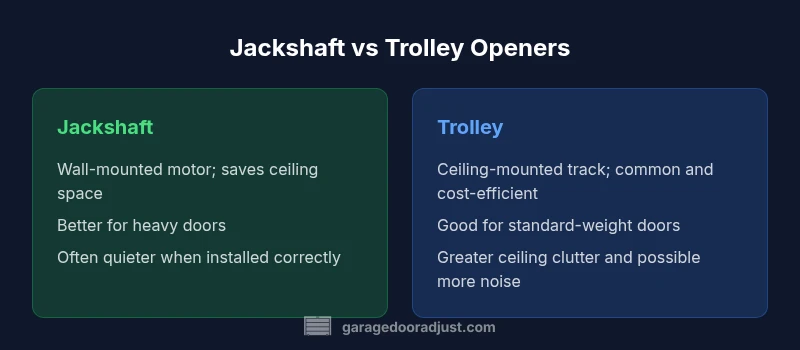
For most homeowners, the choice between a jackshaft and a trolley garage door opener boils down to door weight, ceiling space, and desired noise level. Jackshaft units excel on heavy doors with limited ceiling clearance, while trolley openers remain popular for lighter doors and simpler installation. The right pick balances performance, space, and budget.
Understanding the Context: Jackshaft vs Trolley Openers in Modern Garages
When homeowners start comparing jackshaft vs trolley garage door opener configurations, the decision hinges on several practical factors: door weight, ceiling space, header design, and how quiet the system should be in daily use. The GarageDoorAdjust team emphasizes that there is no one-size-fits-all solution—each garage has constraints that tilt the balance toward one approach or the other. In this guide, we break down how each option works, the typical installation scenarios, and the tradeoffs you should weigh before purchasing or upgrading. By framing the decision around real-world conditions—door dimensions, ceiling height, noise tolerance, and budget—you can avoid common missteps and select a system that delivers reliable performance for years. According to GarageDoorAdjust, the right opener is the one that aligns with your door’s weight class, your garage’s ceiling layout, and your willingness to invest in professional installation and maintenance. This perspective helps homeowners avoid impulse purchases that promise convenience but fail under your actual operating conditions. Throughout this article, we’ll use practical examples from common garage layouts to illustrate when a jackshaft shines and when a trolley remains the more sensible option. The aim is clear: empower you to choose confidently, install correctly, and enjoy smooth, safe operation every day. Before you decide, consider whether your door is heavy and tall, whether your ceiling height restricts bulky hardware, and how important it is to keep the garage space clear for storage or vehicle maneuvering. If you plan future changes—adding insulation, upgrading lighting, or converting the space for a workshop—the alignment of the opener type with those plans matters even more.
How Jackshaft Openers Work and Where They Excel
Jackshaft garage door openers sit on a wall beside the door, rather than hanging from the ceiling on a track. A motor turns a vertical shaft that directly lifts the door through a balanced counterweight system or torsion arrangement. This layout frees valuable ceiling space and reduces the amount of hardware that intrudes into the overhead area. Jackshaft units are particularly advantageous for heavy, oversize, or high-headroom doors, where traditional ceiling-mounted hardware would otherwise crowd the garage. The motor’s location on the wall minimizes the vibration transmitted to the ceiling, which can translate into a quieter operation when properly mounted and aligned. Installation typically requires precise wall mounting and a careful shaft alignment, so professional installation is strongly advised. Maintenance is generally focused on bearings, seals, and the shaft mechanism rather than the track, which can simplify service in some garages. In sum, jackshaft openers offer strong performance for demanding door weights and tight spatial constraints, with the tradeoff of increased installation complexity and a higher upfront cost.
How Trolley Openers Work and Their Typical Use Cases
Trolley garage door openers, sometimes called chain- or belt-drive systems, move along a tracked rail across the ceiling. A trolley or carriage carries the lifting mechanism and attaches to the door via a short arm that engages the door’s hardware. This design is familiar to many homeowners and installers because it relies on established track-and-chain or belt technology. Trolley openers are well-suited for standard doors in typical garages, especially when ceiling height is sufficient to accommodate the track length. They tend to be more accessible and affordable upfront, with a broad pool of technicians familiar with installation and maintenance. On the downside, ceiling-mounted hardware can contribute to more noticeable noise and vibration, particularly if the track or rollers wear over time. Regular inspection of pulleys, belts, and the track can mitigate these issues, but the overall footprint on the ceiling is larger than a wall-mounted jackshaft. For homeowners prioritizing a conventional, cost-effective solution, trolley openers remain a dependable option with a broad selection of brands and service support.
Key Differences At a Glance: Space, Weight, and Ceiling Clearance
- Door weight: Jackshaft excels with heavy or oversized doors; trolley is often sufficient for standard-weight doors.
- Ceiling space: Jackshaft frees ceiling area, ideal when ceiling clutter is a concern; trolley requires clearance for the ceiling track.
- Noise and vibration: Properly installed jackshaft can be quieter due to isolated mounting; trolley noise varies with track integrity and belt/chain condition.
- Installation complexity: Jackshaft installation is typically more complex and may require structural assessment; trolley is a more common, straightforward install for many garages.
- Maintenance needs: Jackshaft focuses on shaft bearings and motor alignment; trolley involves track, pulleys, belts, and alignment checks.
- Cost range: Jackshaft generally commands a higher upfront cost; trolley often offers a lower initial price with comparable safety features.
- Best for: Jackshaft is best for heavy or space-constrained doors; trolley is best for standard doors or tighter budgets.
Noise, Vibration, and Comfort Between the Two
Noise and vibration are not solely determined by the drive type, but by the quality of installation, type of drive (chain vs belt), and hardware wear over time. Jackshaft systems, when mounted on a solid wall and aligned properly, tend to produce less overhead vibration because the motor is isolated from the ceiling. This can translate into a more comfortable garage environment, especially in attached spaces. Trolley systems transmit motor movement through the ceiling and track, which can introduce more perceptible sound and vibration if the track or rollers are worn or misaligned. For households sensitive to noise—such as living above the garage or using the space as a workshop—investing in quality mounts, vibration dampening, and regular maintenance is often worth the extra effort and cost. Both drive types offer modern safety features and soft-start capabilities that minimize abrupt loads, contributing to smoother operation overall.
Installation, Maintenance, and Durability Considerations
The practical realities of installation largely determine long-term performance. Jackshaft systems demand precise wall mounting, shaft alignment, and compatibility with door geometry and springs. In some garages, the wall structure or existing obstructions may complicate installation, and a qualified technician becomes essential. Trolley systems, by contrast, leverage a ceiling-mounted track and conventional lifting mechanism. They generally appeal to homeowners seeking a familiar setup with broad service coverage and simpler troubleshooting for common issues like remote pairing and sensor alarms. Durability depends on quality components—gears, belts, tracks, and rollers—and on how consistently the system is lubricated and inspected. Regardless of drive style, regular safety checks, sensor calibration, and belt or chain tension monitoring extend life and reduce the occurrence of unexpected failure. For most households, a professional assessment during purchase helps map out potential upgrades, compatibility concerns, and seasonal maintenance routines that preserve performance year after year.
Cost, Value, and Longevity: What to Expect
Cost considerations for jackshaft and trolley openers extend beyond the sticker price. Jackshaft units often carry a premium due to wall-mount engineering and balance requirements for heavy doors. Trolley systems typically present a lower upfront cost and a wider selection of models, which can translate to more budget-friendly options and easier replacement parts. Longevity depends on how well the system is maintained, how frequently it is used, and whether labor costs are factored into service plans. For homeowners planning frequent door cycles or operating in harsher climates, investing in higher-quality components and a comprehensive maintenance plan tends to improve reliability and reduce total cost of ownership over time. In all cases, selecting a trusted brand with solid support and ensuring professional installation increases the odds of a long, trouble-free lifespan.
Safety Features, Sensors, and Common Troubleshooting
Modern openers share standard safety features, including photoelectric sensors, manual release handles, auto-reverse tests, and rolling-code remotes. Jackshaft systems add the challenge of ensuring reliable shaft geometry and safe disengagement in the event of power loss, while trolley designs place emphasis on track integrity and pulley alignment. Routine troubleshooting includes checking sensor alignment, clearing obstruction from the door path, testing the force settings to avoid pinch injuries, and confirming that emergency release mechanisms function correctly. If the door behaves irregularly—jumps, binds, or reverses unexpectedly—a professional inspection is advised to diagnose misalignment, worn components, or spring-related issues that could compromise safety. Regular lubrication of moving parts and periodic inspection of springs, tracks, and mounting hardware help maintain safe operation and reduce the risk of injury.
How to Decide: A Step-by-Step Decision Framework
- Step 1: Assess door weight and size. Heavy doors justify a jackshaft for better balance and space efficiency; lighter doors suit a trolley setup.
- Step 2: Measure ceiling clearance and wall space. If overhead clearance is tight, a wall-mounted jackshaft can free valuable headroom.
- Step 3: Consider noise tolerance. If living space above or adjacent to the garage matters, prioritize quiet mounting and precise installation.
- Step 4: Review budget and long-term value. A higher upfront cost for jackshaft can be offset by longevity in heavy-duty applications; a trolley may be ideal for budgets and standard doors.
- Step 5: Get a professional assessment. A trained installer can verify compatibility with springs, tracks, and door design and suggest the best option for your location.
- Step 6: Plan for maintenance. Establish a routine for lubrication, sensor checks, and periodic inspection to maximize safety and performance.
This framework helps homeowners move from features to practical fit, reducing the risk of choosing an option that promises convenience but fails under real-world use.
Comparison
| Feature | Jackshaft | Trolley garage door opener |
|---|---|---|
| Ideal door weight | Heavy/oversized doors | Light/standard doors |
| Ceiling space required | Low to moderate space; wall-mounted | Requires ceiling clearance for track |
| Noise level | Lower when properly mounted | Potentially higher due to ceiling track |
| Installation complexity | More complex; wall mounting and shaft alignment | Typically straightforward for standard ceilings |
| Maintenance needs | Bearings and shaft; less track wear | Track, pulleys, belts or chains require regular checks |
| Cost range | Higher upfront cost | Lower upfront cost (often) |
| Best for | Heavy/large doors with space limits | Budget-conscious homes with standard doors |
Upsides
- Improved space utilization with wall-mounted design
- Better weight distribution for heavy doors
- Potentially quieter operation with proper installation
- Broad compatibility with modern safety features
Disadvantages
- Higher upfront cost compared to trolley systems
- More complex installation requiring professional help
- Limited retrofitting options for some doors
Jackshaft is the better choice for heavy doors and tight ceilings; trolley is ideal for standard doors and budget-minded installs.
If your door is heavy or your ceiling must remain clutter-free, choose jackshaft. If you have a standard door and want a simpler, lower-cost setup, a trolley opener is usually the more practical option.
Got Questions?
What is a jackshaft garage door opener and how does it differ from a trolley opener?
A jackshaft mounts on the wall beside the door and uses a shaft-linked mechanism to lift the door, freeing ceiling space. A trolley opener rides along a ceiling track with a trolley attached to the door. Both provide automatic operation and safety features, but their physical layouts and space requirements differ.
A jackshaft sits on the wall and lifts with a shaft, saving ceiling space; a trolley moves along a ceiling track to lift the door.
Which opener is better for heavy doors?
Jackshaft systems are typically favored for heavy or oversized doors due to balanced weight distribution and reduced ceiling load.
Jackshaft is usually better for heavy doors.
Are jackshaft openers quieter than trolley models?
Noise levels depend on installation quality and components; jackshaft can be quieter since the motor is isolated from the ceiling, but mounting quality matters.
Jackshaft can be quieter, but it depends on installation.
Can I convert a trolley system to a jackshaft?
Conversions are possible only if the door design and header support allow it; most homeowners opt for a full replacement to ensure safety and reliability.
Conversions are possible but not common; many people replace.
What maintenance is required for either type?
Regular lubrication, sensor checks, and periodic inspection of moving parts like belts, chains, and tracks help maintain performance and safety.
Lubricate moving parts and check sensors regularly.
How do costs typically compare?
Trolley openers usually have lower upfront costs, while jackshaft units can be more expensive but may offer better long-term value for heavy doors.
Trolley is cheaper upfront; jackshaft may offer longer life for heavy doors.
Quick Summary
- Assess door weight and ceiling clearance first
- Jackshaft saves ceiling space for heavy doors
- Trolley openers are typically cheaper upfront
- Noise depends on installation quality
- Hire a qualified installer for best results