Can a Garage Door Opener Be Reprogrammed? A Complete How-To Guide
Learn how to reprogram a garage door opener to add or remove remotes and keypads. This step-by-step guide covers compatibility, safety, and troubleshooting with expert guidance from GarageDoorAdjust.


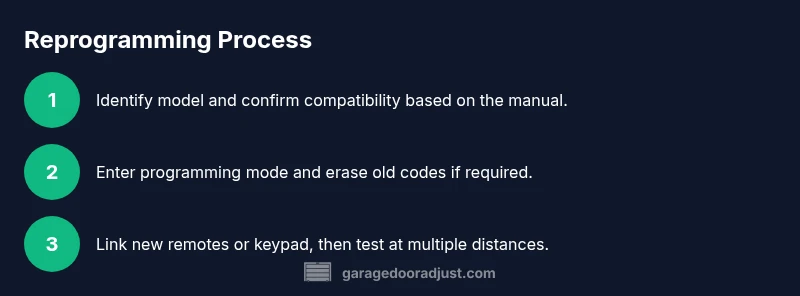
You can reprogram most garage door openers to pair remotes or keypads. The exact steps vary by brand, but the general process is to erase existing codes, enter programming mode, and sync new devices. Gather the opener, remotes, keypad, and fresh batteries before you begin, then follow the manufacturer’s instructions for a successful reprogramming.
Understanding reprogramming: can garage door opener be reprogrammed?
When homeowners ask can garage door opener be reprogrammed, the answer is often yes—especially with newer models that use rolling-code technology. Reprogramming lets you add or remove remote controls, keypads, and even smartphone interfaces without swapping the entire unit. The GarageDoorAdjust team has found that most common issues—lost remotes, upgrading to a keypad, or improving security after a property change—are resolved by reprogramming. The exact method varies by brand and model, but the core idea remains: erase before re-linking, enter programming mode, then connect the new device. Start by locating the learn or programming button on the opener and checking the status indicator, then pull the manual for model-specific steps. Safety note: cut power when servicing exposed wiring and never attempt to reprogram while the door is in motion.
Brand and model compatibility: what you need to know
Compatibility matters because not all remotes or keypads work with every opener. Some brands require proprietary remotes or specific frequency bands. Always verify the model number on the opener and cross-check with the manufacturer’s site or manual. If you’re trying a universal remote, confirm it matches the opener’s frequency and rolling-code method. GarageDoorAdjust testing indicates most households succeed when devices are clearly labeled for the brand and model. For keypad devices, ensure the entered code length and entry pattern are compatible. If you have an older opener, compatibility may limit options, and upgrading to a newer model could provide easier reprogramming.
Safety and prerequisites before you start
Before you begin, ensure the area is clear of people and pets, the door is closed, and the opener is powered. Wear eye protection if you’ll be near wiring or exposed components. Gather the necessary tools and batteries, and label each device to prevent confusion. If you’re unsure about electrical steps, switch off power at the breaker and wait a moment to reset. After programming, verify safety sensors and auto-reverse function are working correctly; misalignment or a faulty sensor can create a dangerous situation.
How rolling codes and programming work (brand-agnostic)
Most modern openers use rolling codes to prevent code grabbing. Reprogramming teaches the opener to recognize newly linked devices while ignoring old ones. The typical sequence: put the opener in programming mode, activate the device by pressing a button or entering a code, watch for a confirmation (light blink or audible beep), then test. Some models require erasing all previous codes before adding new devices; others let you maintain a subset of remotes. Understanding rolling codes helps you anticipate the visual or audible cues during the process.
Common methods by brand families
Brand families share a core approach but differ in button order and indicators. Common steps include locating the learn button on the unit, entering programming mode (indicator light blinks), and then signaling the remote or keypad to link. If you own LiftMaster, Chamberlain, Genie, or similar brands, consult the exact sequence in the manual for model-specific timing. For wall-keypad programming, you may need to input a code or follow a separate pairing procedure. Always perform a test after programming to confirm operation from multiple angles and distances.
Troubleshooting common reprogramming issues
If a device won’t link, check that batteries are fresh and properly installed. Verify you’re following the exact timing and sequence required by your brand. If links fail across all remotes, consider a full memory reset (per manual) and re-add devices from scratch. Intermittent operation may signal sensor misalignment or track obstruction; inspect sensors, tracks, and reverse function. In some environments, nearby electronics can interfere with wireless signals; move devices closer during testing to isolate the issue.
Advanced options: rolling codes, remote pairing, and app control
Beyond basic remotes and keypads, some openers support smartphone apps and smart-home integrations. Reprogramming in this context may involve linking the opener to a hub, re-pairing Wi-Fi or Bluetooth modules, and updating firmware. If you rely on an app ecosystem, ensure your firmware and app are up to date. Security settings, device-specific codes, and multi-factor options may affect how new devices are added. Always follow manufacturer guidance to maintain a secure setup.
When to call a professional and final checks
If you observe power issues, damaged wiring, a non-functional learn button, or the door behaves unreliably after reprogramming, seek professional help. A technician can verify safety sensors, auto-reverse, and motor operation post-reprogramming. After any reprogramming, test all devices at various distances and after power cycles. Document the changes and keep warranty information accessible in case service is needed later.
Tools & Materials
- Owner's manual for your garage door opener(Use to identify brand-specific steps and button sequence)
- Compatible remote control(s)(Before starting, confirm you have the remotes you plan to reprogram)
- Keypad transmitter(Optional if you want to reprogram a keypad)
- Ladder(Safe access to the control panel)
- Batteries for remotes and keypad(Typically coin cell batteries; replace if weak)
- Screwdriver set(Phillips or flat-head depending on screws on the panel)
- Marker or tape(Helpful to label remotes after programming)
Steps
Estimated time: 30-60 minutes
- 1
Prepare and identify model
Locate the opener's model number on the unit and confirm compatibility with the remotes or keypad you will reprogram. Read the manual to understand the brand-specific sequence and any safety requirements. This preparation reduces the risk of mismatched signals.
Tip: Have the model number and brand ready before starting. - 2
Clear existing codes
If your manual instructs it, erase all previously linked devices to avoid conflicts. This step ensures you’re pairing only the devices you intend to use. Do not perform this on a unit in motion or with business-critical automation active.
Tip: A full memory clear prevents unexpected doors from opening. - 3
Enter programming mode
Activate the learning mode on the opener by pressing the learn button or using the control panel as directed by the manual. The indicator light should blink or change pattern to indicate programming mode.
Tip: Timing matters; follow the exact hold or press duration specified by your model. - 4
Program a remote
While in programming mode, press a button on the remote or keypad you want to link until you see a confirmation signal from the opener. Remove the device and test it at a short range.
Tip: Keep the remote close to the opener during linking. - 5
Program a keypad
If you’re adding a keypad, enter the code on the keypad when prompted by the programming sequence. Confirm that the code is accepted and tested before moving to the next device.
Tip: Choose a code that is easy to enter and remember, but not easily guessed by others. - 6
Test each device
Step back and test every linked remote and keypad at different distances. Ensure the door responds reliably and safely in both directions. Address any failures by re-running the linking process or re-checking batteries.
Tip: Test from both inside and outside the garage. - 7
Finalize and label
Label each device with the date of programming and a short identifier. Store manuals and batteries in a safe place for future maintenance or warranty needs.
Tip: Keep a small log for future reference.
Got Questions?
Can I reprogram a universal remote to work with my garage door opener?
Many universal remotes work if they support the same frequency and rolling-code method as your opener. Check compatibility in the manual or with the manufacturer.
Most universal remotes work if they match your opener's frequency and security method.
Do I need to erase codes every time I replace remotes?
Not always. Erasing codes is common when security changes or you want to prevent old remotes from functioning. If you’re simply adding a new remote, you may be able to link it without clearing existing ones.
You usually erase when security changes or you want to block old remotes; otherwise you can add without erasing.
What if my opener doesn't have a learn button?
Some units use a wall console menu or a hidden switch. In that case, refer to the manual for the exact steps or contact support. A few models require a reset sequence instead of a single learn button.
If there is no learn button, check the manual for the alternative programming method.
Is reprogramming safe for older openers?
Reprogramming can be possible on many older units, but the methods vary. If you’re unsure, use the manufacturer guidance or consider upgrading for easier maintenance and better security.
Older openers can often be reprogrammed, but verify with the manual or a pro.
How long does reprogramming typically take?
Most sessions take from 15 to 60 minutes, depending on the number of devices being linked and the brand requirements.
Usually under an hour, depending on devices.
What safety checks should I perform after reprogramming?
Test auto-reverse, confirm sensor alignment, and verify the remote works from various distances. If anything fails, re-check connections and battery status.
Test auto-reverse and sensors, and verify range after reprogramming.
Watch Video
Quick Summary
- Identify model specifics before starting
- Erase memory and re-link devices one by one
- Test all devices at multiple distances
- Keep batteries fresh and labeled
- Follow manufacturer guidance for security and warranty