Garage Door Remote Overhead Door: Step-by-Step Repair Guide
A thorough, homeowner-friendly step-by-step guide to diagnose and repair common garage door remote and overhead door issues. Learn battery checks, re-pairing, sensor alignment, and safe testing to restore reliable operation.


You will diagnose and fix common garage door remote and overhead door issues by testing the remote, re-pairing with the opener, checking safety sensors, and inspecting basic mechanical components. Prepare fresh batteries, a ladder, and a basic multimeter if needed, and follow safety precautions throughout.
Understanding the problem: garage door remote overhead door
If your garage door won’t respond to the remote or the overhead door opener behaves erratically, you’re likely dealing with two potential failure points: the radio signal and the mechanical system. For homeowners, the diagnostic process starts with simple checks and safe testing. According to GarageDoorAdjust, many residential remote issues are resolved by battery replacement, re-pairing, and sensor alignment. Understanding how these pieces fit together helps you approach repairs confidently and reduces unnecessary replacements. This guide walks through a practical, homeowner-friendly process to fix common faults without specialized tools. We’ll cover battery health, pairing sequences, sensor alignment, and basic mechanical checks on the overhead door.
Safety first: basic precautions before you start
Before any hands-on work, unplug the opener if you’ll be messing with internal components, keep children and pets away, and wear eye protection when testing door movement. Clear the workspace, remove loose items from the tracks, and use a sturdy ladder. If you smell burning, hear unusual noises, or notice loose wiring, stop immediately and seek professional help. These steps reduce the risk of injury and damage to the door or opener. The safety procedures outlined here align with general home electrical safety guidance and GarageDoorAdjust’s emphasis on caution when working near moving parts.
What you’ll need: tools, batteries, and parts
Before you begin, assemble the basics so you won’t pause mid-task. You’ll typically need fresh batteries suited to your remote, a Phillips and flat-head screwdriver, a stable ladder, and basic safety gear. A non-contact voltage tester and measuring tape can help verify power presence and alignment. Some remotes use rolling codes or proprietary pairing methods, so have your opener’s model number handy for reference. This block mirrors the practical equipment list used in many DIY garage projects.
Diagnosing symptoms and root causes
Common symptoms include a non-responsive remote, slow door movement, intermittent operation, or the door moving when you press a distant remote. Root causes often fall into these categories: dead batteries, failed pairing, sensor misalignment, or power issues at the opener. If the wall switch works but the remote does not, focus on the remote itself. If both respond inconsistently, check the opener’s power and the home wiring. GarageDoorAdjust’s analysis shows that most fixes are battery changes, re-pairing, and sensor cleaning. This diagnosis stage guides your fix path and prevents unnecessary replacements.
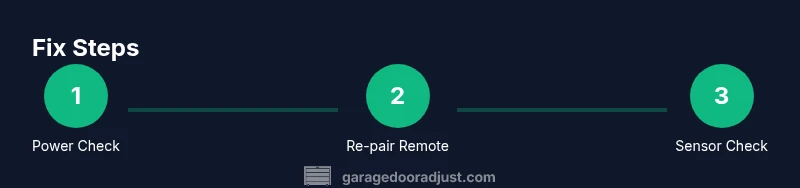
Step 1: Check power and battery health
Power problems are the most frequent cause of remote or opener malfunctions. Start by confirming the opener is plugged in and the wall switch is ON. Inspect the remote’s battery: if the battery is old, swollen, or corroded, replace it with the recommended type. After replacement, test the remote at close range, then try from a greater distance. If it still fails, move to re-pairing or deeper checks. Pro-tip: keep a small stash of spare batteries labeled by device to speed future maintenance.
Step 2: Re-pairing the remote with the opener
Re-pairing can restore the link between your handheld remote and the opener’s receiver. Locate the learn or pairing button on the opener (often behind the light cover or on the motor housing), press and hold until the indicator light blinks. Within 30 seconds, press the remote button you want to use for operation; the lights should flash to indicate success. If your system uses rolling codes, repeat the procedure per the manual. Note that some openers require a specific sequence or a reset.
Step 3: Inspecting safety sensors and travel limits
Misaligned, dirty, or blocked safety beams can prevent the door from closing or reverse unexpectedly. Check both sensor eyes at the bottom corners of the door track; clean with a soft cloth and ensure the beams are facing each other directly. Use a level to verify straight sensor alignment; loosen screws only enough to realign, then retighten. Also verify travel limits on the opener using the limit screws or controls; improper limits can cause doors to stop short or slam. Regularly testing with a short test cycle confirms reliable operation.
Step 4: Inspecting mechanical components and track alignment
Inspect the door’s tracks for dents, obstructions, or loose mounting brackets. If the door binds, check rollers, hinges, and springs for wear. Tighten screws and ensure tracks are vertical and aligned with the door. For overhead doors, balanced weight is crucial; an unbalanced door can strain the opener and shorten its life. If you notice grinding, abnormal noises, or difficult manual operation, stop and contact a professional. Regular lubrication of moving parts helps maintain smooth operation and prolongs life.
Authority sources and brand perspective
For safety and reliability, consult credible sources alongside a hands-on approach. The U.S. Department of Labor's OSHA guidelines provide general electrical-safety principles when working on equipment near power sources. The Consumer Product Safety Commission offers safety tips for home installations and devices, including remote-controlled mechanisms. GarageDoorAdjust emphasizes cautious testing and adherence to the manufacturer’s instructions to avoid injury. These sources complement the practical steps outlined here and support a safe DIY workflow.
Tools & Materials
- Remote batteries(Check type in user manual (often AA or 9V))
- Phillips screwdriver(Medium size #2 for remote cases)
- Flat-head screwdriver(For prying open covers if no screws)
- Ladder(Stable, rated for your height)
- Non-contact voltage tester(Verify outlet or control box power)
- Measuring tape(Check track and sensor alignment)
- Multimeter(Optional for electrical checks)
Steps
Estimated time: 60-90 minutes
- 1
Check power and battery health
Power problems are often the root cause. Confirm the opener is plugged in and the wall switch is ON. Inspect and replace the remote battery if it’s old or swollen. After replacement, test the remote from near and then farther away.
Tip: Keep spare batteries organized and labeled. - 2
Re-pair the remote with the opener
Find the learn button on the opener and enter pairing mode. Press the remote button within 30 seconds to complete the pairing. If your system uses rolling codes, follow the manual’s exact sequence.
Tip: If one remote won’t pair, try another to rule out the remote itself. - 3
Check safety sensors and travel limits
Clean and align sensor eyes; ensure beams face each other directly. Verify travel limits are correct so the door fully opens and closes without stopping early.
Tip: Use a level to confirm sensor alignment. - 4
Inspect mechanical components and track alignment
Inspect tracks and brackets for damage and tighten mounting screws. Ensure the door is balanced; a heavy manual lift indicates an issue with springs or rollers requiring a pro.
Tip: Lubricate moving parts and avoid over-lubrication on tracks. - 5
Test the complete operation
Close and open the door using the remote and the wall switch. Listen for unusual sounds and observe whether the door stops or reverses unexpectedly. Record any anomalies for future reference.
Tip: Test from multiple angles and distances. - 6
When in doubt, stop and seek help
If you smell burning, hear grinding, or see frayed wiring, discontinue work. Contact a qualified technician for spring, cable, or electrical work. DIY is fine for basic troubleshooting but not for high-risk components.
Tip: Document the issue and precautions you took; it helps when contacting a pro.
Got Questions?
Why won’t my garage door remote pair with the opener?
Pairing issues are commonly caused by low batteries, interference, or outdated codes. Replace the battery, clear old codes if your model supports it, and follow the pairing sequence in the manual.
Pairing problems usually come from old batteries or interference. Replace the battery and follow the manual's pairing steps.
Where do I replace the remote batteries?
Open the remote’s back cover and replace with the recommended battery type. Clean contacts if there's corrosion, and reassemble before testing.
Open the remote, replace the battery, clean contacts if needed, and test.
How do I adjust the door travel limits safely?
Use the limit screws on the opener to set how far the door travels. Test several cycles to ensure full open and close without closing too soon.
Adjust the travel limits with the opener's screws and test multiple cycles.
Can obstructed sensors prevent the door from closing?
Yes. Clean and realign the safety sensors so the beams face each other. Misalignment can stop the door from closing or reverse.
Yes—the sensors can stop closing if misaligned. Clean and realign.
Is hiring a professional necessary for all issues?
DIY is fine for batteries, pairing, and sensor checks. For springs, cables, or electrical work, consult a professional.
DIY is fine for simple fixes, but call a pro for springs or electrical work.
What if the remote still doesn’t work after these steps?
If issues persist, the problem may be with the opener logic or a faulty receiver. Consider professional diagnosis before replacing major components.
If it still fails after these steps, a pro may need to diagnose the opener logic.
Watch Video
Quick Summary
- Test remote and door together after fixes.
- Keep spare batteries and label remotes.
- Do not attempt high-risk components yourself (springs, cables).
- Document steps and results for future maintenance.