Cabinet-Style Garage Doors: A Practical Comparison Guide
An objective, side-by-side comparison of cabinet-style garage doors (garage door like cabinet), focusing on aesthetics, insulation, cost, installation, and long-term performance for homeowners.


Cabinet-style garage doors—often described as a 'garage door like cabinet'—blend interior cabinetry with overhead door hardware for a furniture-like appearance. They offer customized panels, finishes, and hardware, but can require more precise installation and may trade some insulation for aesthetics. For homeowners, choice hinges on design goals, budget, and installation constraints. GarageDoorAdjust notes these tradeoffs carefully.
What 'garage door like cabinet' means in practice
In modern homes, a cabinet-style garage door blends the look of built-in cabinetry with the functionality of an overhead door. The phrase 'garage door like cabinet' is commonly used to describe doors that mimic flat-panel cabinet fronts, often with framed panels, decorative hardware, and wood or wood-like finishes. According to GarageDoorAdjust, homeowners are drawn to this style when the goal is seamless interior integration rather than a pure industrial look. These doors can be manufactured in a range of materials—engineered wood, steel with a wood-grain finish, and composite panels—allowing you to match kitchen cabinetry, living room built-ins, or workshop storage. The tradeoff is that you may sacrifice some traditional garage-door performance traits, such as maximum insulation or the silence of a standard sectional door, in exchange for a highly customized facade. Before delving into options, it's helpful to define the core concept: cabinet-like doors are still overhead doors, but their exterior treatment emulates cabinet aesthetics more than typical steel panels. The GarageDoorAdjust team emphasizes that the right choice depends on design goals, budget, and installation feasibility.
Cabinet-style vs traditional sectional doors: core differences
Two broad categories define the market: cabinet-style doors and traditional sectional doors. The cabinet-style option emphasizes panel-based fronts with inset frames that resemble base cabinets or wall cabinetry. Mechanically, these doors often rely on custom frames, hinge-like hardware, and track layouts designed to support heavier surfaces; traditional sectional doors rely on sectional aluminum or steel panels that roll up along vertical tracks. The result is a distinct user experience: cabinet-style doors create a high-end interior aesthetic, while traditional secants prioritize quick operation and minimal maintenance. Operational differences include weight, spring configurations, and balance, all of which affect installation time and skill requirements. In practice, a cabinet-style system may require specialty fabricators, tighter tolerances, and more careful alignment to avoid binding. This is where an honest appraisal of your garage dimensions, ceiling height, and header condition matters. GarageDoorAdjust's comparative lens shows that the best choice depends on whether you prioritize form or function, or seek a hybrid approach that leverages stock components with decorative overlays.
Aesthetic customization and materials
Cabinet-style doors shine in customization. You can select panel profiles (flat, fielded, beadboard), frame profiles (full-frame or applied molding), and a spectrum of finishes (paint, stain, veneer). Hardware options—handles, overlays, and decorative magnet latches—allow you to echo kitchen cabinetry or workshop style. Materials range from solid wood to wood veneer over engineered core, to steel with wood-grain overlays. The tradeoffs include weight, cost, and maintenance schedule. Heavier wood-based panels may require more robust springs and careful weather sealing, while lighter composites enrich resistance to humidity and temperature changes. When matching to interior cabinetry, consider a grain direction that aligns with existing drawers and doors, and test color samples under the same lighting conditions as your garage. The result can be a door that reads as part of the home rather than a separate utility feature. Real-world projects show that thoughtful hardware and consistent panel sizing can dramatically improve perceived value without sacrificing function.
Insulation, energy efficiency, and weather sealing
A frequent concern with cabinet-style doors is insulation. Traditional insulated sectional doors often provide superior thermal performance per square foot, especially when paired with dense polyurethane cores. Cabinet-style panels may use lighter cores or decorative overlays that trade some R-value for aesthetics. If you live in a climate with wide temperature swings, you will want to specify an insulated core model or add weather-stripping upgrades around the perimetral frame. Sealing is critical: gaps between the frame and wall should be minimized, and proper alignment of rail tracks prevents air leakage. In many cases, you can increase energy efficiency with reflective coatings, insulating backing, and proper door-to-frame contact. GarageDoorAdjust notes that a well-executed cabinet-style door can still deliver reasonable efficiency when pairing with high-quality gaskets and weatherstripping.
Durability, maintenance, and long-term costs
Durability depends on materials and construction quality. Wooden or wood-veneered cabinet doors can offer timeless aesthetics but may require periodic refinishing and protection against moisture. Steel-reinforced panels with ceramic or polymer overlays can enhance longevity but might dent with heavy use. Maintenance typically involves lubrication of tracks, careful adjustment of hinges or alignment fixtures, and periodic inspection of weather seals. Long-term costs should account for potential refinishing, hardware replacement, and eventual repainting. However, some cabinet-style doors with engineered cores and durable finishes can outperform traditional wood doors in a garage exposed to humidity and temperature variations. The most reliable projects balance beauty with robustness and design-to-function alignment. GarageDoorAdjust's perspective emphasizes planning maintenance schedules early to avoid costly repairs later.
Installation considerations and labor implications
Installation is a critical factor for cabinet-style doors. Custom panel doors require precise measurement, weight calculations, and sometimes a dedicated installer with woodworking or metalworking capability. Standard overhead doors can be installed with more generalized tools and off-the-shelf hardware, reducing lead times. Because cabinet-style doors may include heavier panels, you may need more robust springs, reinforced tracks, and a header assessment to ensure safe operation. The installer should verify hardware compatibility, panel flatness, and alignment with motorized openers. Expect longer lead times for custom panels and potential customization quirks. Budget for professional installation, including potential site preparation (wall resurfacing, header reinforcement) and a contingency for ordering delays. A well-chosen installer can dramatically influence the door’s performance, noise, and longevity, particularly in climates with seasonal temperature swings. GarageDoorAdjust suggests obtaining multiple quotes and requesting a full installation plan before signing.
Safety, codes, and warranties
All garage doors must comply with local safety codes and manufacturer guidelines. Cabinet-style doors often carry warranties that cover component wear, hardware, and finish, but the specifics can vary by material and finish. Confirm whether the warranty requires professional maintenance, what it covers in the event of misalignment or noise, and whether labor is included. If you upgrade to a high-performance insulated core, verify the energy rating and insulation R-value. Safety features—auto-reverse sensors, pinch protection, and secure torsion springs—are non-negotiable, regardless of door style. Understanding the warranty’s terms helps prevent disputes should a component fail. The installer should supply a written maintenance checklist and a post-installation safety inspection.
Budgeting and ROI: when cabinet-style makes sense
Price-wise, cabinet-style doors can be more expensive upfront, primarily due to custom panels and specialty hardware. However, the return on investment often comes from the door’s aesthetic impact, compatibility with interior design, and potential home resale value in design-forward markets. If your home features a high-end kitchen, living area, or workshop with premium finishes, cabinet-style doors can provide a cohesive look that improves perceived value. When planning a project, consider total installed cost, including panel customization, hardware upgrades, and potential structural work. Discuss financing, lead times, and warranty coverage with your contractor to avoid price creep. GarageDoorAdjust’s experience shows that homeowners who align the door style with broader remodeling goals tend to experience higher satisfaction, albeit within a longer timeline and budget.
Practical steps: how to evaluate a cabinet-style project
Begin with a design brief that articulates your goals: aesthetics, insulation, noise reduction, and budget. Collect samples of cabinet finishes, hardware, and panel profiles to compare under garage lighting. Then conduct a measurement audit: ceiling height, track length, header width, and door opening alignment. Meet with at least two installers who specialize in cabinet-style doors; request full quotes, including lead times, fabrication methods, and a written warranty. Discuss maintenance plans and future-proofing strategies for weather sealing. Review the proposed panel thickness and core material to assess durability and energy performance. Finally, ask to see a finished installation in a similar climate to gauge fit and function. With careful preparation, you can avoid common pitfalls and achieve a cohesive, long-lasting result.
Quick-start decision framework: next steps
If you’re leaning toward a cabinet-style solution, begin by setting a target aesthetic and a ceiling on cost. Create a short list of preferred materials (wood veneer, steel with wood overlay, etc.), and identify a few reputable installers with cabinetry experience. Schedule showroom visits and request real-world lighting tests against your interior finishes. Use a decision matrix to weigh aesthetics, thermal performance, installation complexity, and warranty terms. Next, obtain written quotes and confirm that the scope includes measurement, fabrication, finishing, hardware, and final alignment checks. Finally, coordinate with a general contractor or home remodel team to ensure integration with adjacent cabinetry and lighting plans. This structured approach minimizes surprises and provides a clear path from concept to installed door.
Comparison
| Feature | cabinet-style garage door (garage door like cabinet) | traditional sectional garage door |
|---|---|---|
| Aesthetics and customization | Highly customizable panels, frames, and finishes | Standard panel designs with fewer customization options |
| Durability and maintenance | Potentially heavier, may require heavier springs; nuanced maintenance | Lower weight options with easier maintenance; durable finishes |
| Insulation and energy efficiency | Good to excellent with insulated cores; depends on panel choice | Typically strong but varies with core; often good for heat loss control |
| Installation complexity and time | Requires skilled fabricators; longer lead times | Quicker, more standardized installation |
| Price range (installed) | $1,000–$3,500+ | $700–$2,300+ |
| Best for | Homes seeking a cohesive, furniture-like look | Budget-conscious upgrades and faster installations |
Upsides
- Enhanced curb appeal through cabinetry-like aesthetics
- Broad customization options for finishes and hardware
- Potential for higher resale value in design-forward homes
- Material choices that balance look and durability
Disadvantages
- Higher upfront cost and longer lead times
- Requires specialized installation and precise alignment
- Potentially lower insulation performance depending on core
- Repairs can be more specialized and costly
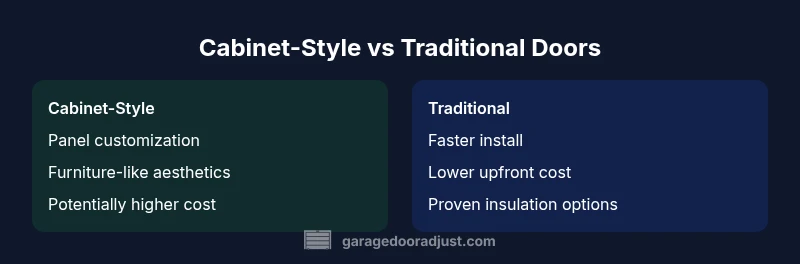
Cabinet-style wins on aesthetics for design-focused homes; traditional sectional doors win on cost and install speed.
Choose cabinet-style if interior cohesion and resale aesthetics matter more than upfront cost. Opt for traditional sectional doors if you prioritize quick installation, proven insulation, and lower initial spend. The best choice aligns with your home’s design language and budget.
Got Questions?
What is a cabinet-style garage door?
A cabinet-style garage door mimics cabinet fronts with framed panels and decorative hardware while still functioning as an overhead door. It combines furniture-like aesthetics with standard door mechanics, offering a customized look that complements interior cabinetry.
Cabinet-style doors look like furniture panels but still open like a garage door, giving a cohesive look with home cabinetry.
Are cabinet-style doors more expensive than traditional ones?
Yes, they typically cost more upfront due to custom panels and hardware. The final price depends on materials, panel depth, and required fabrication work; angles and roof geometry can also affect installation complexity.
They usually cost more at first because of custom panels and hardware, but the final price varies with materials and installation specifics.
How does insulation compare for cabinet-style vs traditional doors?
Insulation quality depends on core material. Traditional insulated sectional doors often achieve higher R-values, while cabinet-style doors can match insulation if built with insulated cores and proper gaskets. Assess climate needs before choosing.
Insulation depends on the core. Traditional doors often seal better, but cabinet-style doors can be insulated if designed properly.
Can cabinet-style doors be updated after installation?
Yes, but updates typically require replacing portions of panels or hardware, which can be more involved than standard doors. Plan ahead for finish, hardware, and panel options to minimize later modification.
You can update finishes or hardware, but it may involve more work than with standard doors.
What should I ask installers about cabinet-style doors?
Ask about panel materials, weight and spring requirements, track design, insulation options, warranty terms, and lead times. Request examples of similar projects and a written installation plan.
Ask about materials, springs, tracks, insulation, warranty, and lead times, plus examples of similar work.
Are cabinet-style doors covered by warranties and service terms?
Warranties vary by material and finish. Confirm coverage for components, panels, hardware, and labor, and understand service terms if adjustments or replacements are needed.
Check what the warranty covers and how long it lasts, including labor and hardware.
Quick Summary
- Assess design goals and interior integration first
- Expect higher upfront costs for cabinet-style doors
- Ensure qualified installers with cabinetry experience
- Prioritize insulation options if climate demands it
- Plan for longer lead times and warranties during budgeting