4 Panel vs 5 Panel Garage Door: A Practical Comparison
A practical, data-driven comparison of 4-panel vs 5-panel garage doors, covering aesthetics, insulation, cost, installation, and long-term value for homeowners.


The quick answer is that 4 panel vs 5 panel garage door choices trade cost and simplicity for curb appeal. 4-panel doors typically cost less and install faster, while 5-panel doors offer more decorative options and a traditional look. For most homeowners, 4-panel doors deliver better value, unless style and heritage aesthetics are a priority.
Understanding Panel Count: What 4-panel vs 5-panel Really Means
When homeowners compare 4 panel vs 5 panel garage door options, they are focusing on aesthetics rather than function. The phrase 4 panel vs 5 panel garage door describes how many steel or composite sections are arranged across the door face, and it influences appearance more than it does mechanical performance in most mid-range doors. According to GarageDoorAdjust, the panel count is largely a design decision, but it can affect perceived value and compatibility with home style. The GarageDoorAdjust Team notes that while both options typically share the same core components (tracks, springs, and openers), panel count can drive subtle changes in weight distribution, seal quality, and the way panels flex under wind loads. For many homeowners, the choice comes down to curb appeal, repair costs, and the availability of matching repair parts. In 2026, the market offers a wide range of 4-panel and 5-panel designs that can be paired with similar insulation levels and hardware kits. The comparison of 4 panel vs 5 panel garage door choices matters most when matching to the home’s architectural style while considering maintenance needs and expected lifespan.
This paragraph includes the exact keyword phrase to anchor the article for readers and search engines.
Comparison
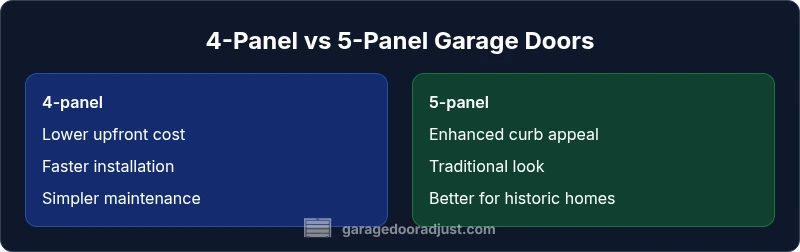
| Feature | 4-panel garage door | 5-panel garage door |
|---|---|---|
| Visual style | Classic, clean lines with fewer divisions | More ornate, traditional look with additional panel lines |
| Typical cost impact | Generally lower upfront cost; simpler design | |
| Insulation impact | Depends on core; panel count itself has limited direct impact | |
| Weight and balance | Similar if using the same material and core; panel count shifts minor weight distribution | |
| Replacement parts availability | Widely available for common sizes and designs | |
| Aesthetic customization | Fewer customization options on 4-panel; more panel options and window styling on 5-panel | |
| Best for | Budget-conscious installs, modern minimalist homes | Classic or historic homes, curb-appeal focused projects |
Upsides
- Lower upfront cost for 4-panel doors
- Quicker installation and serviceability for common sizes
- Easier to find replacement parts and accessories
- Sufficient durability for typical residential use
Disadvantages
- 5-panel doors offer greater curb appeal and historic authenticity
- Higher upfront cost and longer lead times for some designs
- Less common panel options in certain regions
4-panel doors are typically the better value for most homeowners, while 5-panel doors excel in curb appeal and historic aesthetics.
If your priority is budget, quick install, and reliable performance, choose 4-panel. If you want a traditional, visually rich façade that aligns with a period-style home, opt for 5-panel. The right choice depends on home style, neighborhood expectations, and long-term value.
Got Questions?
Is a 4-panel door cheaper than a 5-panel door?
In most markets, a 4-panel door costs less upfront than a 5-panel door because of simpler construction and fewer design options. The price gap varies by material, brand, and features like insulation and windows.
Yes. A 4-panel door typically costs less upfront than a 5-panel door due to simpler construction and fewer features.
Does panel count affect insulation or energy efficiency?
Panel count itself has minimal direct impact on insulation. Insulation quality depends on the door core, seals, and weatherstripping. Both 4-panel and 5-panel doors can be thermally upgraded with similar cores.
Panel count doesn’t directly change insulation; insulation depends on the core and seals.
Can I convert a 4-panel door to a 5-panel door later?
Conversion is rarely practical because it often requires a full replacement of panels or the entire door. If the style demands change, replacing the door is usually more reliable and warranty-friendly.
Conversion is rarely practical; replacement is usually the route to switch panel count.
Which lasts longer, a 4-panel or 5-panel door?
Durability is driven more by material quality, hardware, and maintenance than by panel count. With proper care, both options can last many years.
Lifespan depends on materials and maintenance, not panel count.
How should I decide between 4-panel and 5-panel?
Evaluate budget, home style, neighborhood expectations, and maintenance plans. Compare quotes that include the same insulation, windows, and hardware to ensure an apples-to-apples choice.
Look at budget, house style, and long-term value when deciding.
Are 5-panel doors a better fit for historic homes?
Yes, 5-panel doors often align with traditional or historic aesthetics and can enhance curb appeal for period-style homes, provided they match overall color and hardware.
Good option for historic-looking homes if it matches the style.
Quick Summary
- Assess budget first to gauge 4-panel vs 5-panel costs
- Prioritize curb appeal if resale value matters
- Verify insulation and weather sealing regardless of panel count
- Ensure compatibility with existing tracks and opener hardware
- Consult a pro for accurate fit and warranty terms
- Consider long-term maintenance when choosing panel design
- Compare real-world installations before committing
- Aesthetics can influence perceived value as much as durability