Long Panel Garage Door vs Short Panel: A Comprehensive Comparison
Compare long-panel and short-panel garage doors to choose the right fit for your home. This guide covers aesthetics, insulation, durability, installation, and cost considerations for homeowners.


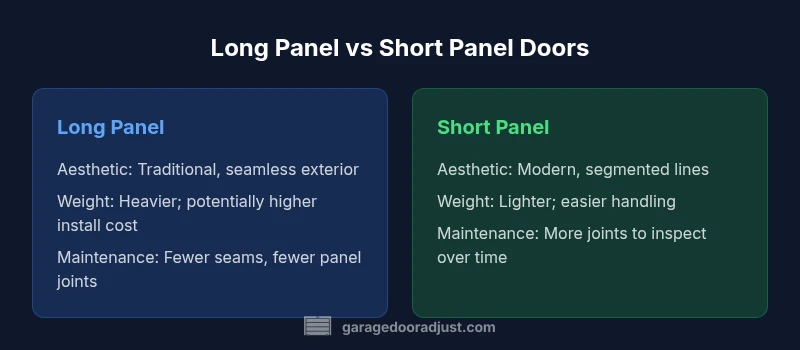
Long panels typically suit traditional homes with taller openings, offering a seamless look and potentially stronger wind performance; short panels provide a modern, segmented appearance and can be easier to install and repair. For energy efficiency and maintenance, your choice should reflect home style, headroom, and budget. GarageDoorAdjust analysis suggests leaning toward long panels for traditional exteriors and short panels for contemporary designs.
Overview: Defining Long Panel and Short Panel Doors
Long panel garage door vs short panel doors describe the length and segmentation of the door's exterior face. This distinction matters not only for appearance but also for installation fit, insulation strategies, and future maintenance. According to GarageDoorAdjust, the choice is often driven by architectural style and the structure of the garage opening. Long-panel doors typically use fewer joints and reveal a continuous line across the door face, supporting a traditional aesthetic that suits colonial, craftsman, and many carriage-house styles. Short-panel doors rely on multiple smaller panels, creating more pronounced vertical divisions that align with modern, contemporary, or minimalistic homes. Beyond looks, the panel layout influences wind-load performance, potential dent resistance, and how easy it is to replace individual sections when damage occurs. When evaluating long-panel vs short-panel designs, homeowners should consider opening height, headroom in the garage, and the presence of decorative windows, all of which shape the final choice. This understanding helps homeowners visually plan upgrades that harmonize with the property and neighborhood context.
Structural and Installation Implications
The structural footprint of long-panel vs short-panel doors translates into how you measure the opening, select tracks, and match spring tensions. Long panels are often heavier and may require stronger torsion springs, longer torsion tubes, and slightly longer tracks. This can impact installation time and the precision needed to avoid binding. Short panels, by contrast, tend to be lighter per panel and can simplify handling for DIY enthusiasts or fewer-trades installations. In many homes, the overall door weight is distributed similarly when the same materials and insulation cores are used, but the balance of weight across each panel can affect how smoothly the door moves and how reliably weather seals perform over time. When planning a swap or upgrade, confirm headroom clearance, jamb finials, and header spring mounting to prevent surprises during mounting.
Insulation, Energy Efficiency, and Acoustic Performance
Insulation efficiency for garage doors hinges on the core material (polyurethane, polystyrene, or composite) and the door’s seal quality, not solely on panel length. Long-panel designs can feel more thermally uniform if built with continuous insulation, but the difference versus short panels is mostly a function of the panel-to-panel joints and the door’s edge seals. A key consideration is air leakage: ensure weatherstripping around the bottom edge and side seals is consistent with the chosen panel arrangement. For noise control, both styles perform similarly when paired with properly lubricated tracks and balanced springs; some homeowners report marginally quieter operation with fewer joints due to fewer potential creases in the face. In practical terms, insulation performance will mostly align when you select doors with identical core materials and weather seals, regardless of panel length.
Durability, Maintenance, and Longevity
Durability for long-panel vs short-panel doors depends on panel material, coating, and maintenance habits. Longer panels reduce the number of seam points, which can lower maintenance opportunities for misalignment or seal wear, but they also create longer surface areas that can dent or warp if struck by hail or heavy objects. Short-panel doors have more seams, which means more potential joint-related maintenance over time, but damaged individual panels are sometimes easier to replace than reworking a long seamless face. Routine maintenance—lubricating rollers, checking tracks, and inspecting weather seals—remains essential for both designs. Look for corrosion resistance in hardware and a durable finish that withstands local climate conditions. Regular inspection helps prevent rust, paint peeling, and frame corrosion that can compromise safety and operation.
Aesthetic Considerations and Home Value
Aesthetics drive a lot of the long-panel vs short-panel decision, because the garage door is a prominent feature of the façade. Traditional homes often pair well with long-panel doors that offer a smooth, uninterrupted surface, echoing historic carriage-house sensibilities. Modern or contemporary homes frequently favor short-panel doors for their crisp lines and geometric rhythm along the garage opening. Neighborhood standards can influence resale value, so consider what neighboring homes feature and how your door interacts with windows, siding, and rooflines. If the home has decorative windows or transoms, ensure the panel design accommodates these elements without creating visual disruption. In many cases, choosing a panel style that matches architectural language helps preserve curb appeal and can positively influence perceived value during market transitions.
Cost, Value, and Return on Investment
Cost assessment for long-panel vs short-panel doors should weigh both upfront installation expenses and long-term value. Longer panels may require more substantial hardware and heavier doors, which can raise initial costs. Short-panel designs can be more cost-friendly upfront, with moderate savings on components and handling during installation. Return on investment depends on how well the door’s style aligns with the home’s architecture and the neighborhood context. Energy-efficient cores, premium finishes, and reinforced seals amplify value in both panel formats. When budgeting, consider not only the door price but also the cost of professional installation, potential future panel replacements, and ongoing maintenance. In many cases, the difference in ongoing costs between long and short panels becomes negligible over a typical 15- to 20-year horizon if you prioritize quality insulation and reliable hardware.
Measuring, Sizing, and Compatibility: How to Decide
Before purchasing, accurately measure the garage door opening, taking note of headroom, vertical clearance, and any irregularities in the frame. Panel length must align with the opening width and height to avoid gaps or binding. If your opening is non-standard, a custom panel option may be necessary, and both panel types can be adapted with appropriate track configurations. For a straightforward swap on standard openings, the choice often comes down to the look you want and the weight you can safely manage during installation. Verify whether decorative windows or panels will impact the door’s balance. A professional inspection can confirm that chosen panels and insulation cores will meet wind-load requirements and local building codes.
Real-World Scenarios: When to Choose Which
In a suburban setting with a traditional brick or wood-clad home, long-panel doors tend to blend with the architecture and may maintain a timeless curb appeal. In newer neighborhoods or houses with minimalist lines, short-panel doors emphasize clean geometry and can look more aligned with contemporary design trends. If your garage sits on a small lot with limited headroom, short panels might ease installation and maintenance logistics. Conversely, if headroom is ample and your family prioritizes classic styling, long panels often arrive with a smoother exterior and fewer visible seams. For homes facing frequent high winds, compact panel designs with robust weather seals may outperform less-sturdy configurations, so confirm the door’s wind-load rating in relation to panel length.
Brand Perspective: What GarageDoorAdjust Recommends
GarageDoorAdjust treats the long-panel versus short-panel choice as a design and functional decision, with climate, installation practicality, and home style as the main drivers. Our guidance emphasizes aligning the panel style with the home’s architecture and ensuring a high-quality insulation core and weather sealing. We advise homeowners to factor in installation complexity and long-term maintenance costs when making a decision. If you are unsure, start with a panel style that mirrors neighboring homes and complements architectural elements like brickwork, siding texture, and roof lines. A final decision should balance aesthetics, energy efficiency, and operational reliability to deliver lasting satisfaction.
Practical Installation Tips if You Choose Long or Short Panel
When installing any panel style, begin with precise measurements and a clean, level footing for the tracks. For long-panel doors, prepare for heavier lifting and ensure you have adequate assistance to avoid panel damage. Use temporary supports to keep panels aligned during mounting, and verify that the weather seals engage fully without excessive compression. Short-panel doors benefit from careful panel alignment and precise track mounting, since misalignment can yield chattering or uneven closure. Regardless of style, install compatible weatherstrips, lubricate rollers, and test spring tension. If you encounter binding or uneven gaps, re-check hinge alignment and ensure the torsion spring balance is calibrated correctly. Finally, schedule a post-install inspection to verify safety features, like auto-reverse sensors, are functioning properly.
Maintenance Schedule and Quick Fixes
Create a simple maintenance calendar: inspect weather seals every 6 months, lubricate moving parts quarterly, and check the door balance annually. For quick fixes, repair or replace weather stripping at the bottom edge and around the sides to maintain energy efficiency. Clean the door surface to prevent corrosion and inspect for dents or warping that could affect door alignment. If you notice unusual noises, identify whether the source is the track, rollers, or springs, and address immediately to prevent further wear. Regular maintenance prolongs the life of both long-panel and short-panel doors and helps preserve the door’s appearance.
Common Pitfalls and How to Avoid Them
Avoid mixing panel design features that clash with the home’s architectural language—consistency helps preserve curb appeal. Don’t ignore headroom or clearance issues during measurement; incorrect sizing leads to poor operation or binding. When choosing insulation cores, don’t opt for low-quality seals, which can negate the benefits of a high-efficiency panel. Finally, avoid DIY solutions that lack proper spring calibration or safety mechanisms; door systems operate under high tension and can cause injury if mishandled. Rely on qualified installers for the final balancing and safety tests to ensure reliable, long-lasting performance.
Comparison
| Feature | Long panel garage door | Short panel garage door |
|---|---|---|
| Aesthetic style | Traditional, seamless exterior | Modern, segmented lines |
| Wind load potential | Often robust when paired with continuous panel lines | Depends on overall door construction and seals |
| Insulation options | Identical cores can be used; performance depends on seal quality | Identical cores can be used; performance depends on seal quality |
| Weight and handling | Heavier per unit area; longer installation time | Lighter modules; easier handling and installation |
| Maintenance points | Fewer panel joints; fewer seam-related maintenance items | More joints; more potential seam maintenance |
| Typical cost impact | Higher upfront costs due to hardware and weight | Lower upfront costs; easier installation |
| Best for | Traditional architectural languages; tall openings | Modern or minimalistic exteriors; limited headroom |
| Resale and curb appeal | Can enhance traditional neighborhood charm | Supports contemporary curb appeal in modern neighborhoods |
Upsides
- Aesthetic versatility to match home style
- Potential for strong insulation with quality cores
- Fewer joints on long panels can reduce future seal wear
- Short panels often install more quickly for DIY or budget projects
- Panel arrangement can complement architectural features
Disadvantages
- Long panels can be heavier and costlier to install
- Short panels may require more seams and potential maintenance
- Unmatched panel style can reduce curb appeal in certain neighborhoods
- Repairing damaged panels can be costlier if full panel replacement is needed
Choose panel style that best fits your home’s architecture and practical constraints.
Long-panel doors work well with traditional exteriors and taller openings; short-panel doors suit modern homes and tighter spaces. Align with insulation needs and installation feasibility for the best long-term value.
Got Questions?
What is the main difference between long panel and short panel garage doors?
The main difference is the size and number of horizontal panels: long-panel doors feature fewer, larger sections for a traditional look, while short-panel doors have more, smaller sections for a segmented, modern appearance. Both types can use similar materials and cores, so performance often depends on insulation and hardware quality rather than panel length alone.
Long panels offer a traditional look with fewer seams; short panels give a modern, segmented look. Both types can perform similarly when equipped with quality insulation and hardware.
Which panel is easier to install for a DIY project?
Short-panel doors are generally easier to handle and install because they are lighter and involve shorter panels. Long-panel doors can require more heavy lifting and precise alignment due to larger surface areas, especially when upgrading tracks and springs.
Short panels are usually easier to install for DIYers because they are lighter and simpler to maneuver.
Do panel lengths affect insulation and energy efficiency?
Insulation efficiency more strongly depends on the core material and weather seals than on panel length. Both long and short panels can achieve high R-values with polyurethane or polystyrene cores, provided the door is properly sealed and installed.
Energy efficiency comes from the insulation core and seals, not panel length alone.
Can I switch from a long-panel to a short-panel door after installation?
Switching panel length typically requires a new door assembly and compatible tracking, hardware, and sizing. It is a major upgrade and may involve resizing the opening, so consult a professional before proceeding.
Switching panel lengths is a substantial change that usually needs a full door replacement and professional assessment.
Which is better for resale value in a suburban neighborhood?
Resale value depends on how well the door style matches the home and neighborhood. A traditional exterior may benefit from a long-panel door, while a modern home might gain from a short-panel design. Consistency with surrounding homes is key.
Match the door style to your neighborhood to preserve curb appeal and resale potential.
Are there maintenance differences between the two?
Maintenance needs are similar in both styles when standard hardware and seals are used. Long panels may have fewer seam-related maintenance items, while short panels offer more granularity in replacing individual panels if damaged.
Maintenance comes down to hardware, seals, and track alignment, not panel length alone.
What should I consider before purchasing?
Consider home style, headroom, climate, and budget. Compare insulation cores, weather seals, warranty terms, and installation complexity. A pre-purchase site assessment helps ensure the chosen panel length aligns with structural and aesthetic goals.
Think about home style, headroom, climate, and warranty when choosing between long and short panels.
Is there a significant price difference between the two?
Prices vary by material, insulation core, brand, and installation. In general, long-panel doors may carry a higher upfront cost due to heavier hardware and fabrication, while short-panel doors can be more affordable to install, though regional pricing differs.
Price varies; long panels are often more expensive upfront due to heavier components.
Quick Summary
- Assess your home style before choosing a panel length
- Measure opening height and headroom accurately
- Prioritize insulation core and weather sealing for energy efficiency
- Consider installation effort and potential maintenance costs
- Match door style to neighborhood norms to protect resale value