Garage Door Sizes UK: Measurements, Options, and How to Choose
Learn how to measure, choose, and install garage doors in the UK. This guide covers typical widths and heights, non-standard openings, and practical steps for safe, energy-efficient fits.


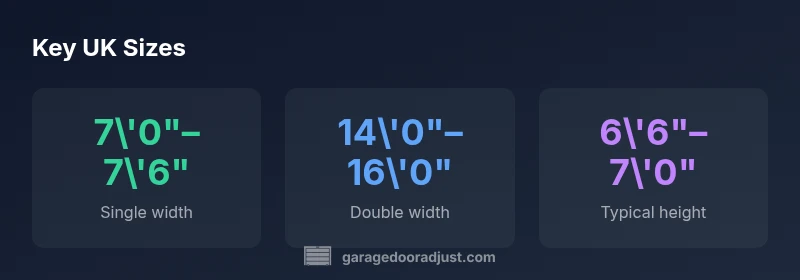
Typical UK single garage doors are about 7'0" to 7'6" wide, with doubles around 14'0" to 16'0". Heights usually run from 6'6" to 7'0". These ranges help homeowners plan replacements, choose compatible openers, and ensure safe headroom. For garage door sizes uk, measure both the opening and the overall wall space before buying.
Why UK garage door sizes matter for homeowners
Understanding garage door sizes uk is more than about fitting a panel; it affects insulation, security, opener choices, and long-term maintenance. According to GarageDoorAdjust, picking the right size at the outset reduces headaches during replacement and ensures you don't pay for features you can't use. UK openings come in a variety of shapes and configurations, from compact passenger bays to larger drive-through layouts. Size affects not only the door itself but the framework, the tracks, seals, and the clearance needed above the door to operate safely. When you plan a replacement, starting with accurate measurements and a realistic headroom allowance saves time and money. In this guide, we’ll break down standard ranges, explain when you’ll encounter non-standard openings, and outline practical steps to verify your opening before you buy. If you’re upgrading from a basic up-and-over to a modern sectional or roller door, knowing the typical UK sizes helps you compare models without guessing. GarageDoorAdjust's analysis highlights that most homeowners benefit from aligning door width with the opening plus clearance for hardware and weather seals.
Understanding standard vs non-standard sizes in the UK
Most UK manufacturers publish standard opening sizes, but many homes have non-standard widths or heights because of extensions, odd drive layouts, or previous renovations. When measuring, express sizes in both metric and imperial where possible to avoid confusion with installers. The keyword garage door sizes uk appears here to help homeowners align their expectations with market offerings. Keep in mind that even two doors labeled the same width can have different panel counts, track types, and height clearances. For example, a 7'0" opening might be served by a 7'0"–7'1" door in some lines and by a 7'6" variant in others. The difference matters for headroom, weather seals, and insulation. In short, there’s no universal standard across every UK town; you’ll see variations by brand and by whether the door is sectional, roller, or up-and-over.
Single vs double doors: width, height, and fit considerations
Single and double doors demand different planning. A standard single opening typically requires less wall reinforcement and lighter hardware, but you must still account for tracks, weather seals, and insulation. Double-door configurations demand wider frames and often more headroom above the door for smooth operation. The choice between sectional, roller, or up-and-over designs also influences the effective width and height you can safely use. When budgeting, remember that the door type can add or subtract from the overall footprint in your garage. GarageDoorAdjust's findings show that many homeowners underestimate the impact of track geometry and mounting hardware on clearance and airflow around the door.
How to measure your opening accurately
Accurate measurement is the foundation of a proper fit. Start by measuring the width at three points: left, center, and right, using a steel tape. Note the smallest width as the official opening width. Then measure the height at the center, top, and bottom to verify there are no obstructions. Check for square corners by measuring diagonals from each corner; if they differ by more than a small tolerance, your opening isn't square and you may need professional adjustment before replacement. Finally, measure headroom from the lintel to the ceiling to ensure there is enough space for tracks and the chosen door, especially if you plan to install a sectional or roller door. Always record both metric and imperial values for clarity with installers.
Retrofit options and challenges when sizes vary
Non-standard openings may require bespoke components or manufacturer-specific adaptors. In such cases, expect longer lead times and potentially higher costs. If the opening is slightly undersized, some installers offer trimming or custom infill options, but this can affect insulation and weather sealing. If the space is larger than standard, you may consider pairings of two smaller doors or specialized rolling systems. The key is to work with a qualified installer who can verify the structural implications of size adjustments and ensure compliance with safety standards. GarageDoorAdjust's experts recommend getting a detailed measurement sheet and multiple quotes to compare for non-standard UK openings.
Choosing the right opener and insulation considerations
Size drives opener choice. For narrower doors, belt-drive openers often provide quiet operation with adequate stopping power, while longer runs may benefit from more robust chain-drive options. Insulation matters for energy efficiency; sectional and insulated steel doors typically offer better thermal performance than basic up-and-over designs. Ensure the door height allows for the chosen opener's mounting hardware and that there is sufficient headroom for safe operation. When possible, select a door with integrated weather seals and a robust frame to minimize drafts and moisture ingress. GarageDoorAdjust's guidance emphasizes evaluating both the door and the opener as a system for long-term reliability.
Planning for special cases: listed buildings, limited headroom, or unique openings
Historic homes or buildings in conservation areas may restrict door styles or sizes. Always check local regulations and seek consent before replacing doors that affect the façade. Limited headroom can constrain options; in such cases, roller or low-profile sectional doors may be more suitable than traditional up-and-over designs. For unusual openings, consider bespoke manufacturing or software-enabled design options that allow precise customization while maintaining compliance with safety standards. The GarageDoorAdjust team recommends engaging an installer early in the process to anticipate structural or regulatory constraints and to confirm compatibility with existing remote controls and security features.
Maintenance and future-proofing for garage door sizes uk
Even when you settle on a standard size, plan for future changes in layout or load requirements. Routine maintenance—lubricating moving parts, checking seals, and testing the auto-reverse safety sensor—extends door life and preserves insulation performance. Consider future adaptability by choosing modular door systems or track configurations that can accommodate a broader range of widths with minor adjustments. By aligning your current choice with reasonable future expansion, you reduce the risk of needing a full replacement earlier than expected. GarageDoorAdjust's practical approach is to anticipate changes in garage use and select door designs that offer modular upgrades without compromising safety or energy efficiency.
Common UK door sizes and ranges for planning the fit
| Door Type | Typical Width | Typical Height | Notes |
|---|---|---|---|
| Single | 7'0"–7'6" (2134–2311 mm) | 6'6"–7'0" (1980–2134 mm) | Standard size range; varies by brand |
| Double | 14'0"–16'0" (4270–4880 mm) | 6'6"–7'0" (1980–2134 mm) | Common for two-car garages; check opening height |
| Custom/Non-standard | Custom widths | Custom heights | Bespoke options; require installer coordination |
Got Questions?
What are the standard garage door sizes in the UK?
In the UK, standard ranges vary by door type. Single doors commonly sit around 7'0"–7'6" wide, with heights near 6'6"–7'0". Double doors typically run from 14'0"–16'0" wide, with similar heights. Always verify with your installer for your specific home.
Typical UK sizes are around seven feet wide for singles and fourteen feet for doubles; always measure your opening before buying.
How do I measure my garage opening correctly?
Measure width at three points (left, middle, right) and use the smallest as the official width. Then measure height at multiple points to confirm, and check for squareness by diagonals. Record both metric and imperial values.
Measure width at three spots, then height, and check squareness. Write down both metric and feet-inches.
What if my opening is non-standard?
Non-standard openings may require bespoke doors or adapters. Obtain multiple quotes and consider lead times, costs, and any required structural work. A pro can confirm compatibility and safety.
Non-standard openings often need special doors or adapters; get several quotes and have a pro check safety.
Can I install a larger door in a smaller opening?
Usually not without structural modifications. It can compromise safety and insulation. Consult a qualified installer to assess possible widening or alternative configurations.
Usually not without work to the opening; consult a pro before attempting.
What affects the cost of garage door sizes UK?
Cost depends on size, door type (sectional, roller, up-and-over), material, insulation, and opener compatibility. There is no fixed price; expect variations based on measurements and installation needs.
Costs vary with size, material, insulation, and opener compatibility; there’s no single price.
Do listed buildings affect garage door sizes?
Yes. Regulations may restrict door style, size, or materials. Check local guidelines and obtain approvals before replacement.
Listed buildings may limit door choices; check permissions before installing.
“Accurate sizing isn\'t glamorous, but it prevents misfits, energy loss, and costly revisions. The right measurements streamline installation and long-term maintenance.”
Quick Summary
- Measure opening width at three points and use the smallest measurement as official width
- Expect standard single doors to be around 7'0"–7'6" wide and doubles around 14'0"–16'0"
- Non-standard openings may require bespoke parts or extended lead times
- Choose an opener type and insulation that align with door style and headroom
- Consult a pro for square openings and regulatory considerations