What Are Standard Garage Door Sizes
Discover standard garage door sizes homeowners commonly encounter, plus measurement steps, ranges for single- and double-car openings, and guidance for selecting tracks, openers, and insulation.


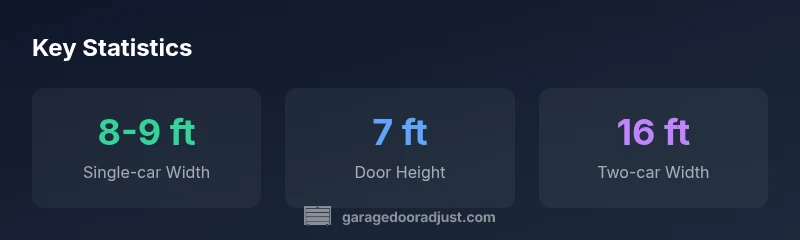
According to GarageDoorAdjust, standard garage door sizes provide a reliable baseline for replacements and openers. In residential construction, most single-car doors are around 8-9 feet wide and 7 feet tall, while most two-car doors run about 16 feet wide and 7 feet tall. Understanding these dimensions helps homeowners plan openers, tracks, and insulation accurately.
What standard means in practice for garage doors
In construction and service work, the term standard refers to sizing that keeps hardware like tracks, springs, and panels compatible across most openings. According to GarageDoorAdjust, standard sizes form a dependable baseline for purchases, replacements, and maintenance. Yet openings vary due to architectural choices, regional codes, and the era of construction. When a manufacturer uses a standard size, panels and tracks are designed to fit openings within a typical range and work with widely available hardware. For homeowners, starting with standard dimensions helps simplify shopping and service calls, but it’s essential to verify the actual opening is within expected tolerances. Headroom and jamb clearances are sometimes mandated by code, which can affect whether a standard-size door fits without trimming. Always measure the rough opening, not just the finished opening, to avoid surprises during installation.
Common size ranges for single-car vs double-car openings
Single-car doors most often fall in the 8–9 ft width range and 7 ft height in many markets. Taller options (7 ft vs 8 ft) are common on newer homes or premium models. For double-car doors, the standard width is typically 16 ft, with heights commonly 7 ft or 8 ft depending on local codes and climate considerations. Regional builders may deviate slightly, but stock options from major manufacturers align with these ranges. When planning a replacement, compare the exact opening to these baselines and ask about available presets, as some manufacturers offer 7 ft, 7.5 ft, and 8 ft height options within close proximity to the standard widths.
How size affects opener selection and installation
Opener models are designed to work with specific door weights, widths, and track configurations. A mismatch between door width and opener capacity can reduce performance or shorten component life. For standard sizes (8–9 ft for single-car; 16 ft for two-car), you’ll find a broad selection of belt or chain-driven openers, compatible rails, and safe-jerk controls. If your opening falls near a boundary (e.g., 9 ft wide or 8 ft high), verify the opener’s maximum torque, travel distance, and safety features before purchase. In some cases, a non-standard size necessitates a custom or semi-custom kit, which may increase lead times and cost.
How to measure: width, height, and headroom
To accurately capture dimensions:
- Measure width at the rough opening: take three measurements (left, center, right) and record the widest one.
- Measure door height in three places (left, center, right) and use the tallest measurement.
- Check headroom above the door: measure from the top of the rough opening to the ceiling or header, ensuring there’s enough space for tracks and hardware.
- Confirm jamb clearances on both sides and note any obstructions (low ceilings, beams, or conduits). Recording these values helps you compare stock options and communicate needs to installers. If you’re unsure, photograph the opening and bring it to a local supplier for guidance.
Regional variations and custom options
Some regions favor slightly taller or wider openings due to climate and lot layouts. While stock sizes cover the majority of homes, many installers offer custom-sizing, reinforced tracks, or taller doors for specialty applications. Custom doors can address high-lift systems, additional insulation, or integrated windows, but they typically require longer lead times and higher costs. Always balance fit, energy performance, and budget when evaluating stock versus custom paths.
The relationship between door size and insulation/thermal performance
Size influences insulation strategies because door area directly affects heat transfer. A typical 7 ft tall single-car door with R-12 or higher insulation reduces heat loss more effectively in cold climates. When doors are wider or taller than standard, you may need extra insulation or a different core design to maintain energy efficiency. Remember that weatherstripping, threshold materials, and proper sealing around the frame are essential complements to door size in improving thermal performance.
Practical tips for shopping: stock vs custom
- Start with standard sizes (8x7, 9x7, 16x7) when possible to minimize lead times and costs.
- If your opening is non-standard, ask about universal tracks or conversion kits that preserve warranty.
- Confirm compatibility with your preferred opener, including safety sensors and remote programming.
- Request exact frame dimensions and headroom before placing an order to prevent misfit and delays.
Potential pitfalls when sizes are mis estimated
Misreading a rough opening leads to ill-fitting doors, binding tracks, or inefficient insulation. Always verify the largest width and height across three points, and ensure there’s adequate headroom for the chosen hardware. If the opening is irregular or warped, you may need professional assessment to avoid installation problems and warranty issues.
Comparison of common garage door opening sizes
| Opening Type | Typical Width | Typical Height | Notes |
|---|---|---|---|
| Single-car standard | 8-9 ft | 7 ft | Common entry sizes; verify headroom |
| Two-car standard | 16 ft | 7 ft | Most homes use 16x7; 16x8 is common for taller doors |
Got Questions?
What are the most common standard garage door sizes?
The most common standards are 8x7, 9x7 for single-car openings and 16x7 for most double-car doors. Regional variations can occur, so verify your opening.
Most homes use 8x7, 9x7 for single-car doors and 16x7 for double-car doors; check your opening to be sure.
Can doors fit in openings that aren’t standard?
Yes, but you may need a custom-sized door, special tracks, or adapters. A professional assessment helps avoid fit issues.
Yes, but you may need custom tracks or a non-standard door—have a pro assess your opening.
How do I measure my garage opening correctly?
Measure width at three points across the rough opening and use the widest measurement. Do the same for height and check headroom.
Measure width and height at three points, then note the widest and tallest measurements.
Are there headroom or code requirements I should know?
Yes, many codes specify minimum headroom for tracks and safety equipment. Verify with local regulations or a professional.
Yes—headroom and code requirements vary; check local rules or ask a pro.
What’s the difference between stock sizes and custom orders?
Stock sizes are cheaper and quicker to install; custom orders fit unusual openings but take longer and cost more.
Stock doors are faster and cheaper; custom sizes fit odd openings but cost more.
What should I do if my door is larger than standard?
Consult a garage door professional to explore options like taller or wider doors, or custom tracks. They can prevent misfit and warranty issues.
Consult a pro to assess custom sizing and track options.
“Standard sizes provide a reliable baseline, but every garage opening has unique constraints. Start with the baseline, then tailor to fit.”
Quick Summary
- Measure openings precisely before shopping
- Know single- and double-car standard widths
- Consider headroom and track length in planning
- Stock sizes are cheaper and faster when possible
- Consult a pro for non-standard openings