Double Doors vs Garage Door: An Objective Comparison for Homeowners
Explore the trade-offs of using double doors instead of a traditional garage door, focusing on installation, security, insulation, and cost considerations for homeowners.


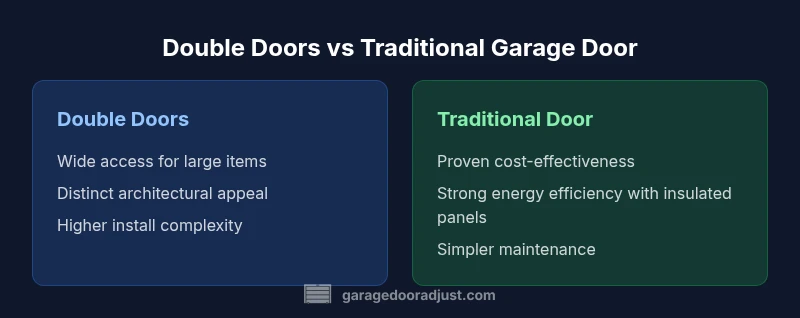
Both options offer distinct trade-offs: double doors can enhance accessibility and curb appeal but require robust framing and possibly higher installation complexity. For most homeowners, a traditional sectional garage door remains simpler and more cost-effective, while double doors may suit historic homes or frequent wide-item access. The choice depends on structural readiness, security priorities, and budget.
Why homeowners consider double doors as an alternative
According to GarageDoorAdjust, homeowners increasingly explore the possibility of using double doors instead of a traditional garage door for reasons that range from architectural harmony to practical access needs. When a driveway is very wide, or when a home’s facade features a period-appropriate look, double doors can provide a distinctive curb appeal that matches the house style. Yet this approach also raises questions about framing, header support, and door hardware. In this section, we outline the scenarios where double doors might be a compelling fit and the trade-offs to anticipate before committing to a conversion. The decision should balance aesthetics with structural feasibility and long-term maintenance expectations. For many households, the traditional sectional door remains the default due to its proven performance and installation simplicity, but a carefully planned installation can deliver amazing results in the right context.
Structural and design implications
Converting to double doors is not just a cosmetic choice; it changes the framing, header design, and opening geometry. You’ll typically need a wider rough opening and a reinforced header to handle the split door panels and their hinge lines. The tracks must be precisely aligned to avoid binding and to ensure even load distribution when the doors travel on their weather seals. Architects and builders often rework masonry or framing to create a continuous lintel over the opening, minimizing potential sag over decades of use. Additionally, the exterior appearance will shift from a single, uninterrupted panel to two distinct leaves, which may require weatherstripping tweaks and custom trim to maintain a seamless look when the doors are closed. The net effect is a more complex installation that can pay off in aesthetics and entry width in some homes.
Security and accessibility considerations
Security planning for double doors differs from a standard panel. With two leaves, you gain a broader opening, which is advantageous for large items but can introduce new pin tumbler or latch vulnerabilities if the leaves are not properly locked in both positions. You’ll want robust locking hardware that engages both doors simultaneously and weatherstripping that resists attempts to pry the leaves. Accessibility is a major benefit if the opening width supports easy passage of vehicles, equipment, or bulky materials. However, dual leaves may require more careful alignment and potential reinforcement of hinge mechanisms to prevent sag and misalignment, which can undermine security over time if neglected. Regular inspection and a well-designed weather seal are essential for maintaining long-term performance.
Insulation and energy efficiency
Double doors can create more surface area for air leakage if not properly sealed. That means you’ll want high-quality weatherstripping along the meeting rails and between leaves, plus a well-insulated door construction. Depending on climate, it may be possible to use insulated panels or add thermal breaks in the hinge areas to minimize thermal bridging. The overall U-value for a double-door opening will depend on the door materials, seal design, and the precision of alignment during installation. In colder climates, the extra edge exposure of two leaves makes meticulous sealing even more important to reduce drafts and improve energy efficiency. A properly sealed double-door system can perform comparably to a standard insulated door when installed with attention to detail and regular maintenance.
Installation practicality and costs
The installation process for double doors is inherently more complex than a standard garage door. You’ll often need to widen the rough opening, reinforce the header, and fabricate two door leaf assemblies with matching hardware. Labor time tends to be longer, and custom fabrication may be required for alignment, weatherstripping, and cosmetic trim. From a cost perspective, expect higher upfront expenses due to additional materials and skilled labor. Typical ranges for this kind of upgrade vary widely by region, opening size, material choices, and whether you keep the existing foundation and structure or implement a full rebuild. It’s prudent to obtain multiple estimates and ask for a phased plan that minimizes downtime.
Aesthetic and curb appeal factors
The visual impact of double doors is substantial, especially on homes with wide frontage or a historically styled exterior. The two-door configuration can mirror classic barn or carriage-house aesthetics, adding character when paired with matching hardware finishes and decorative trim. Color and material choices matter just as much as hardware: wood doors with authentic weathering, or modern composites with bold metallic accents, can dramatically alter the facade. On the downside, two leaves create more visible seams, which may require more maintenance to keep weather seals tight and the appearance uniform. If you prioritize a strong architectural statement and a sense of openness, double doors can deliver; if you want clean lines and a minimal look, a traditional door may remain preferable.
Functional scenarios and best-use cases
Think about how you actually use your garage space. For frequent wide-item access—furniture, appliances, or vehicles with unusually tall profiles—two leaves can simplify entry and loading. Historic homes with period-appropriate facades may benefit from a double-door system that preserves the architectural language of the street. Conversely, if your driveway is narrow, or if you rely on auto-reverse sensors and remote openers, a traditional sectional door offers predictable performance with streamlined integration into smart-home ecosystems. In mixed-use properties, modular doors with dual panels can be configured to optimize airflow, temperature control, and security while accommodating rare large-item moves. The choice depends on your access patterns, climate, and the surrounding architecture.
Maintenance and durability expectations
With two leaves, you’ll have more hinge points and weatherstrips to monitor. Regular maintenance should include lubrication of hinges and tracks, inspection of weather seals, and alignment checks to prevent leaf sag or rubbing at the door jamb. Damage from wind exposure or impact is more likely to create alignment issues with two leaves than with a single panel, so more frequent inspections may be warranted in harsh climates. Durable hardware with corrosion resistance and proper door gaskets can extend service life. A thoughtful maintenance plan helps preserve performance and curb appeal over time, reducing unexpected repair costs.
Building codes, permits, and HOA considerations
Before moving forward, verify that local building codes and any HOA covenants allow nonstandard openings. Some jurisdictions may require specific structural reinforcements or wind-load ratings for two-leaf systems, especially in areas prone to severe weather. Permitting may be streamlined if the project uses commercially available two-leaf components that meet standard code requirements, but custom finishes or historic-adapted designs could trigger extra scrutiny. Engage a licensed contractor who understands regional code nuances and can coordinate inspections to minimize delays. By planning ahead, you’ll reduce the risk of code-related revisions and ensure a compliant installation that maintains home value.
Decision framework: when to choose double doors
When evaluating this option, start with the architectural fit and the operational needs. If your home already features wide openings, or if you require exceptional access for large items on a frequent basis, double doors can be compelling. If energy efficiency, low maintenance, and predictable warranty coverage are priorities, a traditional sectional door is typically more reliable. Consider a staged approach: pilot two leaves with temporary hardware and assess performance before committing to a full conversion. In most residential scenarios, the decision hinges on structural readiness and long-term maintenance tolerance more than purely cosmetic preferences.
Practical pre-installation checklist
- Assess structural capacity: consult a licensed professional about header reinforcement and rough opening width
- Gather design references: choose hinge and lock hardware compatible with two-leaf operation
- Plan weather sealing early: select weatherstripping that minimizes drafts between leaves
- Budget for contingencies: reserve funds for custom trimming, potential masonry work, and extended labor
- Verify code compliance: confirm wind-load, insulation, and inspection requirements with local authorities
- Prepare for maintenance: schedule periodic hinge lubrication and seal checks
- Prepare a phased timeline: reduce downtime by staggering materials and work tasks
Comparison
| Feature | double doors (paired doors) | traditional sectional garage door |
|---|---|---|
| Installation complexity | Higher due to wider opening, reinforced header, and dual leaf hardware | Lower; standard tracks, panels, and spring system are well-established |
| Security considerations | Requires robust dual-leaf locking and precise alignment to prevent gaps | Strong locking with motorized openers; generally straightforward maintenance |
| Insulation and energy efficiency | Potential for greater thermal bridging; relies on quality weatherstripping and design | Typically optimized with insulated panels and weather seals |
| Aesthetics and curb appeal | Distinctive, period-accurate look; two seams and hardware become focal points | Clean, modern lines; broad, uninterrupted exterior surface |
| Cost range (installation and materials) | $2,000–$6,500 (plus regional differences) for custom framing and dual-leaf hardware | $1,200–$5,000 for standard sectional doors with basic hardware |
| Maintenance requirements | More hinges and seals to inspect; potential sag if not regularly serviced | Fewer moving parts; typically lower ongoing maintenance |
| Durability and lifespan | Durability depends on hinge quality and wind-load design; may require more frequent checks | Proven long-term durability with proper spring and track alignment |
| Best for | Historic homes, wide driveways, or frequent large-item access | Budget-conscious homeowners seeking reliability and easy operation |
Upsides
- Unique curb appeal that complements certain architectural styles
- Excellent wide-access for large items and vehicles
- Potential for custom materials and finishes that match home aesthetics
- Improved entry width can ease loading and unloading tasks
Disadvantages
- Higher upfront cost and longer installation time
- More complex maintenance with dual leaves and hardware
- Potential energy efficiency challenges without careful sealing
- Requires reinforced framing and precise alignment to prevent leaks
Double doors can be viable for specific homes, but traditional garage doors remain the safer, more economical default.
Choose double doors if you prioritize architectural authenticity and frequent wide-item access and are ready for a more involved installation. For most households, a traditional sectional door offers simpler installation, lower total cost, and dependable performance.
Got Questions?
What are the main structural differences between double doors and a traditional garage door?
Double doors require a wider opening, reinforced header, and dual-leaf tracks. Traditional doors use a standard single opening with established framing. The choice affects load distribution and how the opening resists wind and deflection.
Double doors need a wider opening and reinforced framing, while traditional doors use a standard frame. Both require proper alignment for reliable operation.
Are double doors more secure than sectional doors?
Security depends on hardware and installation quality. Dual-leaf locking can be strong when correctly implemented, but improper sealing or misalignment can create vulnerability.
Security hinges on proper locking and sealing; both options can be secure with good hardware and installation.
Can most garages accommodate double doors without major structural changes?
Not always. A wider opening and reinforced header may be needed, which can involve masonry work or adjustments to nearby support structures.
It depends on your current opening and structure; some homes need significant framing work.
Do double doors impact insulation and energy efficiency?
Yes, more edge area can lead to drafts if not sealed well. Use high-quality weatherstripping and insulated leaf panels to minimize energy loss.
Yes, but good weather sealing and insulation help keep energy use reasonable.
What is the typical cost range to convert to double doors?
Costs vary widely by region and materials, but expect higher upfront costs than a standard door due to custom framing and dual-leaf hardware.
Costs vary, but plan for higher upfront expenses due to custom framing and hardware.
Do homeowners associations restrict double-door installations?
Some HOAs have rules about exterior changes; check covenants and obtain approvals before starting work to avoid compliance issues.
Check with your HOA and get approvals before starting.
Quick Summary
- Assess structural readiness before considering double doors
- Weigh curb-appeal against installation complexity and cost
- Prioritize high-quality weather sealing for energy efficiency
- Ensure locking hardware provides solid security for both leaves
- Consult a licensed professional to verify code compliance