French Doors vs Garage Doors: A Homeowner's Guide
Explore whether french doors can replace a garage door. This analytical comparison weighs structure, weatherproofing, energy, security, and costs to help homeowners decide when a renovation makes sense.


For most homes, a traditional overhead garage door remains the practical choice for vehicle access. French doors can work when the garage is repurposed or where daylight and aesthetics are prioritized, but they introduce structural, energy, and security considerations that often outweigh cosmetic benefits. This comparison helps homeowners weigh function versus form for their space, budget, and climate.
What this comparison covers
When homeowners consider french doors instead of garage door, the question isn't simply aesthetics. This comparison examines whether such a substitution can work for a garage opening or for repurposing the space. We look at structural feasibility, weatherproofing, daylight, security, and long-term value. The phrase french doors instead of garage door captures a common renovation scenario: transforming a vehicular entry into a living area or courtyard access. According to GarageDoorAdjust, most garages designed for vehicle storage rely on a vertical lift overhead door with an integrated weather seal. Changing that to French doors requires careful assessment of load-bearing walls, header support, and door hardware compatibility. The GarageDoorAdjust team emphasizes that success hinges on achieving a reliable seal, proper insulation, and secure locking mechanisms. In this article we present a side-by-side analysis, followed by a practical decision framework homeowners can use before committing to a design choice. We aim to help readers balance aesthetics with function, and to foresee potential permit requirements, zoning restrictions, and warranty implications that come with such a transformation.
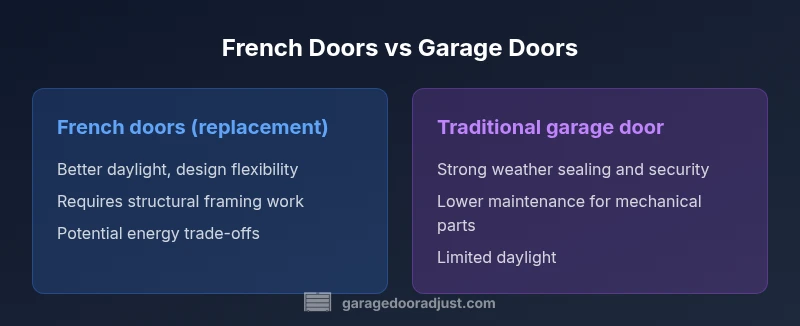
Key differences at a glance
- Primary function: Overhead garage doors prioritize vehicle access and weather sealing; french doors emphasize entry aesthetics and daylight.
- Structural impact: Replacing a garage opening with french doors usually requires new framing, headers, and potentially wall modification; traditional doors rely on standard garage door tracks and torsion systems.
- Insulation and energy: Garage doors often improve energy performance with insulated panels and tight seals; french doors introduce glazing and potential air leaks unless high-performance glass and gasket systems are used.
- Security: Overhead doors use steel sections and heavy hardware; french doors rely on multi-point locks and reinforced frames, but glazing can present a vulnerability if not upgraded.
- Maintenance: Garage doors typically need track cleaning and spring checks; french doors require weather stripping, hinge maintenance, and glass care.
- Aesthetics and daylight: French doors offer more natural light and design flexibility, which can enhance curb appeal in the right architectural style.
- Installation complexity: Converting to french doors is a major renovation that may require permits and specialized carpentry; standard garage door installation is a more established process.
Structural and building-code considerations
Converting a garage opening to french doors necessitates an assessment of framing, header loads, and permitted changes. Load-bearing walls must support the new opening, and the header may need reinforcement to carry roof or second-floor loads. In many regions, permits are required for structural alterations, and inspections may verify that the revised framing meets local codes. From a code perspective, you must ensure that egress requirements, thermal performance, and fire-rated openings (where applicable) are satisfied. The opening’s width and height impact not only the door system but also the building’s overall lateral stability. If the goal is to preserve vehicle access, a hybrid approach—keeping a smaller overhead door for vehicles and installing french doors for daily entry—can sometimes satisfy both code and lifestyle goals. GarageDoorAdjust recommends engaging a licensed contractor to perform a pre-renovation assessment, including a structural engineer if load considerations are significant. This reduces surprises during framing and helps secure approvals early in the project.
Weatherproofing, insulation, and energy implications
French doors introduce glazing into what is typically an envelope-specified opening. Air leaks around sashes, frames, and thresholds can erode comfort and increase heating or cooling loads. To mitigate this, homeowners should prioritize high-performance glazing (low-e coatings, laminated insulating glass), properly sealed frames, and weatherstripping with threshold insulation. For energy-conscious homes, you’ll want to compare U-values and solar heat gain coefficients (SHGC) for the chosen doors. Compared with traditional insulated garage door panels, French doors may require motorized operators to maintain accessibility without compromising seal integrity. The right combination of weather-resistant frames, gaskets, and interior insulation can narrow the energy gap, but it typically won’t match the airtight performance of modern sectional doors under similar climate conditions. The key is to plan for shading, sun control, and seasonal HVAC adjustments when daylight and glass are a central design feature.
Security, safety, and day-to-day usability
Security considerations shift with french doors due to glass and lighter construction relative to steel garage doors. Installing multi-point locking systems, laminated or tempered glass, and reinforced frames can mitigate risks. Additionally, the daily use of french doors in a garage opening requires reliable weather seals and a robust threshold to prevent creeping drafts and water intrusion. For households with children or pets, consider finger-safe hinges and secure door hardware. The practicality of frequent use should also be weighed; overhead doors offer quick one-handed operation and automated openers, which are harder to replicate with dressed glass doors. If security concerns are high, a hybrid arrangement—maintaining a secured, weather-tight secondary entry alongside a traditional vehicle entry—may be the safer, more versatile approach.
Cost, installation timeline, and value proposition
Cost considerations for french doors as a garage-door substitute vary widely. Structural work, custom framing, special glazing, and hardware all influence the final price, and installation can take longer than a standard garage-door replacement. While the aesthetic payoff can be substantial in a renovated living space, the functional trade-offs—reduced vehicle storage, potential energy losses, and higher maintenance—must be weighed. GarageDoorAdjust analysis shows that the value proposition hinges on how the space is used post-renovation and the quality of materials chosen. In many cases, the more practical route is to reserve french doors for rooms adjacent to the garage or to install them as a secondary entry rather than a full replacement. The decision should consider not only upfront costs but also long-term energy, security, and resale implications.
Maintenance, durability, and warranties
Maintenance for french doors centers on keeping hinges, weather seals, and glazing in good condition, along with periodic frame maintenance to prevent warping or settlement. In contrast, traditional garage doors rely on mechanical components—tracks, springs, rollers—and typically require regular inspection and lubrication. Warranty terms are critical here: some renovations remove standard manufacturer warranties for garage components; others may offer combined coverage if the project is treated as a unified system. When planning, confirm warranty transferability and whether installed hardware qualifies for service programs. A well-planned maintenance schedule, including periodic gasket replacement and hinge lubrication, helps preserve door performance and energy efficiency over time.
Decision framework and checklist
Use this framework to decide whether french doors are appropriate for your garage space:
- Is the garage primarily a vehicle space, or is it being repurposed into living or workspace?
- Do you require frequent, quick access with reliable weather sealing?
- Can you accommodate structural changes and permit requirements?
- Will the daylight and aesthetics justify potential energy and security trade-offs?
- Is there a plan for long-term maintenance and potential resale impact? If most answers favor aesthetics and open-space living over vehicle access, a carefully selected french door approach can be compelling. If vehicle use remains central, a conventional door system is typically wiser from a function-first perspective.
Real-world scenarios and design options
In homes where the garage is converted to a home gym, studio, or workshop, french doors can introduce generous daylight and a welcoming entry that blends with the living space. Architects often pair large french door assemblies with proper insulation and shading to maintain comfort. For mixed-use garages, consider a hybrid approach: keep an overhead door for vehicle access and add a French door or set of French doors for human-entry and natural light. Finishes range from wood-stained frames to fiberglass or aluminum-clad options, each with different maintenance needs and warranty periods. Lighting plans should account for glare and privacy if the glass is clear, and security should be addressed through robust hardware and possibly shading screens when not in use.
Next steps and professional guidance
If you’re seriously considering french doors instead of a traditional garage door, start with a detailed site assessment from a licensed contractor. Obtain drawings and a structural assessment to determine if a full replacement is feasible without compromising building integrity. Request multiple quotes that itemize framing, glazing, hardware, permits, and labor. Involve a structural engineer if load changes are substantial. Finally, review energy performance and warranty terms to ensure the renovation aligns with your climate, usage, and budget goals. The right professional guidance will reduce risk and clarify whether this renovation adds value to your home.
Comparison
| Feature | French doors (as replacement) | Traditional garage door |
|---|---|---|
| Primary function | Aesthetic entry with daylight; living-space focus | Vehicle access with weather-tight seal |
| Framing & structural needs | Requires header reinforcement; potential wall modifications | Standard opening with tracks and torsion springs |
| Weatherproofing & insulation | Glazing introduces potential leaks; insulation depends on frame/material | High-insulation panels and tight seals; designed for weather resistance |
| Security & hardware | Multi-point locks possible; glass increases risk if not reinforced | Strong steel construction; integrated locking and modern hardware |
| Maintenance & longevity | Hinge care, seal maintenance, glass care; higher finish upkeep | Track cleaning, spring inspections; generally long-lasting with service |
| Aesthetics & daylight | Bright, inviting entry; design flexibility with glass/transoms | Neutral, functional appearance; limited daylight integration |
| Space requirements | Clearance for door swing/sliding options; may reduce interior space | Driveway and ceiling space must accommodate tracks/door height |
| Installation complexity | Custom carpentry; possible permits; longer lead times | Established process; typical timeline shorter with experienced pros |
| Best for | Renovated living areas, light-filled entries, or spaces prioritizing aesthetics | Vehicle storage or frequent-use garage scenarios |
Upsides
- Enhances natural light and curb appeal
- Creates a welcoming entry when repurposing a garage
- Flexible design options with glass and frame choices
- Can increase usable interior space in a repurposed garage
Disadvantages
- Significant structural changes and higher install costs
- Energy efficiency can be lower unless high-performance glazing is used
- Security risks if not properly reinforced and locked
- Potentially reduced resale value for vehicle storage use
French doors are not typically a direct replacement for most garage doors, but they can be a compelling option in repurposed spaces or design-focused renovations.
For most homes, overhead garage doors remain the practical default. If the goal is daylight and space aesthetics in a repurposed garage, french doors can shine, but expect structural work, higher costs, and careful energy/security planning.
Got Questions?
Can I use french doors as a garage door replacement legally?
Legal allowances vary by jurisdiction and use. In many places, you must still ensure vehicle access and meet building code requirements. It’s essential to consult local authorities and obtain the necessary permits before proceeding.
Local codes vary; check with your building department before replacing a garage door with French doors.
What structural changes are needed?
You’ll likely need new framing and a reinforced header to carry loads. A structural engineer may be required to confirm safe loads and to design appropriate supports.
Expect framing and header work; consult a structural professional.
How does energy efficiency compare?
Garage doors often deliver better energy efficiency with insulated panels. French doors can be energy-savvy if you choose high-performance glazing and proper seals, but it’s generally a trade-off.
Energy can be lower with glass; upgrade glazing for better performance.
Are there security concerns with glass doors?
Yes. Glass increases vulnerability if not reinforced. Use laminated or tempered glass and robust locking hardware, and consider multi-point locks.
Glass adds risk; reinforce with strong hardware and laminated glass.
What about cost and timeline?
Renovations of this type can be expensive and lengthy due to structural work, glazing, and permits. Budget for longer timelines than standard door installs.
Budget higher costs and longer timelines for this renovation.
Quick Summary
- Assess intended use before choosing doors
- Expect structural changes and higher install costs
- Prioritize insulation and seals for energy efficiency
- Plan for maintenance with glass/wood finishes
- Consider a hybrid approach for mixed-use spaces