16 vs 18 Foot Garage Door: A Practical Size Comparison
Analyze the practical differences between 16-foot and 18-foot garage doors. This guide covers width, vehicle fit, costs, installation, and real-world scenarios to help homeowners choose the right size for their garage and budget.


For many homeowners, choosing between a 16-foot and an 18-foot garage door comes down to vehicle size, storage needs, and space for a comfortable opening. The 18-foot option offers extra clearance for larger vehicles and longer equipment but typically costs more and requires a wider opening. In most standard single-car garages, a 16-foot door provides sufficient access while keeping installation simpler and cheaper.
Why the 16-foot vs 18-foot garage door decision matters
Choosing between a 16-foot and an 18-foot garage door isn’t merely about aesthetics. The width of the clear opening directly affects what can easily enter and exit, how you park, and how you store items along the wall and overhead. According to GarageDoorAdjust, the size you select should align with both current and projected needs—especially if you anticipate bringing in larger vehicles or upgrading storage in the coming years. In this guide we examine how the 16 vs 18 foot garage door choice influences daily use, resale value, and long-term maintenance. The keyword "16 vs 18 foot garage door" appears throughout this analysis to keep the topic front and center for homeowners evaluating their options.
Quick factors to compare before you decide
When weighing a 16-foot vs 18-foot garage door, focus on four core criteria: vehicle compatibility, storage and workspace, installation impact, and overall cost of ownership. The 18-foot door typically gives you more headroom and easier backing for wide vehicles or extended gear, while the 16-foot option tends to be cheaper to purchase and easier to retrofit into existing openings. In this section, we’ll unpack these factors with practical benchmarks you can apply to your own garage, ensuring you’re evaluating 16 vs 18 foot garage door options from a homeowner’s perspective.
Comparison
| Feature | 16-foot door | 18-foot door |
|---|---|---|
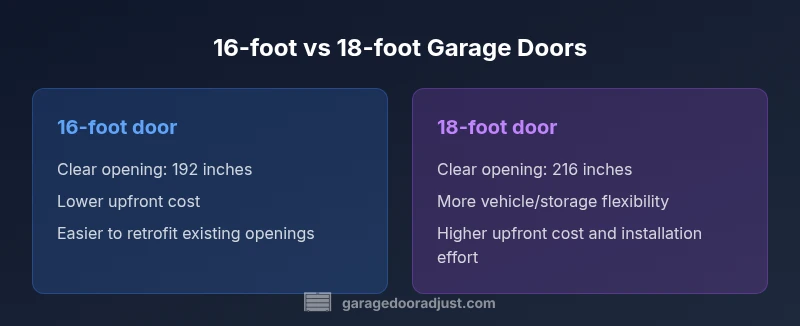
| Width of clear opening | 16 ft (192 in) | 18 ft (216 in) |
| Vehicle fit and storage flexibility | Adequate for most sedans/SUVs; tighter wall storage | Best for larger SUVs, trucks, and extra storage space |
| Upfront cost and value | Lower upfront cost; smaller footprint | Higher upfront cost; more future-proof |
| Installation and framing impact | Easier fit in many existing openings | May require wider opening and stronger framing |
| Opener and hardware considerations | Standard openers usually suffice | May need more powerful opener or longer rails for heavy doors |
| Curb appeal and resale implications | Tends to blend with standard homes | Can boost perceived space and convenience in listings |
Upsides
- 16-foot doors typically cost less upfront and are easier to install in existing spaces
- 18-foot doors maximize vehicle clearance and storage flexibility
- Both sizes are compatible with common openers and standard hardware
Disadvantages
- 18-foot doors require more opening width and structural space, increasing install complexity
- 16-foot doors may limit large vehicle access and long storage options
- Long-term maintenance costs rise with heavier, larger doors if not properly installed
For standard single-car garages, a 16-foot door is often the better value; an 18-foot door is worth it when you regularly accommodate larger vehicles or need extra storage.
Choose 16-foot to save on upfront costs and simplify installation. Opt for 18-foot if you predict needing extra clearance or future-proofing for bigger vehicles.
Got Questions?
What is the typical width difference between 16-foot and 18-foot garage doors?
The 16-foot door provides a 16-foot clear opening (about 192 inches), while the 18-foot door offers an 18-foot opening (about 216 inches). The extra 2 feet can improve vehicle maneuverability and storage access, especially for larger vehicles.
The 18-foot door adds extra width, which can help you maneuver larger vehicles more easily.
Will a larger door require a wider driveway or garage opening?
Yes. An 18-foot door generally needs a wider opening and may require adjustments to the framing and doorway walls to accommodate the larger opening.
Yes. A wider door typically needs a wider opening and may involve wall adjustments.
Is insulation affected by door size, or is it the same across both options?
Insulation depends on the door panel construction and insulation rating, not just width. Both sizes can use insulated panels if you choose, so energy performance is driven by material rather than door width alone.
Insulation depends on the door's panel and insulation; width alone doesn’t determine energy performance.
Does the cost differ significantly between 16-foot and 18-foot doors?
Yes, typically the 18-foot door costs more upfront due to larger materials and more complex installation, but it may offer long-term savings if it reduces the need for future upgrades.
Yes, the 18-foot door usually costs more upfront but may save you money later if it avoids changes for larger vehicles.
Are 16-foot doors compatible with most modern openers?
In most cases, yes. Both sizes are compatible with standard residential openers, but you should verify horsepower and rail length for heavier doors or specialized hardware.
Usually compatible with standard openers; check horsepower and rail length for heavy doors.
Quick Summary
- Assess vehicle width and storage needs before selecting size
- Expect higher upfront cost with 18-foot doors
- Plan for structural implications in wider openings
- Ensure opener and track hardware match the door size
- Consider resale value when sizing for future buyers