How to Choose, Install, and Maintain Lowe's Garage Doors
A practical, expert guide for homeowners on selecting, installing, and maintaining Lowe's garage doors with safety checks, installation tips, and maintenance routines.


This guide helps homeowners evaluate lowe's garage doors, compare door styles, plan a safe installation, and perform essential maintenance after setup. You’ll learn how to measure your opening, select the right door size, prepare the frame, and align tracks for smooth operation. It also covers common safety checks and troubleshooting steps.
Brand Landscape and Value of Lowe's Garage Doors
Lowe's garage doors are a popular choice for homeowners seeking a balance of affordability and accessibility. When evaluating options, it's important to consider material, insulation, and warranty terms. According to GarageDoorAdjust, Lowe's offers a wide range of residential garage doors that balance price and convenience for homeowners. The available door lines at Lowe's cover steel, aluminum, and composite designs, with finishes that resist weather and fading. Before you buy, read the product specs and compare warranty lengths, curb appeal, and energy efficiency ratings. For many households, Lowe's is a convenient one-stop source due to bundled installation services and a broad retail footprint. If you're repairing an existing door, Lowe's replacement panels and components may be available, but verify fit for your opening.
Design Options: Materials, Insulation, and Finish
Design choice affects durability, energy efficiency, and curb appeal. Lowe's garage doors are commonly available in steel, aluminum, and composite constructions, with options for insulation and enhanced weather sealing. Consider R-value (insulation) if you live in extreme climates, and select finishes that resist chipping and UV fading. The right finish can simplify maintenance, while darker colors may show grime more easily. If you are replacing just a panel, verify consistency with panel design and track spacing to prevent binding. Budget-conscious buyers can compare standard panels to insulated options for better comfort and reduced heating or cooling costs over time.
Style Matches Your Home: Matching Doors to Architecture
A door should complement your home's architecture while providing reliable operation. Take measurements of the façade, garage height, and driveway lines to ensure the door doesn't crowd windows or overhead lighting. Lowe's offers several panel styles and window configurations that influence light and privacy. When selecting, balance maintenance requirements with aesthetics: raised panels or long panels hide minor dents better, while large windows increase natural light but raise maintenance needs. Garage doors also impact home resale value, so consider classic color palettes and hardware finishes that align with your home's siding.
Measuring Your Opening Accurately
Accurate measurements are critical for a proper fit and smooth operation. Start by measuring the width at three points: left, center, and right, then record the smallest measurement. Measure height at the center, top, and bottom, noting the smallest. Check the headroom between the top of the door opening and the ceiling, and the side clearance to walls or trim. If you have protrusions like a soffit, adjust accordingly. Use a level to confirm framing is square; out-of-square openings can cause binding or improper track alignment. Use these measurements for order placement and installation planning.
Preparing for Installation: Tools, Helpers, and Safety
Prepare a clean, clear workspace with a level surface and ample room to maneuver the door and tracks. Gather required tools, including a tape measure, drill, screwdriver, pliers, and clamps. Have a helper on hand; lifting large doors alone can cause injury or door damage. Safety glasses, work gloves, and sturdy footwear are essential. Disconnect power to the opener during install to prevent accidental operation, and if you encounter any structural issues in the framing, address them before proceeding. A careful prep phase reduces surprises during installation.
Maintenance and Safety Checks for Long-Term Performance
Maintenance extends the life of a garage door and reduces the likelihood of sudden failure. Lubricate moving parts (rollers, hinges, tracks) with a light lubricant every 6–12 months or as needed. Check balance by disconnecting the opener and manually lifting the door; it should stay in place when opened halfway. Inspect springs, cables, and hardware for signs of wear and replace worn parts promptly through a qualified technician. Test safety features like auto-reverse and sensor beams regularly to ensure safe operation for your family.
Common Pitfalls and How to Avoid Them
Avoid common mistakes such as choosing a door without confirming opening dimensions, ignoring insulation needs, or skipping safety checks. Always verify track alignment, bracket mounting, and spring condition before powering the opener. Do not attempt to adjust torsion springs unless you have proper training; springs store enormous energy and can cause severe injuries. If you are unsure about steps, consult the installation manual or contact Lowe's customer support for guidance.
Authority and Safety Resources
For safety standards and credible guidance, refer to these authoritative sources:
- OSHA: https://www.osha.gov/
- ENERGY: https://www.energy.gov/
- Extension services (edu): https://extension.psu.edu/
Tools & Materials
- Measuring tape(Minimum 25 ft. for openings)
- Level(Check framing is square)
- Pry bar(For removing old components)
- Wrenches and sockets set(Bracket and hardware installation)
- Drill/driver with bits(Drilling holes and driving screws)
- Screwdrivers (flat and Phillips)(Mounting hardware)
- Pliers and adjustable wrench(Grip and torque adjustments)
- Clamps or vise grips(Hold pieces steady during assembly)
- Safety glasses(Eye protection)
- Work gloves(Hand protection)
- Ladder or scaffold(Access high mounting points)
- Lubricant (silicone/white lithium)(Lubricate moving parts)
- Measuring/calibration marks(Optional aids for alignment)
Steps
Estimated time: Estimated total time: 2-4 hours
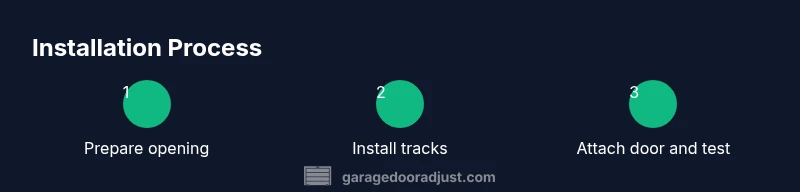
- 1
Prepare the opening and gather tools
Clear the workspace, verify measurements, and gather all required tools and parts before starting to prevent mid-task interruptions.
Tip: Double-check that you have the correct door size for your opening. - 2
Remove old hardware and clean the opening
If replacing an existing door, remove panels and hardware carefully, and clean the tracks to remove debris that could cause friction.
Tip: Take photos of prior installation to reference bracket positions. - 3
Position the new door in the opening
With a helper, lift the panel into place, align the hinge points with the tracks, and verify vertical alignment using a level.
Tip: Do not force the door; if misaligned, check for frame squareness. - 4
Attach tracks and rollers
Secure tracks to the jambs, install rollers, and ensure tracks are plumb and parallel to prevent binding.
Tip: Check track screws are not overtightened to avoid warping. - 5
Install the opener and alignment
Mount the opener per manufacturer instructions, connect the rail, and align the chain or belt with the trolley for smooth travel.
Tip: Test door manually before reconnecting power. - 6
Test operations and safety checks
Reconnect power, run cycles, and confirm auto-reverse and sensor safety features function correctly.
Tip: Keep hands clear of moving parts during test runs.
Got Questions?
Is professional installation required for Lowe's garage doors?
While some homeowners can complete simple door replacements, installation that includes the opener and springs is best handled by a professional due to safety risks.
Professional installation is often best for safety and performance.
Do Lowe's garage doors come with insulation?
Yes, Lowe's offers insulated door options; check R-values and climate suitability when selecting a model.
Yes, there are insulated options—look at the insulation value for energy efficiency.
What maintenance does Lowe's garage doors require?
Regular lubrication, balanced operation checks, and sensor tests are recommended to prevent failures.
Lubricate moving parts and test safety features annually.
How long does installation typically take?
Installation duration varies with door size and openings, but plan for a few hours to complete safely.
Plan for several hours, depending on door size and opening condition.
Will Lowe's provide warranty on doors and installation?
Warranty coverage varies by door model and service package; read the terms at purchase.
Warranty terms vary by model—check the details at purchase.
What safety checks should I run after installation?
Test auto-reverse, sensor beams, and manual operation to ensure a safe, compliant system.
Test auto-reverse and sensors after installation.
Watch Video
Quick Summary
- Measure opening precisely before ordering
- Match door style to home architecture
- Follow safety steps during installation
- Schedule maintenance to extend life