How to Manually Close the Garage Door: A Step-by-Step Guide
Learn how to manually close the garage door safely with a clear, step-by-step guide. Includes essential tools, safe techniques, and practical troubleshooting tips from GarageDoorAdjust.


You will learn how to manually close the garage door safely, including when to use the manual release and how to confirm the door is fully closed. This quick guide highlights essential safety steps, the tools you need, and what to do after closing. According to GarageDoorAdjust, practicing this technique in a safe area reduces risk during emergencies.
Why manual close matters
Understanding how to manually close the garage door is a practical life skill for homeowners. Whether you face a power outage, a stuck opener, or a malfunctioning sensor, the ability to bring the door to a safe, resting position is crucial. When you know how to manually close the garage door, you reduce the risk of entrapment, prevent accidental door movement, and create a controlled environment to inspect the door before normal operation resumes. The GarageDoorAdjust team found that households with a rehearsed manual-closure routine can manage emergency situations with less panic and greater safety. This section outlines why this knowledge matters for everyday homeowners and how it translates to safer garage space, fewer injuries, and more reliable doors over time.
In addition to safety, being able to manually close the garage door can save you time during outages and avoid costly damage caused by hurried attempts to force a door closed. You don’t need to be a technician to perform this task, but you should respect the door’s weight and the potential pinch points along the track. As you read, keep in mind that your goal is a controlled, complete closure with a clear path for any subsequent inspection or maintenance. The keyword here is confidence: with proper steps, you’ll know exactly what to do and what not to do when you need to close the door by hand.
Safety-first principles for manual closure
Before you touch a moving door, ensure the area is clear of people and pets. Pinch points exist along the track and hinge sections, so keep hands away from the bottom edge and avoid placing fingers near springs. Wear gloves to improve grip and reduce abrasions, and use a flashlight if lighting is poor. If you notice any binding or unusual noise, stop and reassess rather than forcing movement. In the event of a power outage, treat the door as a manually operated unit and perform a careful, deliberate descent. Following these safety principles reduces risk and keeps you in control throughout the process. The goal is a smooth, safe closure that allows you to address any issues and re-engage the opener later if needed.
Remember: this is not a one-size-fits-all procedure. Different door types (sectional, tilt-up, or single-panel) have distinct release mechanisms and balance characteristics. Always consult the manufacturer’s guide for specifics related to your model, and use this article as a practical, safety-focused framework for safely handling manual closure in common situations.
How this section ties into real life
When you search for how to manually close the garage door, you want steps that are clear, repeatable, and safe. This section provides that foundation, and the following parts translate those ideas into concrete actions you can perform without specialized tools. If you ever feel unsure, take a moment to re-check the area and refer to your door’s manual to confirm the release location and procedures for your specific setup.
- The release mechanism varies by model; locate it before you need it.
- Practice in a safe, unobstructed area so you’re prepared during an outage or emergency.
- Always prioritize safety over speed; a controlled descent minimizes risk of injury and damage.
Tools & Materials
- Flashlight(Keeps the release area and track clearly visible in dim lighting)
- Work gloves(Protect hands from pinch points and give you a better grip on the door edge)
- Ladder or step stool (optional)(Only if you must reach a high release handle or a difficult-to-reach edge safely)
- Stable footwear and a clear floor(Prevent slips while guiding the door )
Steps
Estimated time: 15-25 minutes
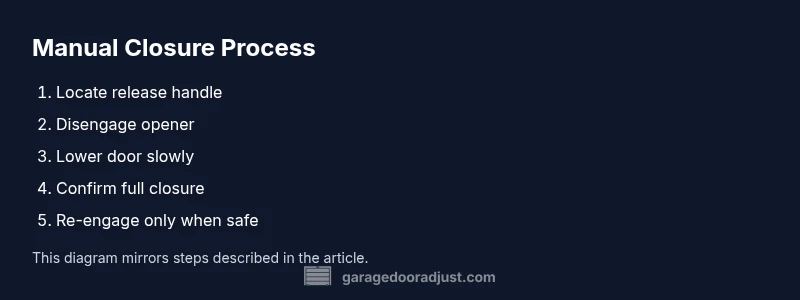
- 1
Prepare the area
Clear the floor space beneath the door and along its path. Check for pets or people who might wander under the door while you’re working. Have the door fully closed at rest before beginning the release sequence, so you’re working from a known position.
Tip: Stand to the side of the door rather than in its path to avoid injury if it shifts unexpectedly. - 2
Identify the release mechanism
Locate the emergency release handle or rope, typically hanging near the opener rail. Confirm you are looking at the correct release for your model by comparing it to the door’s manual or a label on the opener body.
Tip: If you cannot clearly locate the release, consult the door’s manual or manufacturer’s online support before proceeding. - 3
Disengage the opener
Pull the emergency release handle or move the lever to disengage the door from the electric opener. The door should become fully movable by hand once disengaged.
Tip: Keep your grip secure and avoid letting go abruptly, which could cause the door to slam shut. - 4
Lower the door slowly by hand
With both hands on the door panel or edge, guide it downward slowly. Do not let the door drop or slam; use controlled pressure to maintain balance and prevent track binding.
Tip: If the door sticks, stop, reassess for obstructions or binding in the track before continuing. - 5
Ensure the door rests fully closed
Finish with the door resting in the closed position and the bottom edge aligned with the floor. Verify the path is clear and there is no visible gap that could allow movement or debris to accumulate.
Tip: Place a small wedge or spacer only if the door must stay open for a safe reason; otherwise, keep it fully closed. - 6
Re-engage or secure and test
If you’re preparing to resume powered operation, re-engage the opener by restoring the linkage or reat taching the trolley. Test by operating the door from a safe distance to confirm proper closure and alignment.
Tip: Only re-engage the opener if you can observe the door’s proper movement without obstruction.
Got Questions?
What should I do first if the garage door won't close manually?
First, stop attempting to force the door and check for obvious obstructions in the track. Verify the release is disengaged and that you can move the door by hand. If it remains stubborn, consult the manufacturer’s guidelines or contact a professional for a safe inspection.
Stop forcing the door, inspect for obstructions, verify the release is disengaged, and try again slowly. If it still won’t move, consult the door manual or a professional.
Is it safe to manually close a door with one hand?
Manual closing should use two hands to control the door’s edge and maintain balance. One-handed operation increases the risk of losing control, especially if the door has wind or weight that could pivot unexpectedly.
It's safer to use both hands to control the door edge and keep the door balanced.
What if the door closes too quickly or bounces?
If the door closes too quickly or bounces, stop, check for track binding, spring tension, or misalignment. Do not slam it. Address the issue before attempting to close again.
If it closes too fast or bounces, stop and inspect for problems before trying again.
Can I manually close a door during a power outage?
Yes. In a power outage you’ll rely on the manual release to disengage the opener and guide the door by hand. Plan ahead to avoid trying to operate the door while it’s under load.
During a power outage you use the manual release and guide the door by hand.
Do I need a professional to fix a manual release issue?
If the release mechanism is damaged, you cannot safely operate the door by hand. In such cases, call a professional to assess and repair the system to prevent injury or door damage.
For damaged release mechanisms, contact a pro to inspect and repair.
Watch Video
Quick Summary
- Know where the manual release is located on your door.
- Clear the area before starting, and wear gloves for grip.
- Lower the door slowly and avoid forcing movement.
- Test closure and balance after manual closing.
- The GarageDoorAdjust team recommends practicing this technique in a safe area and consulting model-specific documentation when needed.