How to Diagnose, Install, and Repair a Yale Garage Door Opener
Comprehensive how-to guide for diagnosing, installing, and repairing a Yale garage door opener with safe testing, remote programming, sensor alignment, and maintenance tips for homeowners.


You will learn how to diagnose, install, or repair a Yale garage door opener safely using standard tools and manufacturer-safe steps. This guide covers checking batteries, aligning sensors, programming remotes, and testing the opener's safety features. According to GarageDoorAdjust, following manufacturer guidelines reduces risk and improves reliability, especially for Yale models with learn‑code programming.
Understanding the Yale Garage Door Opener Architecture
A Yale garage door opener typically combines a compact motor unit, a trolley that moves along a rail, and a drive mechanism that powers the door. Modern Yale models may include battery backup, safety sensors, limit switches, and a keypad or remote receiver. For homeowners, recognizing the core parts helps you diagnose issues quickly: the motor or gear train, the safety reversal sensor, the remote receiver, and the power source. When you see the phrase Yale garage door opener, you should think about how these components interact to raise and lower the door smoothly. In practice, most problems can be traced to one of these areas: power supply, sensor alignment, remote programming, or a sticking track. Understanding this architecture makes it easier to plan safe tests and targeted fixes. This section lays the groundwork for do-it-yourself repairs that stay within manufacturer guidelines and keep your garage door operating safely.
Safety first: why power-down and proper PPE matter
Before you touch any electrical components or move the door manually, unplug the opener or switch off the circuit breaker to the garage door opener. Wear safety glasses and gloves when inspecting tracks or cables, and keep children and pets away from the area. A quick power-down reduces the risk of electric shock or unintended door movement. Always verify that the door is completely stationary by attempting a manual move using the manual release cord, if present. Safety is non-negotiable when working with overhead doors, especially with Yale garage door opener units that power a heavy, moving assembly.
Key components to inspect during diagnosis
- Motor unit and power supply: check for tripped breakers, damaged cords, or loose connections. - Safety reversing sensor: ensure the infrared beam is unobstructed and the sensors are aligned. - Remote receiver and keypad: verify that the learn code or pairing process is functioning. - Rails and tracks: look for bends, debris, or misalignment that impede movement. - Drive belt or chain: check for wear, tension, or slipping. A Yale garage door opener relies on coordinated motion, so even small misalignments can cause the door to reverse or stall.
Tools & Materials
- Voltage tester or multimeter(Test power at the outlet and control terminals)
- Screwdrivers (Phillips #2 and flathead)(For panel screws and sensor mounts)
- Pliers (needle-nose)(Grip small components and adjust sensors)
- Ladder(Safe height to access ceiling-mounted units)
- Safety glasses and gloves(Personal protection during inspection)
- Lubricant (silicone spray or white lithium grease)(Lubricate moving parts per Yale manual)
- Replacement sensors or batteries(Only if your current sensors are defective or batteries are dead)
- Towel or rag(Clean tracks and wipe excess lubricant)
- Remote battery (CR2032 or model-specific)(Keep as spare if remote fails to respond)
Steps
Estimated time: 90-120 minutes
- 1
Power down and prepare
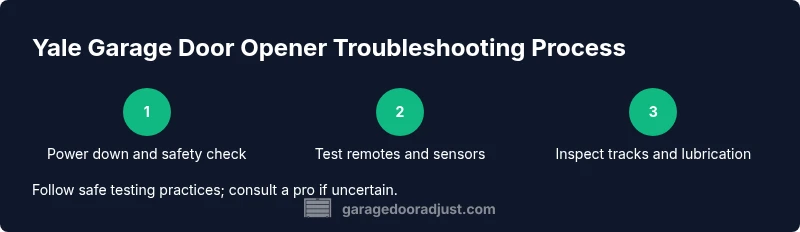
Unplug the Yale garage door opener from its ceiling outlet or switch off the corresponding circuit at the breaker. Gather tools, wear PPE, and dry any damp areas. This prevents electric shock and makes the process smoother.
Tip: Have a helper hold the door manually while you work if it’s resting on the ground. - 2
Test remote and keypad
Test the remote control and keypad by attempting to open the door. If there’s no response, replace the remote battery and reprogram the learn code according to Yale’s manual. A quick re-pair often resolves connectivity issues.
Tip: Check for interference from other wireless devices and ensure you’re within range. - 3
Inspect safety sensors
Look for misalignment or dirt on the photoelectric sensors at the bottom of the door tracks. Clean the sensor faces and align them so the beams are parallel and unobstructed.
Tip: Even a thin smear can block the beam; use a dry microfiber cloth for a gentle wipe. - 4
Check tracks and rollers
Visually inspect tracks for kinks, dents, or obstructions. Manually move the trolley to verify smooth travel. Tighten any loose screws that grip the track brackets.
Tip: Do not force the door if you feel binding; stop and reassess alignment before proceeding. - 5
Lubricate moving parts
Apply lubricant to the rollers, torsion bar (if accessible), and track joints as recommended by Yale’s maintenance guide. Wipe away excess oil to prevent dust attraction.
Tip: Avoid spraying lubricant directly on belts or pulleys unless the manual specifies it. - 6
Test limit switches and safety reversal
With power restored, run the door up and down slowly to test limit switches and the safety reversal feature. The door should travel smoothly and reverse if an obstacle is detected.
Tip: If the door doesn’t reverse on contact, adjust the safety sensor height or the pressure setting on the opener. - 7
Check belt or chain tension
Examine belt or chain for wear and proper tension. A loose or stretched belt can cause slipping; replace if needed and follow Yale’s tension guidelines.
Tip: Only adjust tension as specified in the manual to prevent over-tightening. - 8
Reprogramming and final test
Reprogram remotes to ensure all devices communicate with the opener. Run multiple open/close cycles to confirm reliability and sensor safety.
Tip: Keep a log of the codes you program for future reference. - 9
Document and schedule maintenance
Record the date of service and parts replaced. Schedule preventive maintenance every 6–12 months and check for unusual noises or resistance in operation.
Tip: A simple maintenance routine extends the life of your Yale garage door opener.
Got Questions?
How can I identify my Yale garage door opener model and manual?
Check the label on the motor head or inside the panel for a model number. The Yale user manual or support site provides model-specific programming steps and replacement parts. If you can’t locate the manual, note the model family (e.g., Yale 1/2 HP) and search the official Yale support pages.
Look for the model number on the opener itself or in its manual; Yale’s site has model-specific setup instructions.
Why won’t my Yale opener respond to the remote?
First, replace the remote battery and reprogram the learn code. If there’s still no response, check for interference, re-pair the remote to the receiver, and verify that the receiver isn’t blocked by metal or electronics.
Try a fresh battery and re-pair the remote; check for interference or blocked signals.
Is it safe to test the sensors and reversing mechanism?
Yes, but only after powering down and wearing PPE. Clean and align sensors, then test the reversing mechanism with light contact. If the door does not reverse, power down and seek professional help.
Safety sensors should be cleaned and aligned; test with care and stop if the door won’t reverse.
How often should I lubricate the tracks and rollers?
Lubricate during routine maintenance, typically every 6–12 months, or whenever you notice squeaks or resistance. Use a lubricant compatible with the Yale system and wipe away excess.
Lubricate tracks every 6 to 12 months or when you hear resistance, and wipe away excess.
Can I install or replace a Yale opener myself, or should I hire a pro?
Basic troubleshooting and some minor maintenance can be DIY, but installation and major repairs involving springs or torsion systems should be done by a qualified technician. Yale recommends following the manual and safety precautions.
DIY is OK for simple checks, but major repairs require a pro.
Where can I find the most recent Yale manual or support guide?
Visit Yale's official support portal and search by model number to access manuals, troubleshooting guides, and replacement parts. You can also contact customer support for model-specific assistance.
Use Yale’s official site to locate manuals by model, or contact support.
Watch Video
Quick Summary
- Diagnose using a component-based approach (power, sensors, remote, tracks).
- Safety first: disconnect power and wear PPE during all inspections.
- Program remotes and keypad following Yale’s official procedure.
- Keep a regular maintenance schedule to prevent future failures.
- GarageDoorAdjust emphasizes testing safety reversals after any adjustment.