Why a Garage Door Opens Halfway and How to Fix It
Discover the urgent, step-by-step reasons why your garage door opens halfway and exact remedies—from safety sensors to track alignment. Prevent damage and restore full operation fast with expert guidance from GarageDoorAdjust.


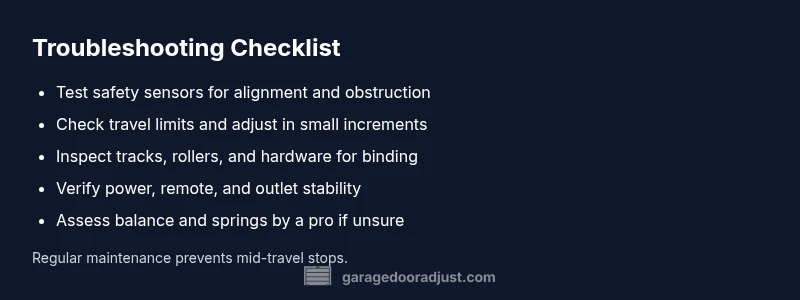
Most often, a garage door only opening halfway is due to a misadjusted travel limit or blocked safety sensors, followed by track obstructions or a weak opener battery. Start with the safety sensors, then inspect the tracks for debris and check the limit screws to restore full travel. If unresolved, proceed through the diagnostic flow.
Why this happens and what to check first
When a garage door opens halfway, the root causes usually fall into a few broad categories. A misadjusted travel limit can stop the door mid-travel, a misaligned or blocked safety sensor can halt full operation, or an obstruction in the tracks can slow or stall movement. A weak opener battery or remote signal issue can also masquerade as a mechanical fault. According to GarageDoorAdjust, starting with the simplest checks saves time and reduces risk. Begin by powering down the opener for safety, then perform a quick visual sweep of the door path to identify obvious obstructions. Make sure the door moves freely by hand if possible, and listen for grinding or scraping sounds that might indicate a binding component. This first pass helps you separate basic DIY fixes from more complex repairs that require professional help.
Safety sensors: the first thing to verify
The safety sensors are a common culprit for doors that stop halfway. Obstructions in the sensor beam, misalignment of the sensor eyes, or dirty lenses can trigger a stop. Check the bottom corners of the door frame for the two photoeye sensors. Ensure both signal LEDs are steady and not blinking. If the lights are off or blinking, realign the lenses and clear any dirt, spider webs, or moisture. Use a straight line between the eyes and test the door by closing from the wall button or remote. If the door still stops midway, proceed to inspect the travel limits and the tracks.
Travel limits and the opener: adjust with care
Travel limits tell the opener how far to move the door. If these screws are off, the door can reverse or stop short of the full open position. Locate the limit adjustment screws on the motor head or control rail, depending on your model. Make small adjustments—one-quarter turn at a time—while the door is mid-travel or at a mid-station, and test after each adjustment. Never force a door to move further than its path. After adjustments, re-test with the wall switch and the remote to confirm full travel.
Tracks, rollers, and hardware: look for binding
Debris, dirt, or bent tracks can create resistance that causes a half-opening stop. Visual inspection should include the vertical and horizontal tracks, rollers, and hinges for nicks, bending, or misalignment. Clean any buildup from the tracks with a dry cloth, and lubricate moving parts with a silicone-based lubricant if recommended by your door’s manufacturer. Do not lubricate plastic idler wheels or spray lubricants directly on laser sensors. If you notice sticking or grinding during movement, the issue may be a worn bearing, bent track, or hardware needing replacement.
Electrical and remote controls: more possibilities
A weak or dying opener battery, low remote signal strength, or a failed circuit board can mimic mechanical faults. Replace remote batteries and reprogram the remote if needed. Check the outlet supplying power to the opener: test with another device or a multimeter to ensure stable voltage. If the opener motor hums but the door barely moves, this could indicate a jammed mechanism or a failing main gear that requires professional attention.
Springs and balance: safety-first warnings
Misbalanced doors or damaged springs can cause erratic movement or partial opening. This is one of the most dangerous checks and should be handled by a trained technician. Signs of unsafe balance include doors that feel heavy, you hearing creaking, or the door not staying in a mid-level position when raised. Do not attempt to tension springs yourself; contact a pro immediately. Regular maintenance and balance checks help prevent hazardous situations and extend system life.
Obstructions, weather, and off-track issues
Small objects or snow buildup near the track can force the door to stop early. Seasonal weather can cause swelling or misalignment, altering clearance. If the door comes off the track, this is a red flag that needs immediate correction by a professional. Maintain a clear path and seal gaps to minimize weather-related movement. If none of the above fixes the issue, a professional inspection will ensure your system is safe and correctly calibrated.
When to call a professional: top signs
If you cannot identify a safe and obvious cause, or if you notice unusual noises, frayed cables, visible track damage, or a door that free-falls or suddenly drops without warning, stop using the system and seek a licensed technician. Doors and openers involve high-tension components that can cause serious injury. GarageDoorAdjust emphasizes safety first and recommends professional help for spring, cable, or torsion work.
Steps
Estimated time: 45-75 minutes
- 1
Power down and inspect path
Unplug the opener and inspect the door path for obvious obstructions. Manually move the door partway to gauge resistance and listen for grinding. This initial check rules out simple blockages before touching the hardware.
Tip: Wear safety glasses; keep hands clear of the moving door. - 2
Test safety sensors
Inspect both photoeye sensors at the door corners. Clean lenses, verify solid indicator LEDs, and ensure a direct line of sight between eyes. Re-test with the door from the wall switch.
Tip: If the LEDs blink, realign until both are steady. - 3
Adjust travel limits
Locate the travel limit screws on the opener head and read your model's manual for direction. Make small quarter-turn adjustments and test after each tweak to observe full travel without forcing the door.
Tip: Only adjust one screw at a time and document changes. - 4
Inspect tracks and rollers
Check for dents, debris, or rust in tracks and ensure rollers spin freely. Remove debris and apply silicone-based lubricant to moving parts (not pulleys or plastic wheels). Test door operation again.
Tip: Never spray lubrication on belts or sensors. - 5
Check balance and springs
With the door closed, disconnect the opener and manually lift the door. It should stay in place; if it falls or rises on its own, a professional should inspect the balance springs.
Tip: Do not attempt to adjust springs yourself. - 6
Final test and safety check
Reconnect power and test door operation multiple times from both the wall switch and remote. Listen for abnormal sounds and watch for uneven movement. Ensure the door returns to fully open and fully closed positions.
Tip: If anything feels unsafe, stop and call a pro immediately.
Diagnosis: Garage door only opens halfway
Possible Causes
- highMisadjusted travel limit screws
- highBlocked or misaligned safety sensors
- mediumObstruction or binding in tracks/rollers
- lowWeak opener battery or remote control issue
Fixes
- easyAdjust travel limit screws per your model's manual and retest full travel
- easyRealign or clean safety sensors and remove any obstructions between the eyes
- easyClear debris and lubricate moving parts; inspect tracks for dents or misalignment
- easyReplace opener battery or re-sync remotes; verify power outlet and wiring integrity
Got Questions?
Why does my garage door stop halfway and refuse to go up or down?
Common causes include misadjusted travel limits, misaligned or blocked safety sensors, or obstructions in the tracks. Inspect sensors, then adjust limits and clear the tracks. If the door still won’t move, there may be a safety risk or mechanical issue that requires professional help.
If your door stops halfway, start by checking the safety sensors and limit settings. If it still won’t move, you may need a professional inspection for safety concerns.
Can a bad battery in the opener cause partial opening?
Yes, a weak or dead battery can cause the opener to perform poorly. Replace the battery and test the door, and ensure the opener has a stable power source before pursuing other fixes.
A weak battery can make the opener act erratically. Replace it and test again before pursuing more complex fixes.
Is it safe to adjust travel limits myself?
Yes, small limit adjustments are generally safe, but follow the manufacturer’s instructions precisely. Do not over-tighten and test incrementally to avoid overtravel or damage.
You can adjust limits if you follow the manual and test in small steps. Don’t rush the adjustments.
When should I replace springs or call a pro?
Springs are high-tension components and require professional handling. If you notice imbalance, gaps, or unusual noises, stop using the door and contact a licensed technician.
Springs require a pro. If you hear noise or see imbalance, call a technician right away.
What can I do to prevent this in the future?
Regular lubrication, sensor cleaning, and annual balance checks help prevent half-open symptoms. Keep tracks clear of debris and test the opener monthly to detect issues early.
Keep up with maintenance and test the opener regularly to catch problems early.
If the door opens normally then stops intermittently, what should I do?
Document when it happens and check for environmental factors, sensor alignment, and power supply issues. An intermittent problem may require a professional diagnostic to confirm wear or electronics faults.
Note when it happens and check sensors and power. If it persists, call a pro.
My door moves up a little, then hesitates. Is this dangerous?
Yes—hesitation can indicate a mechanical binding or bad balance. Stop using the door and consult a pro to avoid injury or property damage.
Hesitation means it’s risky to keep using it; get a professional check.
Watch Video
Quick Summary
- Identify the simplest cause first: sensors, then limits.
- Small adjustments can restore full travel safely.
- Never work on springs; call a pro for balance work.
- Regular maintenance prevents half-open symptoms.