What to Do When Your Garage Door Won't Go Down
Urgent, practical guide to diagnose and fix a garage door that won't descend. Step-by-step checks, safety notes, and when to call a professional.


Your garage door failing to descend is most often caused by a safety sensor misalignment, an obstruction in the door path, or a simple setting error. Start with the easiest checks: clear debris from the tracks, verify the photo-eye sensors line up, and test the opener’s force setting. According to GarageDoorAdjust, begin with these basics, then move to more involved fixes only if the door remains stuck.
Quick Troubleshooting Mindset
When your garage door won't descend, the fastest path to a fix is a calm, methodical approach. Start with the simplest explanations first: is there an object under the door, is the track clear, and are the safety sensors aligned? According to GarageDoorAdjust, most descent issues come from sensor alignment, a minor track obstruction, or a setting that’s off by a notch. Power off the opener before you begin any inspection to prevent unexpected movement, and work with a helper if you need to manually move the door a few inches. The goal is to isolate the symptom and apply a safe, repeatable fix rather than trying to overhaul the system in one go.
Safety First: Hazards and Precautions
Garage doors are heavy and spring-loaded; a sudden drop can cause serious injury. Always disengage power before touching moving parts, never lean under the door while it's moving, and keep children and pets away from the workspace. If the door is in the open position, use the manual release only to move it a few inches with help, not to reposition the whole system. Wear sturdy gloves and eye protection when inspecting tracks, rollers, or sensors. If you smell burning wires or hear grinding, stop immediately and unplug the opener. When in doubt, contact a licensed technician rather than attempting risky fixes yourself.
Common Causes When the Door Won't Descend
Several reliable culprits can keep a garage door from descending. Debris or ice in the track can physically block movement. Photo-eye sensors out of alignment or dirty can stop the door as a safety precaution. A misadjusted safety reversal or an overly tight spring can trigger the opener's safety features. Damaged tracks or bent rollers create resistance, causing the opener to stall or reverse. Lastly, a stale or faulty transmitter or wall switch can fail to send the descent command. Understanding these causes helps you prioritize the fixes that matter most.
Diagnostic Flow: From Symptom to Solution
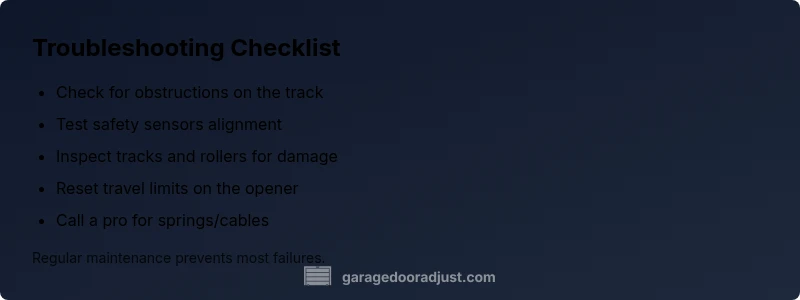
Symptom: the door refuses to descend or reverses mid-cycle. Step 1: ensure power is on at the outlet and the opener is receiving power. Step 2: check for visible obstructions beneath the door and on the track. Step 3: test the safety sensors; if the eyes don't face each other or show error lights, realign or replace. Step 4: inspect tracks for bends; correct small misalignments with careful taps. Step 5: test the limit switch and force settings by resetting travel limits per the owner's manual. If the door still won't descend after these steps, escalate to a professional.
Step-by-Step Fixes for the Top Cause
- Power down and safety: Unplug the opener and cut power to prevent movement while you work. Tip: have a helper ready to hold the door if needed. 2. Clear the doorway and track: Remove debris, ice, or objects from the track and floor. Tip: keep a small flashlight handy to spot dark debris. 3. Realign sensors: Clean the photo-eye lenses and ensure the sensors are facing each other. Tip: use a tape measure to confirm equal distance from sides. 4. Inspect tracks: Look for kinks; loosen screws to straighten. Tip: tighten gradually and check for smooth operation. 5. Reset limits: Use the manual to reset travel limits; test with a full open/close cycle. Tip: run through several cycles to confirm stability. 6. Call a pro if needed: If you hear grinding or the door remains stuck, professional service is required. Tip: capture model numbers for the technician.
Prevention: How to Keep It From Happening Again
Regular maintenance is the best defense. Schedule a yearly inspection of springs, cables, rollers, and hinges by a pro. Keep the tracks clean and free of debris, lubricate moving parts per the manufacturer's recommendations, and replace damaged sensors promptly. Keep the safe-reverse feature enabled and test it monthly. Clear the doorway of any furniture or obstacles, and store remote controls away from children.
Steps
Estimated time: 60-90 minutes
- 1
Power down and safety check
Begin by unplugging the opener or switch off the circuit. Disconnect the door from the opener using the manual release if you must move it; keep hands clear of the door, as it can fall suddenly. Confirm no person or pet is in the path.
Tip: Use a helper to stabilize the door while testing - 2
Clear the doorway and track
Inspect the track for debris, ice, or objects. Remove anything found and wipe the track clean. Lubricate the rollers lightly if they seem dry, but avoid over-lubrication near the sensors.
Tip: Only apply lubricant to metal parts; avoid the belt or sensor areas - 3
Test safety sensors
Re-aim the photo-eye sensors at each other and ensure there is a clear line of sight. Look for misaligned eyes or damaged wiring. Restore power and test the door with the opener.
Tip: Cross-check with a flashlight to ensure no dirt blocks the eye - 4
Check the balance and tracks
Observe the door as it moves; if it binds, stops, or sags, the tracks may be bent or rollers binding. Use a level and gently adjust the track alignment if needed. Do not force a misaligned track.
Tip: Only adjust small amounts; small misalignments matter - 5
Reset the opener and test
Reset the opener's travel limits according to the manufacturer's manual. Reconnect power and run a full open/close cycle to confirm correct travel. Listen for equal motion on both sides.
Tip: If you can't locate the manual, search the model online - 6
Escalate if still stuck
If the door still won’t descend, or you hear grinding or the springs feel stiff, stop and contact a certified technician. Springs, cables, and torsion systems can be dangerous.
Tip: Safety first: don’t attempt spring work yourself
Diagnosis: Door won't descend, stops, or reverses during close
Possible Causes
- highPower issue
- highObstruction or debris in track
- highSafety sensor misalignment
- mediumTrack misalignment or damage
- lowWorn rollers or binding hardware
- mediumFaulty limit switch or force setting
Fixes
- easyCheck outlet and circuit breaker; reset if tripped
- easyRemove obstruction and clean the track and rollers
- easyRealign or clean photo-eye sensors and inspect wiring
- mediumInspect tracks for bends and verify proper alignment with a level
- easyReset travel limits on the opener and re-test
- mediumIf noises persist or springs are involved, call a pro
Got Questions?
Why won't my garage door go down even after resetting the opener?
Resetting the opener can fix minor glitches, but most descent issues involve sensors, obstructions, or track alignment. Follow the diagnostic flow to identify the cause.
Resetting helps with glitches, but sensor and track issues are more common.
Is it safe to manually lower a garage door?
Manual lowering is risky because springs can rapidly snap back. Only use the manual release with appropriate help and never stand in the door's path.
Manual lowering can be dangerous; use the release with caution and help.
What should I check first if the door reverses while closing?
Check the photo-eye sensors for dirt, misalignment, or obstruction. Clear the path and realign the eyes, then test.
Check sensors and path first; clear any obstruction.
When should I call a professional?
If you hear grinding, if springs or cables appear damaged, or if the door still won't descend after steps, contact a licensed garage door technician.
If you hear grinding or see damaged springs, call a pro.
Can weather affect garage door sensors?
Condensation, dirt, or temperature changes can affect sensors and alignment. Clean and realign sensors after bad weather.
Weather can affect sensors; clean and realign after storms.
Watch Video
Quick Summary
- Start with simple checks before complex fixes
- Prioritize safety over speed
- Call a pro for springs or cables
- Maintain annual maintenance to prevent issues