Side Mount vs Top Mount Garage Door Opener: A Comprehensive Comparison
An analytical, in-depth comparison of side mount and top mount garage door openers, covering installation, performance, maintenance, safety, and costs to help homeowners choose the best mounting style for their garage.


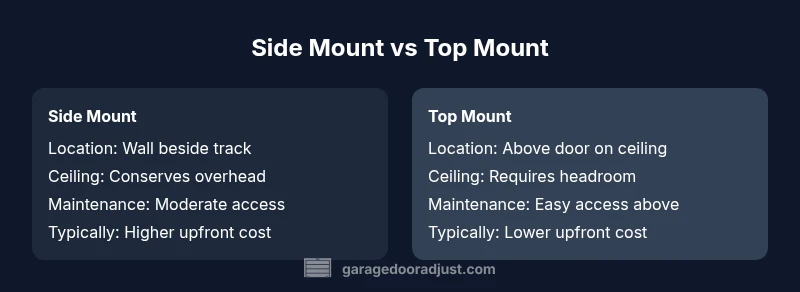
Side mount vs top mount garage door opener choices affect ceiling clearance, access, and maintenance. In general, a side-mount saves overhead space and can simplify installations in tight ceilings, while a top-mount offers easier access for wiring, belt/chain repairs, and maintenance. Your garage height and door type largely drive which is better.
Understanding side mount vs top mount garage door opener
Understanding side mount vs top mount garage door opener is essential for homeowners evaluating space, accessibility, and long-term serviceability. According to GarageDoorAdjust, the choice between side mount and top mount setups is primarily about space, access, and maintenance workflows. The GarageDoorAdjust team found that mounting position affects how much overhead room you have for insulation, lighting, and potential future upgrades, as well as how easy it is to reach belts, tracks, and sensors. In practical terms, the side mount attaches to the wall beside the track, saving ceiling space but sometimes complicating wiring routes. The top mount sits above the door on the ceiling, freeing wall space but demanding more headroom. The decision hinges on ceiling height, door type, and your priorities for serviceability and future upgrades. This guide will unpack these tradeoffs with real-world scenarios and practical checklists.
Performance, reliability, and maintenance implications
The mounting position of a garage door opener influences performance characteristics such as torque, balance, and the way forces are transmitted to the door system. Side-mount models can offer compact profiles that reduce overhead weight distribution and can be advantageous if your ceiling is crowded with lighting or insulation. Top-mount designs tend to place the motor above the door, which can simplify belt and chain maintenance, lubrication, and sensor alignment because components are more accessible from above. However, the exact reliability and noise profile depend heavily on the specific model, alignment quality, and how well the unit is supported by brackets and mounting hardware. The GarageDoorAdjust team emphasizes evaluating mounting rigidity, track alignment, and bracket integrity as part of a proactive maintenance plan.
Installation considerations: ceiling height, braces, and headroom
Choosing between side mount and top mount also turns on installation realities. If your garage has limited ceiling height or a crowded overhead space, a side-mount can be a practical choice because it minimizes the vertical footprint. Conversely, homes with ample headroom and clean above-door space may benefit from a top-mount that allows simpler wiring routes and easier belt replacement. Before selecting, homeowners should assess existing joists, drywall thickness, insulation clearance, and potential interference with lighting fixtures or HVAC ducts. The goal is to ensure a stable mounting surface and adequate space for future service work without compromising door travel or safety sensors.
Compatibility with door types and springs
Not all garage doors are created equal, and compatibility with side-mount or top-mount openers depends on door type and spring configuration. Most standard sectional doors with torsion or extension springs can work with either mounting style, but some setups require structural reinforcement or modified track alignment for side-mount installations. Top-mount options may necessitate a sturdy ceiling anchor system and precise bracketing to avoid friction against door panels. Always check the door’s track geometry, spring type, and door weight rating when planning the upgrade, and consult the manufacturer’s compatibility chart. The right choice balances door design, spring tension, and mounting reliability.
Noise, vibration, and user experience
Operational noise and vibration are influenced by motor type, belt vs chain drive, and how well the unit is mounted, not solely by the mount position. Side-mount installations can sometimes reduce overhanging noise near living spaces by placing the motor on a wall facet away from the door track, but improper bracketing can transfer vibrations to the ceiling or studs. Top-mount units often exhibit different vibration characteristics because the motor sits above the door. In practice, choosing a model with a quiet drive train, anti-vibration brackets, and proper isolation pads will have a bigger impact on user experience than the mount position alone.
Safety, sensors, and long-term reliability
Safety features—such as photoelectric sensors and auto-reverse mechanisms—must be correctly aligned regardless of mounting style. Side-mount configurations may complicate wiring runs to sensors if access is restricted by studs or insulation, increasing the risk of misalignment. Top-mount layouts can provide more straightforward sensor placement and easier manual-reverse testing, but only if the ceiling mounting points are solid and free from flex. Regular inspection of cables, limit switches, and the track hardware is essential for both configurations, especially in households with pets or children.
Cost, value, and return on investment
Cost considerations for side mount vs top mount garage door openers extend beyond the sticker price. Side-mount kits and the necessary wall brackets can carry a modest premium due to their specialized hardware and installation complexity, while top-mount options may incur lower upfront costs on average due to broader compatibility with standard ceiling anchor systems. GarageDoorAdjust analysis shows that long-term value often hinges on ease of maintenance and the likelihood of future upgrades, rather than initial price alone. When budgeting, include installation labor, potential ceiling reinforcement, and the cost of any needed wiring or sensor relocation. The choice should reflect not only current costs but forecasted maintenance needs over the unit’s expected life.
DIY installation vs professional installation: what to weigh
Diy mounting of either configuration is possible for those with strong mechanical skills and a good understanding of door balance and safety protocols, but it carries risk. Side-mount installations may require precise wall reinforcement and careful alignment to avoid lateral play in the track. Top-mount installations often demand secure ceiling anchors and accurate headroom calculations. In many cases, professional installation is worth the investment to ensure safety, warranty coverage, and correct sensor alignment. If a DIY route is chosen, thoroughly review the manufacturer’s installation manual, use the right brackets, and verify door balance and spring tension after mounting.
Quick decision guide: when to choose which mounting style
- Choose side mount if ceiling height is limited and you need to preserve overhead space for insulation or lighting.
- Choose top mount if you value easier access to the motor, belt/chain components, and sensor calibration.
- Consider house layout: wall space for mounting hardware vs. ceiling headroom and track geometry.
- Weigh long-term maintenance and serviceability over upfront cost.
- Consult a professional if you’re unsure about structural reinforcement or spring compatibility.
Common pitfalls and troubleshooting tips
Common mistakes include improper bracketing, misaligned tracks, and sensors placed too close to moving parts. For side-mount installations, ensure the wall brackets are solid and that there’s no interference with joists or wiring. For top-mount setups, avoid over-tightening ceiling anchors which can transmit vibrations. Regularly test auto-reverse and sensor function, and lubricate moving parts per the manufacturer’s recommendations. When problems arise, document noise, misalignment, or slow operation to help a technician diagnose the underlying cause quickly.
Authority sources and further reading
For readers seeking authoritative sources, the following references provide safety standards, installation guidance, and best practices:
- https://www.osha.gov
- https://extension.illinois.edu
- https://www.consumerreports.org
This article integrates guidance from industry safety standards and university-extension resources to help homeowners make informed decisions about side mount vs top mount garage door openers.
Comparison
| Feature | Side mount opener | Top mount opener |
|---|---|---|
| Mounting location | Mounted on wall beside track | Mounted above door on ceiling |
| Ceiling clearance required | Conserves overhead space | Requires more headroom |
| Ease of installation | Often simpler in tight ceilings; wall brackets essential | Often straightforward with above-door mounting; bracket planning crucial |
| Access for maintenance | Moderate wall access; some components reachable from side | Excellent access from above for belt/rail work |
| Noise and vibration | Model-dependent; can reduce overhead noise with proper isolation | Model-dependent; proper ceiling mounting reduces transfer of vibration |
| Compatibility with door types | Works with most standard sectional doors; may need reinforcement | Widely compatible but may require headroom and proper bracketry |
| Price range | Varies; can be higher due to specialized hardware | Typically lower upfront cost but depends on model |
Upsides
- Conserves wall and ceiling space when ceiling height is tight
- Provides easier access to certain maintenance points for top-mount variants
- Offers a clean, low-profile appearance in specific layouts
- May enable simpler wiring routes in walls for side-mount systems
Disadvantages
- Can require structural reinforcement and precise alignment for side-mount
- Top-mount installations need adequate headroom and may be less accessible to side components
- Maintenance and parts availability vary by model and brand
Side mount is best for tight ceilings; top mount excels in serviceability and standard headroom.
If your garage has low headroom or crowded overhead space, a side-mount opener can be the smarter choice. If you prioritize easy service access and compatibility with a range of door configurations, a top-mount option is typically more convenient. The best decision balances space constraints, maintenance needs, and door type.
Got Questions?
What is the main difference between side mount and top mount garage door openers?
The main difference is where the motor and mechanism are mounted: side mount on the wall beside the track, top mount above the door on the ceiling. Each has distinct space, access, and maintenance implications.
The main difference is mounting location and its impact on space and maintenance.
Can I install a side-mount opener on any garage door?
Most standard sectional doors can support either mounting style, but some setups require structural reinforcement or track adjustments. Consult the manufacturer’s compatibility guide before purchasing.
Most doors can work, but check compatibility first.
Are side-mount openers quieter than top-mount ones?
Noise levels depend more on the drive system and installation quality than mounting position alone. A properly installed unit with good isolation can be quiet in either configuration.
Noise mainly depends on the model and setup, not the mount.
Is one mounting style easier to service or repair?
Top-mount units generally offer easier access for belt/rail work and sensor calibration from above. Side-mount units can be modified for access but may require wall clearance and bracket adjustments.
Top-mount often makes maintenance easier, but depends on model.
What installation considerations should I know before choosing?
Check ceiling height, headroom, wall and ceiling structure, and existing electrical and sensor placements. Ensure bracket compatibility and door weight ratings match the opener. When in doubt, consult a professional installer.
Know headroom, structure, and sensor placement before starting.
Quick Summary
- Assess ceiling height and overhead space before selecting mounting style
- Prioritize easy maintenance access when planning for future service
- Verify door-type compatibility and required reinforcement for side-mount options
- Plan for sensors, wiring, and safety features during installation
- Consider professional installation for warranty safety and optimal alignment