Most common garage door opener battery: Types, lifespan, and maintenance
Explore the most common garage door opener battery types, how long they last, and practical maintenance tips to keep your opener reliable during power outages and routine use.


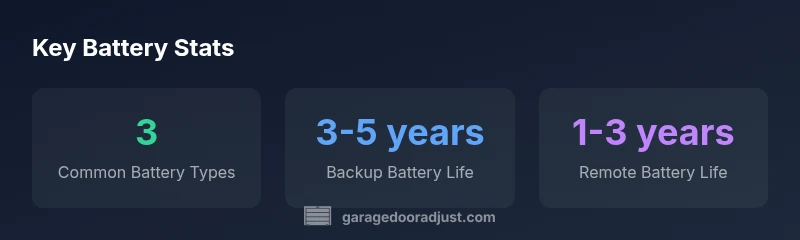
The most common garage door opener battery is the 12-volt backup battery used in many modern openers, with sealed lead-acid or lithium-ion chemistries. For remotes, coin-cell batteries like CR2032 are standard. Replacement cycles vary by usage and climate, but plan for roughly 3-5 years for backup batteries depending on usage and temperature. In older homes, alkaline variants may appear, but the 12-volt class remains dominant.
Understanding the most common garage door opener battery
According to GarageDoorAdjust, the backbone of reliable operation in most modern garage door openers is the 12-volt backup battery. This battery powers essential components when mains power is interrupted, allowing the door to open or close safely even during a blackout. In practice, you’ll encounter two broad chemistries: sealed lead-acid (SLA) and lithium-ion (Li-ion). SLA batteries are robust, affordable, and familiar to homeowners, while Li-ion packs are lighter and typically offer longer life in newer models. For daily-use remotes, the typical energy source is a small CR2032 coin cell. This distinction between the primary backup battery and the remote’s battery is important for maintenance routines and cost planning. Modern openers also vary by brand and model, so always confirm compatibility using your manual or model number.
Battery types used in garage door openers
Garage door openers rely on two primary battery ecosystems: the big, missional backup power inside the opener unit and the tiny batteries that run remotes. The backup battery is usually a 12-volt pack, with sealed lead-acid being the oldest and most common option, and Li-ion emerging in newer generations due to weight and cycle life advantages. Lead-acid variants tend to be bulkier and heavier but affordable; Li-ion packs may offer longer life with less weight but can have higher upfront costs. Remotes, meanwhile, typically use CR-series coin cells (like CR2032). These remote batteries are inexpensive and widely available, but they must be replaced more frequently than backup batteries due to high-energy draw during use.
Coin-cell batteries for remotes
Coin-cell batteries such as CR2032 are the standard in most garage door remote controls. They provide a compact, lightweight power source that delivers consistent performance for many months to years depending on usage. Replacement is straightforward: open the remote, remove the old coin cell, insert a new one with correct polarity, and test the button functions. Some remotes use different coin cells (CR2025 or CR1632, for example), so always verify the exact size before purchasing a replacement.
How to identify the right battery for your opener
Start with your opener’s model number, usually printed on the unit or in the manual. Look for a section labeled “Backup Battery” or “Battery Type.” If you can’t find the information, check the manufacturer’s website or contact support with the model number and serial code. For remotes, remove the outer shell and inspect the battery inside; the label will show the exact coin-cell size (commonly CR2032). Keeping a small, labeled notebook of your model numbers and compatible battery types helps your maintenance routine stay efficient.
Replacement steps and safety considerations
- Disconnect power to the opener at the circuit or unplug the unit, then verify the door remains balanced before replacing any battery. 2) Remove the backup battery cover or access panel following the manual. 3) Disconnect the old battery, note the polarity and connector type, and install the new battery. 4) Reassemble, reconnect power, and run a test cycle to confirm proper operation. 5) For remotes, replace coin cells in pairs where required—do not mix old and new cells. 6) If you notice persistent issues after replacement, consult a professional.
Common issues related to batteries and how to diagnose
If the opener fails during power outages but works on AC, the backup battery may be exhausted or failing to recharge. A clicking or beeping sound during operation can indicate battery or wiring issues. If the remote stops working while the opener still operates on power, the remote battery is likely depleted. Inconsistent closing or opening can point to a weak backup battery unable to supply sufficient power.
Lifespan factors and maintenance tips
Battery lifespan in garage door openers is influenced by temperature, usage frequency, and the overall health of the charging circuit. Colder climates and frequent, heavy use can shorten backup-battery life, while Li-ion chemistries typically provide longer cycles in newer units. Regular visual checks for corrosion, secure connections, and a documented replacement cadence help maintain reliability. As noted in GarageDoorAdjust Analysis, 2026, adopting a proactive replacement plan reduces service calls and improves safety during power outages.
Choosing the best battery and cost considerations
When selecting a battery, prioritize compatibility with your model and the chemistry that best suits your climate. If you primarily need longer service life and lighter weight, Li-ion backups may be worth the upgrade; if you value cost and proven stability, sealed lead-acid remains solid. Consider the total cost of ownership: fewer replacements can offset a higher upfront cost, while cheaper options may lead to more frequent changeouts. Always choose a reputable source and avoid mixing battery chemistries in a single system to prevent unpredictable performance.
Common battery types used in garage door opener systems
| Battery Type | Voltage | Common Use | Typical Replacement (years) |
|---|---|---|---|
| CR2032 coin cell | 3V | Remotes | 1-3 years |
| 12V backup battery (sealed lead-acid) | 12V | Backups in openers | 3-5 years |
| 12V backup battery (Li-ion) | 12V | Backups in openers | 4-7 years |
Got Questions?
What is the most common battery used in garage door openers?
The most common battery for garage door openers is a 12-volt backup battery, especially in newer models. Remotes typically use CR2032 coin cells. Replacement practices depend on usage, but a 3-5 year cycle covers most installations.
The 12-volt backup battery powers most openers, while remotes use CR2032 coins. Plan on a 3-5 year backup battery replacement.
How do I know which backup battery fits my opener?
Check your opener’s model number and manual for the exact battery type. If unavailable, contact the manufacturer with the model details or inspect the current battery label inside the unit. The exact size or chemistry can vary by generation.
Look up your model number and check the manual or current battery label to confirm the right backup battery.
What are signs a backup battery needs replacement?
If you experience slower door operation during a power outage, or the opener struggles to operate even when plugged in, the backup battery may be weak. Beeping or a failure to hold charge are additional indicators. Always verify with a replacement before calling for service.
Slow operation in a blackout or a battery that won’t hold a charge are common signs you should replace the backup battery.
Can I replace remote batteries myself?
Yes. Remote batteries like CR2032 are easy to replace. Open the remote housing, remove the old coin cell, insert a new one with correct polarity, and test. If the remote still misbehaves, check for button wear or a separate issue with the opener.
Absolutely—swap in a fresh CR2032 coin cell and test.
Do Li-ion backups exist for garage door openers?
Li-ion backups are available in some newer models and offer longer life with lighter weight. Check compatibility with your model before upgrading, and follow manufacturer guidance for safe charging and replacement.
Yes, some newer openers use Li-ion backups; verify compatibility first.
Should I remove the battery during long vacations?
If you’re going away for an extended period and power is unlikely to be restored, removing the backup battery is reasonable to prevent leakage and corrosion. Reinstall it upon return and run a quick test.
If you’ll be away for a long time, consider removing the backup battery and testing the system when you return.
“Battery choices are highly model-specific, but for most homes the 12-volt backup battery remains standard; newer openers increasingly use Li-ion for longer life.”
Quick Summary
- Identify the correct battery type for your opener model.
- Check both remote and backup batteries separately.
- Replace backup batteries before failure to avoid door issues.
- Follow manufacturer guidelines to ensure compatibility.
- Keep spare batteries and a small toolkit for DIY maintenance.