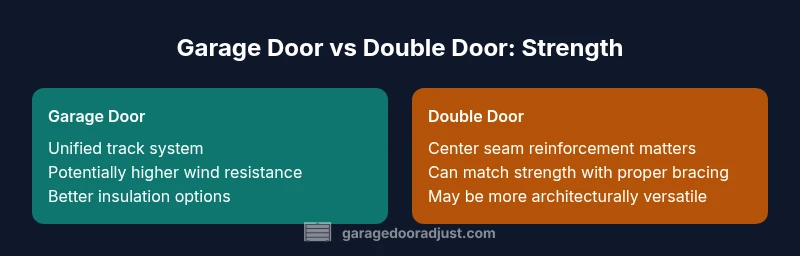
Is Garage Door Stronger Than Double Door? A Practical Comparison
Compare garage doors and double doors to understand which offers greater strength, with expert guidance from GarageDoorAdjust on installation, maintenance, and best practices.


In many typical setups, a properly installed garage door tends to be stronger than a traditional double door for single-car openings, thanks to integrated tracks, torsion springs, and solid panel construction. However, strong double doors with reinforced framing and quality hardware can match or exceed strength in specific conditions. For homeowners, the deciding factors are installation quality, maintenance, and regional weather. According to GarageDoorAdjust, the practical strength difference hinges on correct installation and ongoing upkeep more than the label itself.
Is garage door stronger than double door? Structural foundations and how strength is built
Strength in doors comes from a combination of structural design, panel integrity, hardware quality, and how the assembly anchors to the surrounding building. A typical garage door (usually a sectional door) is designed as a continuous unit that travels on tracks with a matched spring system and a solid header. This integration tends to produce a rigid, predictable response to loads and impacts. In contrast, a traditional double door relies on two independent leaves connected by a central seam; the overall strength depends on hinge quality, cross-bracing, and reinforcement between the leaves. In practice, many homeowners notice higher perceived strength with a properly installed garage door, particularly for single-car openings, because the system forms a continuous plane that resists flex and racking. As GarageDoorAdjust notes, installation quality and ongoing maintenance are the largest determinants of real-world strength, more so than the door label itself.
Panel construction and materials: how depth, cores, and rigidity influence strength
Door panels contribute directly to stiffness and load-bearing capacity. Steel skins with a rigid core and properly spaced rails create a stiffer surface that resists bending under wind or impact. Modern garage doors often incorporate thermal insulation and reinforced beading that reduce flex during gusts. Double doors, by contrast, rely on the rigidity of two leaves and a central hinge system; without adequate reinforcement, the central seam can become a weak point under heavy loads or misalignment. The material choice—steel, aluminum, or composite—and the thickness of skins and cores determine how much load the door can safely carry before deforming. When choosing between options, homeowners should consider not only the nominal strength but also how the door will behave under regional weather stresses and temperature cycles.
Hardware and spring systems: the heartbeat of strength
Strength is as much about the mechanism as the panel. Torsion springs or extension springs distribute lift and counterbalance the weight across the door’s span. A single, robust spring system attached to an interior torsion bar provides predictable force and reduces stress on the tracks. Two-leaf double doors rely on two separate spring systems or a shared one; if one leaf sags or the hinge hardware loosens, the entire pair may experience uneven loading. High-quality hinges, rollers, and bracing deliver better resistance to lateral forces and help prevent warping. Routine maintenance—lubrication, tension checks, and replacing worn components—preserves strength over time.
Frame integration and mounting to the structure
The strength of any door starts with how it anchors to the building. A garage door is mounted to a reinforced header and a stable jamb system, with the wall framing designed to carry the door’s loads. Proper fasteners, anchoring, and shimming ensure minimal movement under wind and impact. Double doors must rely on accurate alignment of two leafs and solid sidings; when misaligned, the frame can flex at the center, reducing overall strength. If the surrounding structure is compromised—rotting wood, cracked masonry, or shifting studs—the entire door’s performance suffers. For lasting strength, it is essential to assess the building envelope and perform any necessary framing improvements during installation.
Weather sealing, insulation, and wind resistance
Insulation and weather sealing contribute to long-term performance by reducing thermal cycling that can warp panels and joints. Good seals limit drafts that cause differential movement and reduce moisture intrusion that can corrode hardware. While strength is primarily a structural attribute, weather resistance minimizes recurring stresses on the frame and hinges. In many regions, wind uplift resistance is a critical factor; garage doors designed for high-wind zones often include reinforced edge bracing and wind-load rated panels. Double doors with proper bracing and secure anchoring can approach similar wind-resistance levels when installed with high-quality weather seals and frame reinforcement.
Maintenance and wear: how to preserve strength over time
Regular maintenance is the most practical path to preserving strength. Garage doors benefit from periodic balance checks, spring tension assessments, track alignment, and roller lubrication. Worn springs or misaligned tracks quickly translate into performance degradation and greater stress on the entire system. For double doors, inspect hinge joints, brace connections, and the central seam. Warping, rust, or loose fasteners can reduce stiffness and allow flex that undermines strength. A proactive maintenance plan—seasonal inspections, professional tune-ups, and timely part replacements—helps both door types sustain their intended strength and service life.
Real-world scenarios: best for typical homes vs unique doors
For most single-car residential openings, a well-installed garage door offers strong, predictable performance due to continuous connection to tracks and a unified spring system. In specialized cases—historic houses with custom double-leaf doors, or openings that demand symmetric leaf loading—reinforced construction and careful hinge/bracing can make a robust double-door setup competitive. The key is to match the door’s design with the expected loads: wind exposure, seismic activity, and daily use patterns. In areas with extreme weather, a properly chosen and maintained system, regardless of type, outruns generic expectations about “strength.”
Cost-to-strength tradeoffs and value considerations
Strength does not exist in a vacuum; it comes with cost and value. Garage doors often present a higher upfront cost due to integrated hardware, a full rail system, and insulation, but their long-term performance and reliability can offset initial expense. Double doors may appear cheaper initially but can incur higher maintenance or reinforcement costs if central seams loosen or hinges wear out. The overall value hinges on installation quality and ongoing service. For homeowners balancing budget with durability, a mid-range garage door with proper reinforcement and reliable hardware often delivers the best long-term strength-to-cost ratio.
Regional considerations: wind, seismic, and climate influences
Structural demands vary by region. In high-wind zones, doors are rated for wind load with reinforced panels and edge bracing; the same applies to windows or incidental openings. Seismic regions emphasize rigid mounting and frame-to-wall shear resistance. In cold climates, insulation quality reduces panel warping due to temperature shifts, indirectly supporting structural integrity over time. For double doors, regional considerations may demand extra reinforcement at the central seam and along side jambs to maintain strength under load. Always choose a system that is designed for your local climate and structural conditions.
Decision-making checklist for homeowners
Create a practical checklist to guide your choice: 1) evaluate current structural condition and framing; 2) assess wind-load and seismic requirements for your area; 3) inspect insulation and weather sealing; 4) review hinge, track, and spring quality; 5) consider maintenance capacity and service availability; 6) compare total cost of ownership over 10–20 years. This checklist helps you translate technical strength criteria into actionable decisions for your home.
Common myths and misperceptions about strength
A common myth is that the term “double door” is inherently weaker than a garage door. The reality is nuanced: a double-leaf design can be exceptionally strong with proper reinforcement, while a garage door can be less robust if installed poorly or poorly maintained. Another misconception is that insulation alone guarantees strength; insulation improves energy efficiency and rigidity but does not substitute for structural reinforcements. Understanding the underlying design, hardware, and installation quality is essential to separating fact from myth.
Installation pitfalls that undermine strength
Poor installation is the leading cause of reduced door strength. Common pitfalls include misaligned tracks, insufficient header reinforcement, loose fasteners, incorrect spring tension, and improper shimming. In double-door configurations, inadequate central reinforcement and uneven leaf alignment can create a weak center seam. To avoid these issues, hire a qualified pro, follow manufacturer torque specifications, and perform post-installation alignment checks. Regular professional tune-ups ensure the system remains within design tolerances and maintains its intended strength.
Brand guidance and professional installation from GarageDoorAdjust
From a homeowner’s perspective, professional installation matters more than the door label. GarageDoorAdjust emphasizes a structured installation protocol, including frame assessment, precise track alignment, and proper spring balance. Our guidance stresses choosing components with quality bracing, reinforced corners, and tested weather seals. Regular maintenance is the companion to strong performance, ensuring your door maintains its strength over the years and remains safe for household use.
The practical bottom line: when to choose a garage door vs double door
If your priority is a straightforward single-car opening with consistent performance, a well-chosen garage door often provides greater strength and reliability when installed correctly. If your architectural or historic aesthetic calls for two leaves, invest in high-quality hinges, central bracing, and reinforced frames; strength can be competitive with a careful design. In both cases, the best outcome comes from upfront assessment, proper installation, and ongoing maintenance, rather than assuming one type is universally stronger than the other.
Comparison
| Feature | Garage Door | Double Door |
|---|---|---|
| Panel Construction | Monolithic sectional panels with integrated rails and insulation | Two leaves with central seam; strength depends on hinge and brace quality |
| Frame/Header Integration | Single, continuous header with track-supported mounting | Two leafs require dual headers or shared reinforcement; central seam can be a weak point |
| Hardware & Springs | Unified torsion or extension spring system; tracks and rollers designed for single-span load | Separate leafs may need dual springs and more hinge hardware; potential for misalignment at center seam |
| Wind Load & Impact Resistance | Often rated for higher wind loads with reinforced edge bracing | Strength varies with reinforcement; performance depends on hinge quality and mounting |
| Weather Sealing & Insulation | Higher potential for continuous insulation and weather seals along a single plane | Sealing depends on central seam integrity and leaf alignment |
| Maintenance & Longevity | Generally lower maintenance if installed correctly; easier to service as a single unit | Two leaves may require more frequent hinge and seam checks; central seam maintenance matters |
| Cost & Value | Typically higher upfront cost but long-term reliability and simplicity | Lower upfront cost but potentially higher maintenance or reinforcement costs |
Upsides
- Higher reliability for single-car, weather-sealed openings
- Unified track and spring system reduces misalignment risk
- Often better insulation and energy efficiency when selected with quality cores
- Easier maintenance and replacement due to a single unit
Disadvantages
- Higher upfront cost in many cases
- Central seam weaknesses are not a factor in a garage door but can appear in older designs
- Double doors can be aesthetically preferable in certain architectural styles
- Installation quality heavily influences actual strength in both options
Garage doors generally offer stronger, more consistent strength for typical homeowners when installed and maintained properly
For single-car openings, a well-installed garage door usually outperforms a traditional double door in structural rigidity and reliability. With reinforced construction and quality hardware, a robust double-leaf system can approach the same strength, but only with meticulous installation and ongoing maintenance.
Got Questions?
Is a garage door always stronger than a double door?
Not automatically. Strength depends on design, reinforcement, and installation. A well-built garage door usually offers consistent rigidity, while a reinforced double door can be equally strong in certain installations. Always assess panel construction, bracing, and mounting quality rather than relying on the label alone.
Not always. Strength depends on design, reinforcement, and installation. A well-built garage door is typically rigid, but a reinforced double door can be just as strong when properly installed.
What factors influence the strength comparison most?
Main factors include panel thickness and material, bracing and hinge quality, spring balance, track alignment, and how well the door is anchored to the building frame. Weather sealing and insulation can also affect perceived strength by reducing stress from temperature changes and moisture.
Key factors are panel and material, bracing and hinges, spring balance, track alignment, and how solidly the door is anchored. Sealing and insulation also play a role.
How can I improve the strength of a double-door opening?
Upgrade hinges and braces, reinforce the center seam, ensure accurate alignment, and install quality weather sealing. Regular maintenance and professional tuning help sustain rigidity. In some cases, replacing with a single garage door might be the more reliable long-term option.
Upgrade hinges and braces, reinforce the center seam, ensure alignment, and keep seals in good condition. Regular tune-ups help too.
Are there code or safety considerations when replacing with a single garage door?
Yes. Follow local building codes for wind load, fire safety clearances, and structural fasteners. Ensure proper header support and mounting into a solid frame, and verify that emergency release and safety reverse features are installed and functional.
Yes. Check wind-load, structural, and safety requirements; ensure proper header support and emergency features.
What is the typical cost difference between garage doors and upgrading a double door?
Costs vary by size, materials, and regional labor. Generally, garage doors have higher upfront costs due to integrated components, but long-term maintenance may be lower. Double doors may incur reinforcement or hinge costs if you want comparable strength, depending on the existing frame.
Costs vary; garage doors usually cost more upfront but can be cheaper to maintain long-term. Double doors may need extra reinforcements to reach similar strength.
How do I choose between a garage door and a reinforced double door for my home?
Assess structural readiness, local climate, and load demands. Consider long-term maintenance, security needs, and aesthetic preferences. If in doubt, consult a professional who can evaluate your opening and recommend the best option for strength and reliability.
Evaluate structure, climate, and maintenance needs. A pro can help decide which offers better strength for your home.
Quick Summary
- Prioritize installation quality over door labeling
- Inspect frames, tracks, and springs during maintenance
- Choose materials and bracing aligned with regional weather
- Balance upfront costs with long-term durability
- Consult professionals for wind-load and seismic requirements