Garage Door vs Armored Door: Which Is Better for Security?
A data-driven comparison of standard garage doors and armored doors, focusing on security, cost, maintenance, and usability. Learn which option best balances daily convenience with protection, according to GarageDoorAdjust.


When weighing options, a standard garage door is the practical choice for daily use and cost, while an armored door offers markedly higher resistance to forced entry. The best option depends on your risk profile, budget, and willingness to invest in maintenance. For many homes, reinforced garage doors deliver a balanced blend of convenience and protection, whereas armored doors shine in high-risk entry scenarios.
Is garage door or armored door better for your home?
Is garage door or armored door better for your home? This question sits at the core of many home security decisions. According to GarageDoorAdjust, most homeowners prioritize everyday usability and cost, so a standard garage door often makes the most sense for daily vehicle access and routine maintenance. Yet, for entry points that face higher risks of forced entry, an armored door can provide a meaningful security improvement. In this article, we will compare these two door types across practical metrics and risk scenarios, to help you make a well-informed choice that aligns with your budget and lifestyle.
Key differences: security, cost, and practicality
To answer the question is garage door or armored door better in a given situation, it helps to separate three core criteria: security level, cost and value, and practicality. Armored doors typically deliver superior resistance to break-ins and tampering due to thicker materials, reinforced frames, and heavy-duty locking hardware. Garage doors, by contrast, excel in ease of use, wide availability of components, and lower upfront costs. The trade-off is that garage doors rely on multiple components to maintain security (springs, tracks, openers, and panels), which can require regular maintenance. When you evaluate is garage door or armored door better, think about the access points in your home and the likelihood of threats from the outside in, as well as how much downtime you can tolerate during repairs.
Material, construction, and design implications
Door performance hinges on material strength, joint design, and installation quality. Armored doors use solid steel plates, thicker skin, and multi-point locking. This construction makes them much harder to breach than standard residential garage doors. However, the additional weight can require reinforced frames and specialized hardware, increasing installation complexity and long-term maintenance. From a design perspective, armored doors often carry a more utilitarian look that might clash with some home aesthetics, whereas modern garage doors come in a wide range of finishes and panel styles that blend with most exteriors. If you are exploring is garage door or armored door better for aesthetics, consider your home’s architectural style and curb appeal goals in tandem with security needs.
Threat models and usage scenarios
Security is not one-size-fits-all. If you live in an area with elevated burglary risk, or if your primary entry point is a ground-level exterior door with direct street exposure, armored doors can offer a stronger line of defense. For typical suburban homes with attached garages, a high-quality insulated garage door with robust hardware, reinforced rollers, and a reliable opener can provide ample security while preserving convenience. When evaluating is garage door or armored door better for your situation, map out threat sources (vandalism, break-ins, weather-induced damage) and the value of the items behind the door to guide the risk assessment.
Cost and maintenance considerations
Cost considerations play a central role in the is garage door or armored door better debate. Armored doors carry higher upfront costs due to material, hardware, and installation complexity, plus potential structural modifications. Garage doors generally incur lower initial investment and have a wide service network for repairs and maintenance. Over time, armored doors can deliver lower maintenance needs in some scenarios by reducing the likelihood of forced-entry damage, but the repair costs for armored doors can be substantial if damage occurs. GarageDoorAdjust Analysis, 2026 notes that while armored doors provide higher resistance, the total cost of ownership depends heavily on installation quality and how often the door is used. Understanding is garage door or armored door better hinges on balancing upfront spend with long-term security expectations and maintenance tolerance.
Installation considerations and common pitfalls
Installation quality is a key determinant in the is garage door or armored door better decision. Armored doors often require structural reinforcement, precise alignment, and specialized fasteners, which can extend lead times and complicate revisions. Garage doors benefit from a mature ecosystem of installers, a range of track systems, and standard repair practices. The pitfall to avoid is underestimating the load on the door frame and anchor points, especially when replacing a standard door with an armored model. In summary, installation should reflect the door’s security rating, local building codes, and the overall design of your entryway.
Maintenance routines and longevity tips
Maintenance for either option should focus on moving parts, weather sealing, and locking mechanisms. For garage doors, routine lubrication of rollers, cables, and tracks helps prevent misalignment and noise, while checking the weather seal maintains interior climate control. Armored doors benefit from inspecting locking hardware, corrosion protection on reinforced components, and ensuring that the frame remains square and secure. In both cases, periodic checks of weatherstripping and door balance extend life and reliability. Remember, more secure doors may require specialized service technicians for certain tasks, so plan for preventative maintenance in your annual home maintenance routine.
Decision framework: tailoring the choice to your home
If you are weighing is garage door or armored door better for your home, start with a risk-based framework. Define your primary objective (ease of access vs maximum security), assess your budget, and consider the long-term maintenance commitments you are willing to manage. For most single-family homes, a high-quality insulated garage door with reinforced hardware offers a strong blend of convenience and protection. In higher-risk scenarios, or for entry points that face direct exposure to the street, an armored door can be a prudent investment, provided you have the structural capacity and budget for installation and upkeep.
Comparison
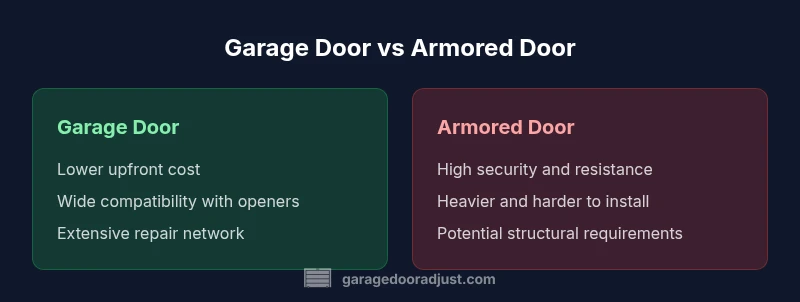
| Feature | Garage Door | Armored Door |
|---|---|---|
| Security level | Moderate to high with proper reinforcement | Very high due to reinforced steel and multi-point locking |
| Cost | Lower upfront cost with broad options | Higher upfront cost due to materials and installation |
| Maintenance | Regular maintenance for panels, tracks, and opener | More intensive, specialized maintenance over time |
| Installation complexity | Typically straightforward; standard garage-door framing | Often requires structural work and skilled installation |
| Aesthetics | Wide range of finishes and panel styles | Rugged, utilitarian appearance with limited finish variety |
| Best for | Everyday access and cost-conscious households | High-security needs and high-risk entry points |
Upsides
- Clear trade-off between cost and security for informed decisions
- Garage doors are widely available with broad service networks
- Armored doors offer superior resistance for high-risk scenarios
- Both doors can be integrated with modern smart-home security
Disadvantages
- Armored doors are costly and heavier to install
- Garage doors may require ongoing maintenance and upgrades to security components
- Armored doors may require structural modifications and specialized installation
Armored door is better for extreme security needs; garage doors fit most homes with balanced security and convenience
For high-risk or exposed entry points, armored doors offer superior protection. For most homes, a reinforced garage door delivers strong security without sacrificing daily usability, plus lower upfront costs and easier maintenance.
Got Questions?
What is the primary difference in security between a garage door and an armored door?
The primary difference is in construction strength and locking hardware. Armored doors use reinforced materials and multi-point locks to resist forced entry more effectively, while garage doors rely on sturdy panels and hardware but are generally easier to breach without upgrades.
Armored doors are built tougher for higher security. Garage doors can be strong, but armor adds resistance against forced entry.
Is armored door worth it for a typical home entry?
For homes with higher risk factors or exposed entry points, armored doors can justify the investment. For most homes, a well-reinforced garage door with quality hardware provides a practical balance of security and cost.
Armored doors can be worth it if risk is high; otherwise, a reinforced garage door often suffices.
How does maintenance differ between these two door types?
Garage doors require regular lubrication, balance checks, and weather-seal maintenance. Armored doors demand more specialized checks on locking hardware, frame integrity, and corrosion protection, which may call for skilled service.
Garage doors need routine parts care; armored doors need more specialized maintenance for locking and frame integrity.
Can I upgrade from a garage door to an armored door later?
Upgrading typically involves more than swapping doors; it may require framing reinforcement and structural assessments. Plan for the additional labor and ensure compatibility with your existing access system.
Upgrading later can be complex and costly; expect structural work and system compatibility checks.
How do insurance and risk considerations affect the choice?
Insurance considerations vary by provider and region. In high-risk areas, armored doors may lower premiums or qualify for security-related discounts, while standard garage doors with proper reinforcement can still meet many policy requirements.
Insurance can favor higher security, but requirements vary—check with your provider.
What about aesthetics and curb appeal when choosing between these options?
Garage doors offer a wider range of finishes that blend with most homes, while armored doors tend to have a more utilitarian look. If curb appeal is a priority, plan for the door design and surrounding facade.
If looks matter, garage doors usually offer more finishes; armored doors are more rugged in appearance.
Quick Summary
- Assess risk before choosing between doors
- Balance upfront cost against long-term maintenance
- Consider installation complexity and home aesthetics
- Armored doors excel in security; garage doors suit daily use
- Use a risk-based framework to guide installation and upgrades