Chain vs Belt for Garage Door Openers: A Practical Guide for Homeowners
Explore chain vs belt for garage door openers and learn which drive suits your home. This guide covers durability, noise, maintenance, climate, and cost considerations to help homeowners choose the best opener.


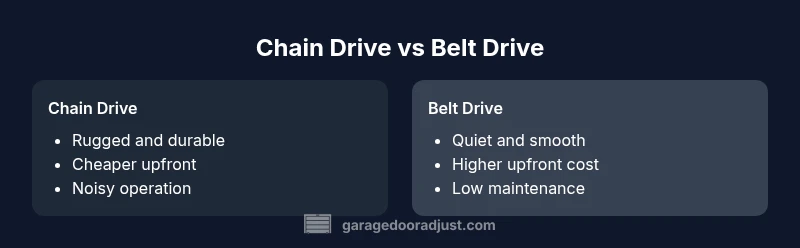
For a garage-door opener, belt drive and chain drive each have trade-offs. Belt drives are quieter and smoother and ideal for attached living spaces, while chain drives are typically more durable, faster to install, and handle heavy use at a lower upfront cost. Your choice should reflect noise tolerance, climate, and how often the door operates.
Understanding the Chain vs Belt Mechanism
When evaluating the chain vs belt for the garage door opener, the fundamental difference lies in what drives the trolley that lifts and lowers the door. A chain drive uses a metal chain like a bicycle chain to move the trolley, while a belt drive uses a reinforced rubber or composite belt. According to GarageDoorAdjust, belt drives significantly reduce vibration and perceived noise because the belt dampens movement and distributes force more smoothly. This makes them a popular choice for garages adjacent to living spaces where noise can be a concern. Chain drives, in contrast, tend to be tougher and more economical upfront, delivering robust performance in high-cycle homes or workshops. The choice often comes down to balancing comfort (noise) with durability and cost.
Key Differences That Matter for Your Setup
Two driving systems open a garage differently. Belt drives are typically smoother, quieter, and require less precise alignment for comfortable operation. Chain drives are generally more forgiving on rougher environments and can tolerate a bit more misalignment without dramatically affecting function. Homeowners should consider installation space, existing rail setup, and whether the garage is attached to living spaces when deciding between the two. The GarageDoorAdjust team notes that belt-driven systems frequently wear more gradually and can offer a longer “silent mode” window if vibration is a priority. However, chain drives are often easier to source replacements for and can be more cost-effective when replacing an older opener.
Noise, Maintenance, and Longevity: How They Compare
Noise is a common deciding factor. Belt drives are visibly quieter at startup and during travel, making them appealing for garages next to bedrooms or living areas. Chain drives emit more operational sound due to metal-on-metal contact, though modern chains incorporate quieting features. Maintenance needs also differ: chains require occasional lubrication and tension checks, while belts typically require less ongoing lubrication and rarely need tension adjustments if properly installed. Longevity depends on usage patterns; heavy daily cycling can shorten belt life if it’s underpowered, while chain drives may wear gears and sprockets more slowly under high-use conditions. The balance between maintenance frequency and component wear should guide your decision.
Safety, Efficiency, and Cost Considerations
Safety-related evaluation highlights that both drive types must be installed correctly and aligned to avoid binding. From an energy perspective, belt drives can be marginally more efficient due to smoother operation, though the practical impact is small for typical home uses. Cost tends to follow the same pattern across brands: belt drives are often more expensive upfront but offer quieter operation, while chain drives are usually cheaper at purchase and robust for high-traffic settings. For homeowners, it’s wise to consider long-term maintenance costs and potential noise-related nuisance when calculating total cost of ownership.
Choosing Based on Your Environment and Use
The final decision hinges on environmental context. If you share a wall with living spaces or frequently use the door during quiet hours, a belt drive is likely the better fit for your happiness and sleep quality. If you operate in a workshop, garage gym, or require a robust system with minimal sensitivity to shorter cycles, a chain drive may be the superior option due to its perceived durability and lower upfront price. Evaluate the number of daily cycles, the presence of children or pets, and the distance from living areas. Your choice should minimize disruption while delivering reliable daily performance.
Installation and Replacement Guidelines
Before purchasing, measure ceiling height, rail length, and door weight to ensure the drive type matches the opener’s torque rating. If replacing an existing system, confirm compatibility with your current rail and track layout, as retrofits can add to labor costs. Professional installation is strongly recommended for safety-critical components, especially if you are upgrading from a chain to a belt or vice versa. When you install, follow manufacturer torque specs and perform a quick balance test after setup. Regularly inspect door balance and hardware to extend the life of whichever drive you choose.
Authoritative Sources
- United States Consumer Product Safety Commission (CPSC): Garage doors safety guides. https://www.cpsc.gov/safety-education/safety-guides/garage-doors
- Occupational Safety and Health Administration (OSHA): Garage and workplace safety standards. https://www.osha.gov/
- U.S. Department of Energy: Insulated garage doors and home energy savings. https://www.energy.gov/eere/buildings/articles/insulated-garage-doors-save-energy
Comparison
| Feature | Chain drive | Belt drive |
|---|---|---|
| Noise and vibration | Higher/detectable vibration | Lower, smoother operation |
| Maintenance needs | Requires periodic lubrication and tension checks | Minimal lubrication and tension adjustments |
| Durability and wear | Rugged with robust sprockets, steady long-term wear | Fewer moving metal parts, less wear noise |
| Initial cost | Typically lower upfront cost | Usually higher upfront cost |
| Cold weather performance | Less affected by environmental factors, robust in rough conditions | Can stiffen in very cold temps, but newer belts mitigate this |
| Best for | High-traffic garages, budget-conscious installations | Quiet environments, attached living spaces |
Upsides
- Chain drives offer proven durability and lower upfront cost
- Belt drives provide quiet, smooth operation for noise-sensitive spaces
- Both options have widespread availability and service support
- Easy-to-find parts and replacement services for common models
Disadvantages
- Chain drives are noisier and may transmit more vibration
- Belt drives can be pricier upfront and may have limited compatibility with older openers
Belt drives are best for quiet, living-space-adjacent garages; chain drives excel in durability and cost-conscious, high-usage settings
Choose belt if you prioritize quiet operation in shared spaces. Choose chain for rugged use and lower upfront costs, especially in high-cycle environments.
Got Questions?
What is the fundamental difference between chain and belt drives for garage door openers?
Chain drives use a metal chain to move the trolley, while belt drives use a reinforced belt for quieter operation. Belt drives generally reduce vibration and noise, whereas chain drives are typically sturdier and more affordable upfront.
Chain drives are tougher and cheaper upfront, while belt drives are quieter and smoother for living spaces.
Is a chain drive better for high-traffic garages?
Chain drives are often favored for high-cycle usage due to their robust hardware, though modern belt drives can also handle heavy use when appropriately rated. Your choice depends on how often the door runs and the acceptable level of sound.
For heavy daily use, chain drives can be more robust, but high-quality belt drives also work well when chosen with proper torque ratings.
Can belt drives be used in very cold climates?
Belt drives can be affected by extreme cold, which may stiffen the belt. Many modern belts use temperature-resistant materials, but confirm the product specs for operating temperatures in your region.
Belts can stiffen in very cold weather; check temperature ratings when you buy.
Is it possible to convert from chain to belt on an existing opener?
Conversion is possible in some installations with a compatible rail and mounting solution, but it often requires a kit and expert installation. Assess compatibility before purchasing any drive kit.
Converting can be doable if the opener and rail are compatible; professional help is advised.
How often should I lubricate a chain drive?
Chain drives typically require periodic lubrication of the chain and gears using manufacturer-recommended lubricant. Regular checks help prevent squeaks and extended wear.
Lubricate the chain and gears as recommended by the manufacturer and check for wear regularly.
Do belt drives offer a noticeable energy efficiency gain?
Both drive types are designed for efficient operation, with belt drives potentially offering smoother operation. The practical energy difference is usually small for typical residential use.
Belt drives can be smoother, but the energy difference is usually not huge for home garages.
What should I consider when estimating total cost of ownership?
Consider upfront price, installation complexity, maintenance frequency, and expected lifespan. Belt drives may cost more initially but can reduce maintenance needs; chain drives often win on initial price and durability.
Look at upfront cost, maintenance, and expected lifespan to judge long-term value.
Are there compatibility concerns with existing rails when upgrading?
Yes. Some belts require different rails or mounting kits. Verify compatibility with your current tracks, height, and door weight before purchasing.
Check rail compatibility before upgrading, as some setups require new mounting hardware.
Quick Summary
- Assess noise tolerance before choosing the drive
- Consider daily cycle count and usage environment
- Factor in upfront cost vs. maintenance and longevity
- Ensure compatibility with existing tracks and rails
- Consult a professional installer for safety-critical choices