Bothell Garage Door Repair: A Practical How-To Guide
This Bothell garage door repair guide walks homeowners through diagnosing common issues, safety checks, and practical fixes with expert tips from GarageDoorAdjust.


Goal: diagnose and fix common Bothell garage door issues safely. Start by checking the opener, tracks, springs, cables, and alignment. Gather basic tools and safety gear, then follow a clear step-by-step process to test power, balance, lubrication, and force limits. If you encounter frayed cables, broken torsion springs, or mains power concerns, pause and contact a pro.
Bothell garage door repair safety and scope
Bothell homeowners tackling bothell garage door repair should prioritize safety above all else. Garage door systems are heavy, under tension, and connected to electricity, which means a mistake can cause serious injury. This guide provides practical, safety-first steps for diagnosing and repairing common problems while helping you decide when to call a pro. According to GarageDoorAdjust, starting with a clear plan and protective gear reduces risk and increases success rates. For many Bothell residences, seasonal weather, damp conditions, and occasional power interruptions can reveal or aggravate issues with tracks, springs, or openers. Set aside dedicated time, ensure children and pets are away, and work in a well-lit, dry area. For most homeowners, with the right approach, routine maintenance and careful fixes can restore smooth operation without compromising safety.
Bothell garage door repair safety and scope
Bothell homeowners tackling bothell garage door repair should prioritize safety above all else. Garage door systems are heavy, under tension, and connected to electricity, which means a mistake can cause serious injury. This guide provides practical, safety-first steps for diagnosing and repairing common problems while helping you decide when to call a pro. According to GarageDoorAdjust, starting with a clear plan and protective gear reduces risk and increases success rates. For many Bothell residences, seasonal weather, damp conditions, and occasional power interruptions can reveal or aggravate issues with tracks, springs, or openers. Set aside dedicated time, ensure children and pets are away, and work in a well-lit, dry area. For most homeowners, with the right approach, routine maintenance and careful fixes can restore smooth operation without compromising safety.
Tools & Materials
- Safety glasses (ANSI Z87.1 rated)(Protect eyes from flying debris or springs under tension)
- Work gloves(Grip and protection during lifting and tightening)
- Sturdy step ladder(Access higher components safely; avoid overreaching)
- Screwdriver set (Phillips and flathead)(For mounting brackets and small fasteners)
- Socket wrench set(Torque essentials for bolts on track and hinge mounts)
- Lubricant (silicone or lithium-based)(Lubricate rollers, hinges, and tracks; avoid grease on nylon parts)
- Non-contact voltage tester(Verify power off before touching opener and wiring)
- Torque wrench (optional)(Useful for torsion-spring assemblies if you have proper training)
Steps
Estimated time: 1 hour 30 minutes
- 1
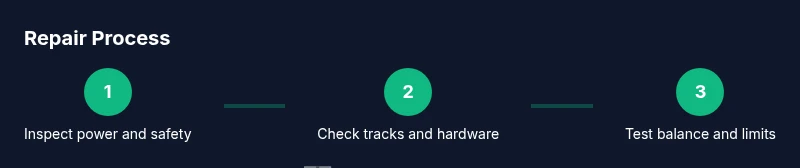
Verify power and safety first
Disconnect power to the opener at the wall switch and, if comfortable, unplug the unit from the outlet. Use the voltage tester to confirm there is no live feed before touching any wiring. This prevents accidental starts while you inspect components.
Tip: Keep all odd tools in a dedicated pouch to avoid mixed up placements near springs. - 2
Inspect tracks and rollers
Look for dents, bends, or debris along the vertical and horizontal tracks. Manually move the door to observe binding or sticking. Clean tracks with a soft brush and wipe away grime. If rollers are worn or cracked, plan for replacement.
Tip: When loosening track mounting bolts, support the track from below to prevent sudden shifts. - 3
Test opener alignment and balance
With the door closed, disconnect the opener from the door (usually a release cord). Manually raise and lower the door slowly; it should stay roughly halfway without dropping. If it feels heavy or unbalanced, spring tension or balance may be off and require expert adjustment.
Tip: Do not force the door beyond its natural range; stopping points indicate binding or misalignment. - 4
Lubricate and tighten hardware
Apply silicone-based lubricant to nylon rollers, track joints, hinges, and pulley interfaces. Tighten loose nuts and bolts on hinges, brackets, and track anchors. Wipe off excess lubricant to prevent dust attraction.
Tip: Avoid over-lubrication; excess lubricant can attract dirt and cause more friction. - 5
Inspect springs and cables
Look for signs of wear, corrosion, or fraying on torsion springs or extension springs. Do not attempt to unwind or adjust tension unless you’re trained—springs are under high load and can cause serious injury.
Tip: If you see gaps, shiny metal, or warped coils, treat as a safety alert and call a pro. - 6
Test force limits and final run
Reconnect any disconnects, restore power, and test the door using the opener. Verify the door fully opens and closes; ensure limit switches are set so the door doesn’t rack or slam. Observe for unusual sounds or trembling.
Tip: Record a quick video of the test for reference if you later contact a technician.
Got Questions?
What are the most common Bothell garage door problems?
Most homeowners encounter misaligned tracks, worn rollers, and noisy operation. Power loss at the opener, binding in the tracks, or weak springs can also cause doors to stall. A systematic check helps identify the root cause before taking action.
Common issues include misaligned tracks, worn rollers, and noisy doors. Start with a track check and lubrication before considering other fixes.
Can I repair torsion springs myself?
Torsion spring work is dangerous due to high tension. Do not attempt to unwind or adjust springs unless you’re trained and equipped. For Bothell homes, contact a licensed technician promptly if you notice gaps, rust, or cracking.
Torsion spring work is dangerous; contact a professional if you suspect issues.
How do I know if I should replace the opener or just fix it?
If the opener struggles to reach set limits, keeps reversing, or has visible wiring damage, consider replacement. In many cases, a repairable unit can be restored with a service call and proper calibration.
If the opener reverses often or has wiring damage, a replacement may be wiser.
What maintenance should I perform monthly?
Lubricate moving parts, test the safety reverse on the opener, check balance, and tighten hardware. Keeping a simple checklist can prevent emergencies and extend the life of your Bothell garage door.
Lubricate parts, test safety, and check balance every month.
When should I call a pro for Bothell garage door repair?
Call a pro when wires show damage, springs appear stressed or cracked, the door is unbalanced, or you hear grinding under load. Pro work ensures safety and a guaranteed result.
Call a professional if you see damaged springs or unbalanced doors.
Are there safety standards I should follow at home?
Always disconnect power before inspection, avoid attempting to remove springs, and use protective gear. Refer to general safety guidelines from OSHA and electrical safety practices when servicing any powered system.
Always follow basic safety practices and avoid handling springs yourself.
Watch Video
Quick Summary
- Inspect safety first and power off before touching components.
- Balance and track alignment are essential for smooth operation.
- Differentiate DIY tasks from dangerous spring work; call a pro when in doubt.
- Document maintenance to guide future Bothell garage door repair needs.