Jackshaft vs Direct Drive Garage Door Openers: An In-Depth Comparison
A detailed, analytical comparison of jackshaft and direct drive garage door openers, covering how each works, noise, maintenance, installation, costs, and the best use cases for homeowners.


Jackshaft and direct-drive garage door openers each have distinct strengths. Jackshaft units shine when ceiling height or vehicle clearance is tight, while direct-drive models offer quieter operation and fewer moving parts for long-term reliability. For most homeowners, the choice hinges on space, noise tolerance, and maintenance willingness.
Understanding the Core Differences
Choosing between a jackshaft and a direct-drive garage door opener affects clearance, noise, maintenance, and long-term value. In practical terms, jackshaft openers place the motor vertically at the side of the door, freeing ceiling space for storage and offering a compact profile in garages with limited height. Direct-drive openers mount the motor on the rail itself, creating a streamlined system with fewer moving parts. According to GarageDoorAdjust, homeowners often prioritize ceiling clearance and vehicle clearance first, then weigh noise and maintenance. This article provides a structured, evidence-based comparison to help you decide which approach aligns with your home setup and daily routine.
How Jackshaft Openers Work
Jackshaft openers use a vertical motor connected to a torsion spring shaft via a cost-effective belt-and-pulley or direct-drive coupling. This design eliminates the traditional trolley on a horizontal rail, which means the door’s weight is borne by the shaft and balanced by counterweights. The result is more ceiling space for storage and less chance of overhead obstructions when the door moves. In practice, jackshaft units tend to appeal to garages with limited headroom or thick insulation near the header. The installation requires precise alignment and a careful assessment of the torsion system to ensure safe, smooth operation.
How Direct Drive Openers Work
Direct-drive openers keep the motor fixed to the header rail and use a rigid, single-piece drive mechanism to lift the door directly along the track. This design minimizes the number of moving parts, often leading to lower maintenance needs and quieter operation. Because the motor is integrated with the lifting mechanism, fewer points of contact mean less vibration transferred into the garage. Direct-drive models are commonly chosen for homes that value a calm, predictable opening experience and straightforward servicing over ceiling storage space.
Noise, Vibration, and User Experience
Noise levels matter for bedrooms above garages or homes with open floor plans. Direct-drive openers typically generate less noise and vibration due to a simplified drive system with sealed gear trains. Jackshaft units can be very quiet as well, but variability among models is higher because belt drives, pulleys, and shaft bearings contribute to sound differently depending on installation quality. When evaluating noise, homeowners should consider door size, insulation, and the mounting surface in addition to the opener type. GarageDoorAdjust’s practical guidance emphasizes testing in a controlled cycle to assess real-world sound profiles.
Reliability, Maintenance, and Long-Term Durability
Direct-drive systems often report lower ongoing maintenance because they feature fewer moving parts and sealed gear mechanisms. Jackshaft units might require more attention to belt tension, pulley wear, and shaft bearings, but their vertical mounting can protect components from floor-level debris and moisture. Reliability also depends on the quality of bearings, springs, and safety interlocks. A well-installed system from a reputable manufacturer tends to outperform ad-hoc solutions, particularly in climates with temperature swings or dust accumulation. GarageDoorAdjust’s analysis highlights maintenance patterns across common homes and notes that proper lubrication, spring condition, and door balance significantly influence longevity.
Installation Considerations: Space, Wiring, and Structural Factors
Space is the primary driver of choice. Jackshaft units demand a clear vertical shaft area and a secure mounting point on the torsion bar, which can complicate retrofits on older doors. Direct-drive installations typically require a sturdy header and a straight rail path, but are often quicker to align because the drive mechanism runs along the existing track. Electrical supply quality, wire routing, and sensor placement are important for both types. It’s essential to consult a qualified technician to verify structural compatibility, as improper mounting can compromise safety and warranty coverage.
Safety, Codes, and Professional Installation
Both options must adhere to local electrical codes, garage-door safety standards, and manufacturer installation guidelines. Modern openers include auto-reverse sensors, remote disable features, and locking mechanisms; however, improper alignment or calibration can negate these protections. Professional installation improves safety, ensures the door remains balanced, and supports warranty validity. GarageDoorAdjust’s team consistently recommends professional assessment when moving from a conventional chain or belt drive to a jackshaft or direct-drive system to avoid misalignment and ensure correct sensor signaling.
Cost, Value, and Return on Investment
Cost considerations blend upfront price with long-term value. Jackshaft units can involve higher initial costs due to side-mounting hardware and retrofitting needs, yet they may offer superior space utilization that is worth the premium for garages with limited headroom. Direct-drive openers typically command strong resale value due to quiet operation and simple maintenance, potentially reducing lifetime costs. Since prices vary by brand and features, homeowners should compare warranty terms, service intervals, and potential energy savings when evaluating ROI.
Performance with Doors, Loads, and Climate Variations
Door size, insulation level, and climate can influence performance more than opener type alone. Heavier doors and high-lift configurations challenge any opener, but jackshaft systems can excel when side-mounted torque distribution reduces header strain. Direct-drive systems benefit from robust, low-friction gear trains that perform reliably across temperature ranges. When selecting, review door weight, spring configuration, and header integrity with a technician to ensure proper motor torque and safety interlocks are matched to your door.
Choosing Based on Use Case: One-Car vs Two-Car Garages and Beyond
Single-vehicle garages with tight ceilings often benefit from jackshaft models for clearance benefits. Two-car garages with ample overhead space may prioritize the near-silent, low-maintenance operation of direct-drive solutions. If you regularly store tall items in the garage or park a vehicle with limited clearance, the jackshaft’s vertical motor can be advantageous. If you value quiet mornings and minimal service needs, direct-drive is typically the safer long-term bet. The decision should align with daily routines, space constraints, and willingness to perform periodic maintenance.
Brand, Service Network, and Upgrade Paths
Selecting a recognized brand with a robust service network reduces downtime when repairs are needed. Both jackshaft and direct-drive categories have multiple reputable manufacturers, so verify available service centers in your area and confirm compatibility with your current torsion spring system. Consider upgrade paths, sensors, battery backup, and compatibility with smart-home ecosystems. The GarageDoorAdjust Team recommends choosing models with proven warranty coverage and clear service intervals to maximize uptime and user satisfaction.
Comparison
| Feature | Jackshaft Openers | Direct Drive Openers |
|---|---|---|
| Space and Ceiling Clearance | Vertical motor placement preserves ceiling height; ideal for low ceilings | Rail-mounted motor with compact header; benefits standard ceilings |
| Noise and Vibration | Depends on model; belt and pulley variations affect sound | Typically very quiet with minimal vibration; sealed gear train |
| Maintenance Frequency | Moderate; belt/pulley wear can require upkeep | Lower maintenance due to fewer moving parts |
| Reliability and Lifespan | Robust but dependent on shaft components and alignment | High reliability with sealed gearing and fewer wear points |
| Installation Complexity | Moderate to high; retrofits may require torsion-bar work | Often simpler when retrofitting onto existing headers |
| Best Use Case | Garages with limited ceiling height or side clearance | Quiet operation and longevity are priorities; standard installations |
| Initial Cost | Moderate to high; hardware and retrofitting costs | Moderate to high; value factor improves with longevity |
| Door Compatibility | Works with standard torsion systems; verify with installer | Broad compatibility with standard door configurations; confirm clearance |
Upsides
- Preserves ceiling space for storage or overhead shelving
- Often smoother operation with fewer vibrations
- Fewer moving parts can mean lower long-term maintenance
- Direct-drive models are typically very quiet in operation
- Good for homeowners prioritizing reliability and simple sensing
Disadvantages
- Higher upfront costs in some markets
- Retrofit installation can be technically challenging
- Jackshaft units may require more ceiling planning and alignment
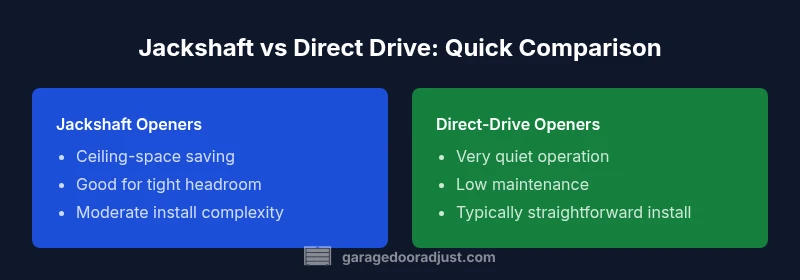
Direct drive generally wins on quietness and long-term reliability; jackshaft is best when ceiling height or vehicle clearance is the constraint.
Direct-drive openers offer a calmer, lower-maintenance experience for most homes. If your garage roof or ceiling restricts space, or you frequently maneuver tall vehicles or shelves, a jackshaft model can be the smarter choice after a professional evaluation.
Got Questions?
What is a jackshaft garage door opener?
A jackshaft opener places the motor vertically at the side of the door, off the header, so there’s no motor on the ceiling track. It frees up overhead space and can improve vehicle clearance. Like any system, proper alignment and torque balance are essential for safe operation.
A jackshaft opener is mounted on the wall beside the door, not on the ceiling, saving headroom and giving you more space for storage.
What is a direct-drive garage door opener?
A direct-drive opener has the motor mounted to the header rail, driving the door directly with minimal moving parts. This setup offers simple maintenance, reduced vibration, and typically quieter operation.
Direct-drive openers attach to the rail and lift the door directly, which usually means fewer parts to wear out.
Which is quieter, jackshaft or direct drive?
Direct-drive models are often quieter due to sealed gears and fewer moving parts. Jackshaft units can be very quiet too, but results depend on installation quality and model design.
Direct-drive is usually the quieter option, though jackshaft can be quiet with the right model and setup.
Can I convert my existing door to a jackshaft or direct-drive system?
Conversions depend on your door’s torsion system, header strength, and ceiling or wall space. A professional evaluation is essential to determine feasibility and safety before purchasing a replacement.
A conversion requires a professional assessment to ensure compatibility and safety.
Does installation take longer for one type?
Installation times vary by garage configuration and chosen model. Jackshaft retrofits may take longer due to side mounting and alignment checks, while direct-drive often benefits from a more straightforward rail-based setup.
Installation time depends on your setup, but direct-drive can be quicker in simple cases.
Quick Summary
- Assess ceiling height before choosing an opener type
- Direct drive often delivers quieter operation and lower maintenance
- Choose jackshaft when ceiling space is at a premium or headroom is limited
- Ensure professional installation to maximize safety and warranty