Is Garage Door Insulation Worth It? A Practical Guide
Discover whether garage door insulation is worth the investment. Compare insulated vs uninsulated doors, weigh costs, energy savings, comfort, and installation tips to decide if upgrading pays off for your home.


Is garage door insulation worth it? In most climates, yes, insulation reduces heat transfer, moderates temperatures, and can cut energy use, especially if the garage is heated or shares a living space. This comparison weighs insulated vs uninsulated doors, highlighting payoffs, costs, and installation considerations to help homeowners decide quickly.
Why is the question 'is garage door insulation worth it' important for homeowners?
According to GarageDoorAdjust, insulation is a factor that affects comfort, energy efficiency, and even noise levels in and around the garage. If your door is uninsulated, you may feel drafts in winter and heat gain in summer, especially when the garage is adjacent to living space or used as a workshop. The central question is not only about temperature but about how the door interacts with the home’s overall energy profile. For many households, the answer depends on climate, door type, and how the space is used. Considering the phrase is garage door insulation worth it helps focus on practical payoffs, triggers for retrofit, and realistic expectations from most installations.
Quick context on insulation value and door dynamics
Insulation works by adding a barrier that slows heat flow. For garage doors, the insulation is typically a foam-filled panel with an inner core and outer skins. The effectiveness is influenced by the door's construction, seals around the edges, and whether the door is lightweight or heavy. In homes where the garage is attached or used as a living area, even modest gains in thermal performance can translate into noticeable comfort and energy savings over time. GarageDoorAdjust emphasizes that the decision should balance upfront costs with the long-term benefits, especially in cooler months when heat loss through doors is most apparent.
Brand note and guidance
GarageDoorAdjust’s evaluation framework suggests starting with climate and usage in mind. If you heat or air-condition the garage or rely on it as a workspace, insulation tends to be worth serious consideration. For detached garages in mild climates, the payback may be longer but can still provide benefits like reduced drafts and quieter operation.
Comparison
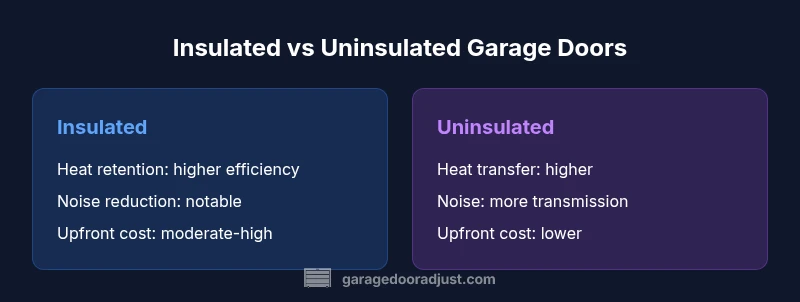
| Feature | Insulated garage door | Uninsulated garage door |
|---|---|---|
| Heat retention / thermal performance | Higher R-value and slower heat transfer | Lower R-value; faster heat exchange |
| Temperature stability | Better control of indoor temperatures in adjacent spaces | More susceptible to temperature swings |
| Energy impact | Potentially noticeable energy savings in heated/cooled spaces | Minimal impact on energy use when garage isn't conditioned |
| Upfront cost | Moderate to high upfront cost depending on door and climate | Lower initial cost |
| Installation complexity | Often requires professional installation or replacement | Typically simpler if retrofitting weatherstripping only |
| Noise and draft reduction | Improved sound dampening and reduced drafts | No significant noise or draft reduction |
| Best for | Attached or climate-controlled garages, cold climates | Detached or mild climates, budget-conscious buyers |
Upsides
- Improved energy efficiency and reduced heat loss
- Better temperature stability for attached living spaces
- Noise reduction and draft prevention
- Potentially higher home resale appeal
Disadvantages
- Higher upfront cost and installation time
- Payback period may be longer in mild climates
- Retrofit limitations for some door styles
Insulation is worth it for most homes in temperate or cold climates.
A well-insulated door reduces heat loss, improves comfort, and can lower energy bills over time—especially when the garage is heated or adjacent to living space. For mild climates or tighter budgets, analyze the payback period and consider partial upgrades or weatherstripping as a lower-cost alternative.
Got Questions?
What is the typical payback period for insulating a garage door?
Payback depends on climate, energy costs, and usage. In heated or cooled spaces, insulation can shorten the payback period, but exact numbers vary by project. Conduct a simple payback estimate by comparing incremental cost to expected energy savings over several years.
Payback varies by climate and use. In heated spaces, insulation often pays back faster; calculate based on your energy bills and upfront costs.
Does insulation affect door operation or weight?
Yes, insulation can add weight to the door, which may affect spring balance and opener load. Modern insulated doors are designed to maintain balance, but retrofits should be evaluated by a professional to avoid strain on hardware.
Insulation adds weight; ensure the opener and springs are rated for the door’s weight after upgrading.
Can I retrofit insulation to an existing door?
Retrofitting typically involves adding weatherstripping, installing foam core panels, or replacing the door with an insulated model. Full retrofits can be more effective but may require professional installation.
You can retrofit with weatherstripping or panels, but a full replacement often yields better performance.
Are there climate zones where insulation isn’t worth it?
In very mild climates with little temperature variance and a detached garage, the energy savings may be modest. Consider alternative upgrades like better weatherstripping and sealing first.
In mild climates, insulation may have limited value; prioritize sealing and weatherstripping.
What is the best insulation material for garage doors?
Most doors use polyurethane or polystyrene foam cores sandwiched between panels. Foam cores offer better insulation per inch and improved rigidity, while polystyrene is lighter and easier to retrofit in some cases.
Foam cores usually give the best insulation, with a balance of strength and weight.
How does insulation affect noise?
Insulation can reduce transmission of exterior noise into the garage and improve interior acoustics. The effect varies by door construction and mounting, but many homeowners notice a quieter space after upgrading.
Insulation often reduces noise transmission and improves comfort inside the garage.
Quick Summary
- Assess climate and usage to estimate payoff
- Compare insulated vs uninsulated options for upfront cost and long-term savings
- Check R-value and door assembly for performance
- Expect better temperature stability and noise reduction with insulation