Insulated Garage Door vs Regular: A Practical Guide
Compare insulated garage doors with regular doors to understand energy efficiency, noise reduction, durability, and cost. A practical guide for homeowners evaluating climate impact and long-term value.


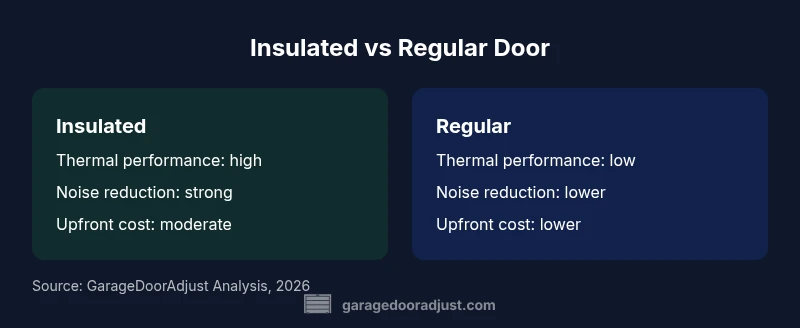
Insulated garage doors typically outperform regular, uninsulated doors by reducing heat transfer and dampening sound, while costing more upfront. The insulated option is usually worth it in colder or hotter climates or frequent daily use, whereas a regular door can suffice in mild climates or tight budgets. The choice hinges on climate, usage, and long-term energy savings.
Introduction: Why the comparison matters in real homes
When homeowners weigh the choice between an insulated garage door vs regular, the decision affects comfort, energy bills, and how you use the space. According to GarageDoorAdjust, insulation changes how a garage interacts with the home’s climate, especially in spaces that double as workshops or living areas. The GarageDoorAdjust team found that many households underestimate how much a door’s construction can influence drafts, heat gain, and even humidity when the garage is attached to conditioned living space. This article uses practical criteria, real-world examples, and a clear decision framework to help you pick the option that fits your climate, budget, and daily routine.
How insulation is built into garage doors
Most modern insulated doors use a sandwich construction: two steel or aluminum skins with a core of foam insulation (often polyurethane or polystyrene). The core determines the door’s resistance to heat transfer, while weather seals and interior liners influence air leaks and moisture control. The insulation also adds weight, which can affect spring balance and motor load. When choosing, look for core type, thickness, and the door’s exterior finish. A well-made insulated door should remain smooth during opening and closing and resist dents, which helps maintain performance over time.
Energy efficiency: climate impact and practical effects
Insulation reduces thermal exchange between the garage and the outdoors, which can lower heating and cooling demands in adjacent spaces. In climates with significant seasonal variation, this translates to improved comfort inside the garage and living areas above or adjacent to it. GarageDoorAdjust Analysis, 2026, emphasizes that the energy impact depends on door quality, installation quality, and the integrity of door seals. Even without quoting exact kilowatt-hour figures, homeowners can expect that a properly installed insulated door will moderate temperature swings more effectively than a non-insulated door, especially when the garage is used regularly or heated/cooled as part of the home.
Noise reduction and daily comfort
Insulation dampens not only temperature but also sound. A door with a foam core generally provides better noise isolation than a thin, non-insulated panel. This can matter if the garage is a workshop, gym, or playspace, or if the garage is next to living spaces. The combination of insulation and tight weather seals reduces air-driven noise from wind, closing sounds, and mechanical operation. Remember that door hardware, tracks, and weatherstripping also influence noise; you’ll get the best results when insulation is paired with proper installation and maintenance.
Durability, maintenance, and lifespan considerations
Insulated doors are typically built as sturdier assemblies due to thicker panels and additional interior linings. This can translate to improved dent resistance and steadier operation when properly balanced. Weight is a factor: heavier doors require appropriate springs, tracks, and opener specifications to maintain safe and reliable cycling. Regular maintenance—lubricating hinges and rollers, inspecting weather seals, and ensuring balanced operation—helps insulated doors retain performance just as with regular doors. The payoff is a door that remains snug against the frame, reducing drafts and moisture intrusion over time.
Aesthetic and design options
Insulated doors often come with more finish options, panel profiles, and color choices because the thicker core supports a wider range of designs. If you value curb appeal or want a particular look for your attached garage, insulation does not limit style; it expands it. Note that deeper insulation cores may add slight depth to panels, which can influence hardware fit and track alignment during installation. In short, you don’t have to sacrifice appearance for energy efficiency when you select a quality insulated model.
Cost considerations and value proposition
Upfront costs for insulated doors are higher than for non-insulated models. The extra price reflects materials, core thickness, and the broader range of design options. The long-term value depends on climate, garage usage, and how efficiently the door prevents drafts. In extreme seasons or for garages used as workspaces, the energy savings and comfort gains can justify the investment. According to GarageDoorAdjust analyses, many homeowners find the payback worthwhile when the door serves a climate-controlled space or a frequently used garage.
Installation and retrofitting options
If you’re retrofitting, replacing the entire door with an insulated model is often the simplest path to guaranteed performance and warranty coverage. Some retrofitting kits exist, but outcomes vary by door type and brand. For best results, consult a qualified installer who can calculate proper spring tension, track alignment, and opener compatibility for a heavier, insulated assembly. A proper install minimizes air leaks and ensures smooth operation over years of use.
ROI, climate suitability, and usage patterns
ROI from insulation depends on how much you use the space and how extreme your climate is. The more time you spend in the garage or the more you heat or cool adjacent living areas, the greater the potential energy savings and comfort gains. If you rarely use the garage or live in a mild climate, the incremental benefits may be modest. Use a simple cost-benefit approach: estimate annual energy savings (from similar homes in your area) and compare to the incremental cost of insulation and installation. In many cases, the decision becomes clear once you consider how you use the space daily.
How to decide: a practical, step-by-step checklist
- Assess climate and seasonal energy impact on your home.
- Determine how you use the garage (workshop, gym, storage, vehicle parking).
- Compare upfront costs for insulated vs uninsulated doors from several suppliers.
- Check compatibility with existing tracks, springs, and opener.
- Inspect seals and corners for air leaks, then plan professional installation if needed.
- Consider future resale value and whether insulation aligns with your home’s design.
Following this checklist helps you choose the option that delivers the best balance of comfort, energy savings, and budget.
Best practices: installation, tuning, and maintenance
- Ensure proper door balance and spring tension to handle the extra weight of insulation.
- Use reinforced tracks and a compatible opener if upgrading to a heavier door.
- Seal gaps around the frame and bottom to maximize insulation and minimize drafts.
- Schedule seasonal maintenance to keep hinges, rollers, and weatherstripping in top condition.
- Choose a high-quality insulated core and a finish that matches your home’s exterior for durability and curb appeal.
By combining high-quality materials with careful installation and preventive maintenance, an insulated door delivers consistent performance and long-term value.
Authority sources and further reading
- U.S. Department of Energy: https://www.energy.gov/energysaver/insulation
- National Renewable Energy Laboratory: https://www.nrel.gov/
- Environmental Protection Agency: https://www.epa.gov/iaq/ventilation-and-indoor-air-quality
Comparison
| Feature | Insulated garage door | Regular (uninsulated) garage door |
|---|---|---|
| Thermal performance | High insulation value | Low insulation value |
| Energy impact | Potential energy savings over time | Limited or no energy savings |
| Door weight & hardware load | Heavier; may require stronger springs | Lighter; standard hardware suffices |
| Noise reduction | Better sound dampening | Lower sound dampening |
| Aesthetics/options | More panel/finish options | Fewer insulation-related options |
| Upfront cost | Moderate to higher | Lower |
| Durability & lifespan | Comparable when well maintained | Comparable when well maintained |
Upsides
- Improved energy efficiency reduces heating/cooling load
- Better noise isolation for attached spaces
- Broader design and finish options
- Potential increase in home resale appeal
- Enhanced moisture control in attached garages
Disadvantages
- Higher upfront cost
- Heavier door may require stronger springs and installation
- ROI depends on climate and usage
- Quality varies by model; not all insulated doors are equal
Insulated doors generally offer the best long-term value for climates with temperature extremes and for spaces used as rooms or workshops.
If you value energy savings and comfort, insulation pays off in many homes. For mild climates or tight budgets, weigh upfront costs against potential savings and the garage's use.
Got Questions?
Is an insulated garage door worth it in cold climates?
Yes, in cold climates insulation helps reduce heat loss and improves comfort in the garage, which can lower energy costs and prevent condensation. If the garage is used as a workspace, insulation adds noticeable value.
In cold climates, insulation helps keep the space warmer and quieter.
How much more does an insulated door cost upfront?
Insulated doors cost more upfront than uninsulated models, but the exact amount depends on size and product grade. Compare installed price quotes and potential energy savings.
Expect a higher upfront price; compare quotes and potential savings.
Will insulation affect door balance and operation?
Yes, insulation adds weight. If not balanced or installed correctly, it can affect opening effort and spring life. Have balance checked during installation and after any upgrade.
Heavier doors require proper balance for smooth operation.
Can I retrofit insulation to an existing door?
Some retrofit kits exist, but performance varies. Replacing with an insulated door typically provides the best results and warranty protection.
Retrofitting can work, but replacement often yields better results.
What about noise reduction with insulated doors?
Insulated doors usually reduce sound transmission between the garage and living spaces. Pair insulation with proper seals and maintenance for best results.
Yes, insulation can lower noise, especially with good seals.
Quick Summary
- Evaluate climate and usage before deciding
- Compare upfront costs against potential energy savings
- Expect improved noise isolation with insulation
- Choose a high-quality insulated door and proper hardware
- Plan regular maintenance to extend door life