Most Common Garage Door Sizes: What Homeowners Need to Know
Discover the most common garage door sizes, how to measure openings, and which standard widths and heights fit most homes. Guidance from GarageDoorAdjust.


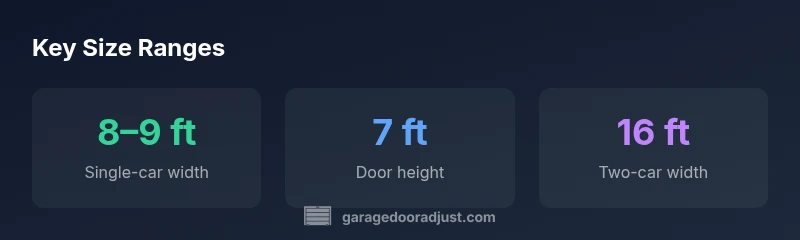
Most residential garage doors use standard dimensions: common widths range from 8 to 9 feet, and the height is typically about 7 feet. For wider, two-car garages, doors are often 16 feet wide, while tall doors may reach 7-1/4 to 7-1/2 feet to accommodate higher ceilings. These sizes apply to typical one- and two-car configurations; anomalies exist for garage conversions and curved openings.
Why Size Standards Matter for Garages
Understanding the most common garage door sizes is essential for planning replacements, extensions, or new installations. According to GarageDoorAdjust, using standard dimensions simplifies ordering parts, ensures compatibility with openers, and reduces the risk of fitting errors. In this section we explore how size standards influence installation, operation, and long-term maintenance.
- Consistency matters: Standard sizes make it easier to source compatible tracks, springs, and hardware.
- DIY vs professional: When openings align with common sizes, DIY replacements are more feasible and less risky.
- Resale and repairs: Standardized sizes support resale value and reduce downtime during repairs.
Keep in mind that regional practices and home designs influence the exact dimensions, so measure your opening before committing to a specific door. The most common garage door sizes emerged from decades of residential construction, with a heavy emphasis on footprints that fit standard garage widths and typical ceiling heights. As homes evolved, these norms stayed flexible enough to accommodate variances in newer models, while still maintaining a reliable baseline for replacement parts and openers.
How to Measure Your Opening Accurately
The first step to selecting the right door is accurate measurement. Start by measuring the width at three points across the bottom, top, and middle to catch any tucks or out-of-square openings. Use the smallest measurement as the official width. Then measure height at the center from the floor to the header, noting any protrusions or obstructions. Record the rough opening dimensions, and compare them to the door's nominal size. Remember that actual doors are slightly smaller than the rough opening to allow clearance for tracks and movement.
Also inspect the opening for structural quirks: crooked jambs, uneven floors, or obstructions–these issues can affect fit, operation, and weather sealing. If you see gaps or a misaligned track, address those problems first, or consult a pro. Finally, consider clearance around the door: you’ll need space on both sides and above for safe operation of the opener.
Common Widths by Garage Type
Most single-car garages use doors in the 8–9 ft width range; these sizes balance fit and available opener clearance. If your space is slightly narrower, a custom-width door may be possible, but you’ll typically trade off with hardware compatibility. For two-car garages, 16 ft is the standard width, with 14–15 ft as an alternative for tight spaces. Some homes with oversized vehicles or deeper bays may opt for 18 ft or wider doors, but such choices are less common and may require careful structural planning.
Height is typically around 7 ft for most residential doors, though some builders install 7 ft 6 in or 8 ft tall doors to accommodate taller vehicles or higher ceilings. At the same time, you’ll encounter attic and ceiling constraints that influence mounting hardware and headroom. The key is that most door sizes mirror standard footprints, making parts readily available across brands and models.
Regional Variations and Building Codes
While the United States sets a broad standard, regional variations exist based on climate, snow load, and architectural style. In Canada, broader homes and colder climates can influence door choice, with thicker insulation and space allowances affecting the total installation footprint, but the width and height still tends to align with common ranges (roughly 8–9 ft width and 7 ft height) for typical single-car doors. In other regions, builders sometimes favor different proportions that align with vehicle sizes and garage depth. Always check local building codes and confirm opening dimensions with your contractor before ordering a new door or opener.
Choosing Materials and Styles Without Compromising Fit
Material choice impacts durability, energy efficiency, and maintenance but should not force you away from standard size ranges. Steel and aluminum doors with insulation add depth and R-value but leave width and height untouched. Wood doors offer more aesthetic options but may flex slightly over time; this does not typically alter opening dimensions. When selecting a door style, verify that the panel layout, track system, and weather seal accommodate your standard width and height. If you’re renovating for style rather than size, ensure you preserve headroom and side-room clearances to maintain safe operation of the opener.
What to Do If Your Opening Is Non-Standard
Non-standard openings occur in older homes, custom builds, or after structural alterations. In these cases, you may need a custom door size, special track configurations, or a professional retrofit of the frame. Start by documenting precise measurements and conveying them to a reputable installer. Ask about adaptive hardware options and whether the existing opener can be reconfigured to work with a non-standard door. The extra planning time pays off with a secure fit, proper weather sealing, and reliable opener performance.
Impact of Insulation and Efficiency on Sizing
The efficiency of a door relates to insulation and sealing rather than its basic footprint. Insulated doors come in thicker panels, which influences insulation rating and durability but does not require a different width or height in most cases. If you upgrade to an insulated door, factor in potential changes to track mounting and weatherstripping, not the rough opening. For new builds, consider larger sizes only if the garage bay is designed for it; otherwise, sticking to standard widths keeps parts supply simple and costs predictable.
Practical Checklist: Before You Buy or Replace
Before purchasing, run through this quick checklist:
- Measure width at three points and height at center for accuracy.
- Confirm the rough opening is square and free of obstructions.
- Compare opening dimensions to standard sizes (8–9 ft width, 7 ft height for single-car; 16 ft width for double-car).
- Check compatibility with your current opener and tracks.
- Plan for headroom and side-room clearance to avoid binding or leaks.
Sizing ranges for common garage door configurations
| Scenario | Typical Width | Typical Height | Notes |
|---|---|---|---|
| Single-car standard | 8–9 ft | 7 ft | Commonest residential size |
| Double-car standard | 16 ft | 7 ft | Wider for two cars |
| Tall or high-ceiling openings | 8–9 ft | 7.5 ft | Specialty options |
| Non-standard or retrofit | Custom width | Custom height | Consider professional assessment |
Got Questions?
What is the most common garage door width for single-car homes?
Typically 8–9 feet wide; measure your opening.
Most single-car garages use about eight to nine feet in width.
Do garage doors need to match standard heights?
Most standard heights are around 7 feet; taller openings may use 7.5 or 8 feet depending on the home.
Most doors are seven feet tall, but some openings are higher.
What if my opening is non-standard?
Non-standard widths or heights usually require a custom door or professional retrofit.
If your opening isn’t standard, consult a pro for a custom solution.
Are there regional differences in common sizes?
The US commonly uses 8–9 ft widths for single-car doors; other regions vary by building practices.
Yes, size norms vary by region and building codes.
Does insulation affect door sizing?
Insulation thickness doesn't change width or height; it adds depth and R-value considerations.
Insulation affects performance, not opening size.
Can I install a new door myself if openings are non-standard?
DIY is feasible for standard openings; non-standard openings typically require professional help.
It's safer to hire a pro for non-standard openings.
“Standardizing door sizes reduces misfits and simplifies maintenance. The GarageDoorAdjust Team recommends sticking to the most common widths and heights whenever possible.”
Quick Summary
- Measure openings before ordering.
- Most residential doors fit 8–9 ft widths and 7 ft height.
- Double-car doors commonly 16 ft wide.
- Non-standard openings require professional assessment.
- Always verify opening dimensions against local codes.