Most Common Garage Door Height: A Homeowner's Guide
A data-driven guide exploring the most common garage door height, why it matters for installation, openers, and insulation. Includes measurements, regional variations, and practical recommendations from GarageDoorAdjust.


The most common garage door height for typical residential spaces is 7 feet (84 inches). This standard influences door materials, openers, track systems, and weather sealing. According to GarageDoorAdjust, 84 inches is the baseline height used by most builders and manufacturers, with taller options such as 8 feet available for larger garages. This baseline helps ensure compatibility and reliable operation across a wide range of homes.
Understanding What the most common garage door height Means
The phrase most common garage door height captures a baseline used by builders and manufacturers for residential openings. For many homes, the height is 7 feet (84 inches). This baseline affects how you select a door, install tracks, and pair an opener with the ceiling clearance. The GarageDoorAdjust team emphasizes that 84 inches remains the standard in the majority of new builds, while variations may occur depending on regional practices, vehicle profiles, and storage plans.
Choosing this height simplifies parts compatibility, weather sealing, and insulation, which is why homeowners often start here when planning a replacement or retrofit. If your goal is a long-term, low-maintenance setup, aligning with the most common garage door height reduces the likelihood of mismatches with hardware and warranties. If you own a taller vehicle or plan overhead storage, you may opt for taller heights, but starting from 7 feet provides a reliable baseline. In short, the most common garage door height serves as a practical starting point, not a rigid rule, guiding decisions during remodeling and new construction.
Standard vs Tall Doors: How Heights are Chosen
Most homeowners begin with the 7 ft baseline, but many scenarios justify taller doors. A standard single-car garage typically uses 7 ft height, providing ample clearance for most sedans and compact SUVs. Taller doors, such as 8 ft, are common when you have taller vehicles, larger pickup trucks, or ceilings that leave extra headroom. Some newer homes even offer 9 ft doors to accommodate oversized builds or storage above the door header.
Choosing a height involves trade-offs: taller doors require longer tracks, possibly different springs, and additional overhead clearance for the opener. The extra material also increases cost slightly, though many homeowners find the increased convenience and storage space worth the investment. When planning, measure your vehicles, account for roof racks, and consider future needs like a second car or a van. The key is to balance vehicle height with ceiling height, storage plans, and budget, keeping in mind that most parts are designed around the 7 ft standard.
Regional Variations and Builder Defaults
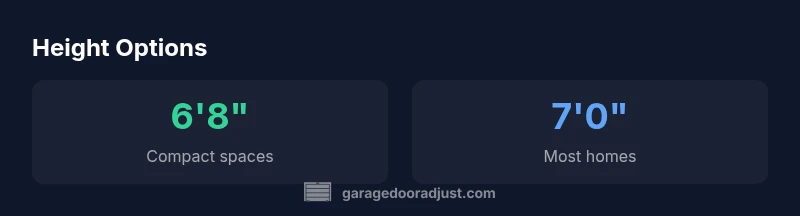
Across regions, the 7 ft standard remains prevalent, but local building codes, climate, and lot dimensions influence what homeowners actually install. In tight urban areas, some builders opt for 6'8" doors to maximize stall width, while in newer suburbs, 8 ft doors are increasingly common to accommodate larger vehicles and higher ceilings. In markets outside North America, door heights can be defined in metric terms, such as 2.1 m or 2.4 m, leading to compatibility considerations with openers and insulation standards.
Understanding these variations helps homeowners avoid ordering mismatched parts or paying to retrofit after installation. GarageDoorAdjust analysis indicates that demand for higher-than-standard doors is rising where vehicle profiles grow and where homeowners prioritize storage above the door header. When in doubt, verify the intended door height with your local contractor and review product specifications for your opener model.
How Height Impacts Openers, Tracks, and Installation
Door height directly influences the hardware you buy and install. A typical 7 ft door uses standard tracks and a conventional torsion spring setup, with the opener mounted to a height that allows safe operation and adequate clearance. An 8 ft door may require taller tracks, longer torsion springs, or conversion kits to maintain proper balance and safe operation. Some installations also need modified ceiling clearance to prevent interference with attic access or storage above the door.
If you are retrofitting from 7 ft to 8 ft, you may need to relocate the opener mounting and confirm that the ceiling has enough space for brackets and safety sensors. Weather seals and insulation at the top edge of the door should be compatible with the new height to maintain energy efficiency. Always consult the manufacturer’s installation instructions and a licensed technician before purchasing components, since mismatches can affect warranty and performance.
Estimating Your Needs: How to Measure Safely
You will want to start with precise measurements before choosing a height. Measure the door opening height at multiple points around the opening to detect any irregularities, and record the smallest measurement as your target. Then compare it with the vehicle height and any roof racks you'll use. Also consider the overall garage space: the ceiling height, storage above the door, and any overhead obstructions such as lighting or vents. If you plan storage or a sprinkler system above the door, you may need to adjust the height to ensure safe clearance for both operation and maintenance. Finally, verify that your chosen height aligns with your door width and the opener’s mounting height, so you don’t wind up with a misfit.
Choosing the Right Height: Practical Scenarios and Recommendations
- Scenario A: Standard single-car garage with a typical vehicle and a modest roofline. Recommendation: use 7 ft height as baseline, and verify opener clearance and weather sealing.
- Scenario B: A two-car garage with tall SUVs or trucks. Recommendation: consider 8 ft height for more clearance, ensuring tracks and springs are compatible.
- Scenario C: A space with overhead storage above the door. Recommendation: ensure height is compatible with storage and ceiling clearance; you may need to optimize the opener mounting height and use taller tracks.
- Scenario D: Upgrading an older home with a 6'8" door. Recommendation: a direct upgrade to 7 ft or 8 ft depending on vehicle height and storage needs; consult a professional for structural adjustments.
- For all scenarios, confirm device compatibility, weather sealing, and energy efficiency features such as insulation. The goal is to achieve reliable operation while maximizing storage and clearance.
Height options and typical applications
| Height (ft/in) | Typical Use | Fit Type |
|---|---|---|
| 6'8" / 80 inches | Compact garages, small cars | Residential, low clearance |
| 7'0" / 84 inches | Most single-car garages | Baseline standard |
| 8'0" / 96 inches | Tall vehicles or higher ceilings | Tall-door option |
| 9'0" / 108 inches | High-ceiling spaces, large vehicles | Large-vehicle or commercial-style |
Got Questions?
What is the standard height for most residential garage doors?
Most residential garages use a standard height of 7 ft (84 inches). This baseline accommodates most sedans and SUVs, and aligns with common openers and tracks. If you own a taller vehicle or have storage above the door, you may need an 8 ft door.
The standard height for most homes is seven feet. Taller vehicles or overhead storage may call for an eight-foot option.
Does height affect the garage door opener and track system?
Yes. Taller doors require longer tracks and sometimes different springs or mounting locations. Ensure your opener has enough clearance and that the mounting height supports safe operation.
Yes. Taller doors need longer tracks and sometimes different springs, so check your opener clearance.
Can I replace a 7 ft door with an 8 ft door without major remodeling?
Upgrading height generally requires taller tracks, possibly a stronger torsion spring, and may involve structural considerations. A professional assessment is recommended to confirm compatibility with your opener, header, and ceiling space.
Upgrading from 7 ft to 8 ft usually needs taller tracks and may involve structural checks. Get a pro to confirm.
How do I measure my garage door height safely?
Measure the door opening height at multiple points to ensure consistency, and verify the exact door height you plan to install. Record the smallest measurement to avoid overestimating clearance. Use a level and a tape measure for accuracy.
Measure the opening height at several points, then use the smallest measurement as your target.
Are there code or safety considerations for door height?
Height requirements vary by location. Check local building codes and homeowner associations for minimum door heights, especially in regions with tall vehicles, but prioritize proper insulation, weather sealing, and safe opener installation.
Local codes vary; check with your inspector. Ensure insulation and safe opener setup.
“Choosing the right garage door height isn't just about clearance; it's about balancing vehicle needs, ceiling space, and hardware compatibility. The right height improves insulation, operation, and long-term reliability.”
Quick Summary
- Start with 7 ft as the baseline for most homes.
- Measure door opening precisely before choosing height.
- Choose 8 ft or higher only if vehicle height or storage demands require it.
- Verify opener compatibility and track requirements for new heights.
- Consult a professional for retrofits and structural checks.