Garage Door Size Chart: Reading, Measuring, and Choosing
Learn how to read a garage door size chart, identify standard openings, measure your garage precisely, and choose the right door or opener with practical, step-by-step guidance from GarageDoorAdjust.


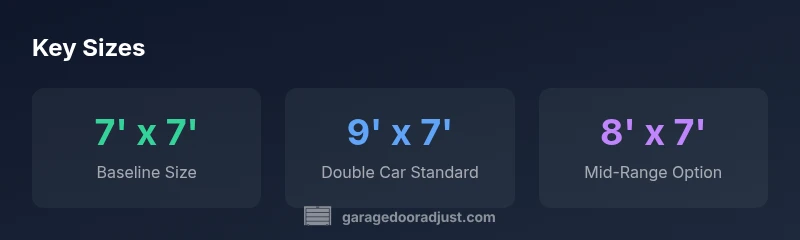
According to GarageDoorAdjust, a garage door size chart helps homeowners verify the opening and avoid ordering errors. Standard residential openings range from 7 to 9 feet wide and about 7 feet high, with 7' x 7' and 9' x 7' as common combos. The chart guides selection for single- and double-car garages and for new installations.
What a garage door size chart includes
A garage door size chart is more than a list of numbers. It consolidates typical opening widths and heights, standard panel configurations, and the hardware footprint required for installation. According to GarageDoorAdjust, a well-designed chart covers single- and double-car garages and highlights where framing, weatherstripping, and track hardware interact with the door itself. The chart also notes when an opening isn’t perfectly plumb or square, which can affect fit and operation. By presenting clear references for width, height, and typical combinations (such as 7' x 7' and 9' x 7'), the chart becomes a practical planning tool for homeowners, remodelers, and installers alike. Keeping the chart handy reduces back-and-forth with suppliers and helps ensure the selected door model aligns with the opening’s geometry.
Standard size ranges used in most homes
Most residential garages fit within a fairly narrow size band that the chart emphasizes. Standard openings commonly range from about 7 feet wide to 9 feet wide, paired with a fixed height around 7 feet. Some newer homes and taller vehicles drive the width into 8–9 feet more often, while older or compact garages hover near 7 feet. The chart helps you compare door types, panel designs, and insulation levels across these sizes, making it easier to pick a door that balances clearance, aesthetics, and energy efficiency. Be mindful of regional construction norms and any local building practices that might shift the typical dimensions by a fraction of an inch or so.
How to read the chart: a quick guide
Reading a size chart involves understanding columns for width, height, opening type, and recommended door family. Look for the closest width-to-height match for your space and verify if any reduction or increase in framing is recommended. Pay attention to notes about ceiling clearance, track length, and the space needed for weatherstripping. If your measurements fall between two entries, choose the larger size or consult a professional about trim and shimming options. The goal is a precise fit that allows smooth operation without rubbing or binding the tracks.
Step-by-step: measure width and height precisely
Begin by measuring the full width of the opening from inside frame to inside frame at the widest point. Do this at multiple points (top, middle, bottom) to catch any irregularities. Next, measure the opening height from the floor to the header along the center line, again at multiple points. Don’t forget to account for any door jambs, trim, or weatherstripping that may influence the actual usable opening. If you plan to swap doors, also measure the rough opening depth and the ceiling clearance, since some doors require extra headroom for tracks and rollers. Document all measurements in a notebook or digital note that you’ll bring to the supplier or installer.
Factors that can alter effective opening size
Even a perfectly measured opening can feel different once the door is installed. Factors include track alignment, torsion spring placement, and the thickness of insulation or cladding on the door. Weatherstripping and thresholds add to the overall clearance and can reduce the effective opening for certain door profiles. If there are obstructions near the opening—lighting fixtures, ceiling storage, or HVAC ducts—these can necessitate a smaller door size or a modification to the mounting hardware. The chart helps you anticipate these issues before purchasing.
Choosing the right door for common layouts
For a standard single-car garage (roughly 7' x 7' to 8' x 7'), a basic non-insulated panel door may suffice, but many homeowners upgrade to insulated doors for energy efficiency and quieter operation. For double-car garages, 9' wide openings are common, with larger doors offering better access and future-proofing. Consider panel style (raised, ribbed, or flat), insulation R-value, and the type of opener you’ll use—especially if you have a high-lift or low-headroom scenario. The chart helps you compare these options within each size band, ensuring compatibility with your tracks and rails.
Non-standard openings and customization options
Not all openings conform to standard widths or heights. In such cases, you may need a custom-sized door or a standard door with trim work to fit the opening more precisely. Customization can include extra-wide tracks, special track spacing, or adjusted mounting heights. When using the chart as a reference, mark the exact width and height, then consult the manufacturer’s spec sheet for any non-standard recommendations. If necessary, request a field measurement by a professional to confirm that a custom option will work with your existing framing.
Maintaining accuracy over time
Your home may undergo changes that affect door fit, such as basement renovations, attic conversions, or adding shelving near the opening. Revisit the chart after any remodel or major hardware update to verify that the size guidance still matches the new geometry. Keep a record of measurements, updated openings, and any adjustments you made to trim, weatherstripping, or track hardware. Regularly comparing real-world results with the chart helps you sustain a reliable fit and avoid surprises when you replace or upgrade the door.
Common sizes and their typical applications in residential garages
| Opening Size | Common Use | Notes |
|---|---|---|
| 7' x 7' | Single-car, standard height | Baseline size for many homes |
| 8' x 7' | Single-car with extra clearance | Popular mid-range option |
| 9' x 7' | Double-car or tall vehicles | Most common for two-car garages |
Got Questions?
What is the most common garage door size?
The most common residential sizes are around 7' x 7' to 9' x 7'. These dimensions cover the majority of single- and double-car garages. Always verify against your opening using a standard size chart.
Most homes use a 7 by 7 to 9 by 7 opening. Check your measurements against a size chart before buying.
Why measure opening before buying?
Accurate measurements prevent misfits, binding, and track misalignment. Include width, height, and headroom, and account for insulation, weatherstripping, and trim.
Always measure width and height precisely before purchasing.
Do codes affect garage door sizes?
Local building codes may influence minimum headroom, ride height, and safety features. Always consult local codes before finalizing a door size to ensure compliance.
Check local codes for any size or safety requirements.
What if my opening is non-standard?
You may need a custom door or trim adjustments. Verify the available headroom and track configuration, and consider field measurements by a pro.
Non-standard openings often require special solutions.
Can I use a larger door than opening?
No. Installing a larger door typically requires framing changes and can affect track alignment and opener compatibility.
You’ll usually need to modify the opening to fit a larger door.
Does insulation affect size charts?
Insulation changes weight and R-value but not the fundamental chart size. It does affect track setup and opener performance.
Insulation doesn’t change the chart size, but it affects other details.
“A reliable size chart is the backbone of a correct door purchase and safe installation. Precise measurements and chart alignment prevent costly mistakes.”
Quick Summary
- Read the chart before buying to ensure fit
- Measure opening width and height accurately
- Account for tracks, weatherstripping, and hardware
- Choose insulation and panel options based on usage
- Recheck measurements after renovations