Garage Door Opener: How to Choose for Your Home today
Learn how to pick the right garage door opener with a balanced focus on drive type, horsepower, safety features, and smart compatibility. This guide covers evaluation criteria, comparisons, and practical installation considerations for homeowners.


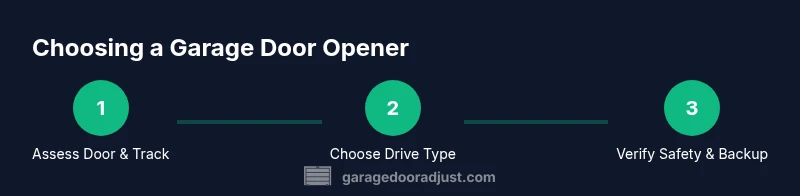
You will choose a garage door opener by evaluating drive type, horsepower, safety features, and compatibility with your door and budget. Start by identifying a drive that fits your noise tolerance and installation needs (belt for quiet, chain for cost, screw for balanced performance), then compare horsepower, safety sensors, backup power, and smart features. End with a practical price range and a plan for installation.
Why the right garage door opener matters
Choosing a garage door opener with care matters for safety, reliability, and daily convenience. A poorly matched opener can wear prematurely, create unnecessary noise, or fail to lift a heavy door. Homeowners benefit when the opener matches door weight, track configuration, and mounting options, while prioritizing quiet operation, backup power, safety sensors, and smart features. According to GarageDoorAdjust, the right choice also reduces the risk of jams and track damage and helps avoid frequent service calls.
Before you buy, take stock of your door’s weight, track layout, and garage usage. Map features to priorities: quietness, safety, battery backup, and future-proof connectivity. This approach makes the buying process efficient and reduces buyer’s remorse later on. You’ll also want to consider installation requirements and whether you’ll need professional help to achieve optimal alignment and safe operation. The more deliberate your assessment, the more dependable your opener will be over years of use.
As you read, compare models side-by-side and note which items you truly need vs. “nice to have.” Practical testing as you shop—like verifying remote range and app responsiveness—will translate into fewer headaches once it’s installed in your garage.
Understanding drive types
There are several drive configurations for residential openers, each with trade-offs in noise, maintenance, and price. Chain drives are typically the most affordable and robust but tend to be louder, which matters if your garage is attached to living spaces. Belt drives run smoother and quieter, making them a popular choice for bedrooms above the garage or open-plan homes. Screw drives are a middle ground, offering decent speed with moderate noise; direct-drive (or jackshaft) openers, while less common in older homes, provide excellent quiet operation when a ceiling-mounted unit isn’t feasible.
When deciding, consider how much you value quiet operation versus upfront cost and ease of maintenance. Belt drives shine in noise-sensitive setups; chain drives are hard to beat on price and durability; screw drives offer a balance that can work well for many single-car garages. For garages with limited space or unusual layouts, assess whether a ceiling- or wall-mounted solution is possible and compatible with your door’s track arrangement. GarageDoorAdjust analyses indicate that most homeowners select belt or chain drives based on noise tolerance and installation constraints. The key is to choose a configuration that aligns with your door type and garage use, not just the lowest price.
Horsepower and door weight: how to match
Horsepower translates into lifting capability and speed. In typical residential doors, many professionals start with a 1/2 HP unit for standard single-car doors and move up to 3/4 HP for heavier doors or dual-car configurations. Heavier wooden doors or doors with extra insulation may benefit from a 1 HP model or a slightly higher rating. The goal is to have enough power for smooth lifting and consistent operation without overworking the motor, which can shorten its life.
To assess what you need, estimate your door’s weight (often printed on the door or in the manufacturer documentation) and review the opener’s rated lifting capacity. If your door has high-tension springs or unusual track geometry, you may need a higher horsepower model, or you may require professional service to ensure safe operation and proper balance. Avoid underpowered units that stall or struggle with warm-up and closing. The right horsepower helps preserve the system and reduces the likelihood of premature component wear.
Noise, vibration, and durability considerations
Noise level isn’t the only consideration—vibration and overall durability influence long-term satisfaction. Belt drives are often the quietest, thanks to flexible carriers and smoother operation, while chain drives tend to transmit more vibration into the structure. If you have a living area adjacent to the garage, you’ll want options with anti-vibration mounts and reinforced brackets to minimize sound transfer. Durability also depends on the rail and hardware quality; look for units with steel reinforced tracks and corrosion-resistant components for longevity.
In addition, consider installation constraints: ceiling height, ceiling type, and whether you’ll mount the opener to the ceiling or wall. A properly mounted unit reduces wobble and wear. Budget-conscious buyers should still prioritize reliable track alignment and a robust rail system to prevent rattling and misalignment over time. A well-chosen opener balances noise, smoothness, and long-term durability, delivering more consistent performance with less maintenance.
Safety features you should demand
Every garage door opener should include essential safety features that protect your family and pets. At minimum, ensure there are photo-eye safety sensors that reverse the door when an obstruction is detected, plus auto-reverse when resistance is encountered during closing. A manual release mechanism and clear instructions for disengaging power in an emergency are also important. A rolling code transmitter helps prevent signal interception, and a status indicator on the unit can alert you to misalignment or sensor faults. In some regions, additional safety standards apply, so check local codes.
Don’t skip testing the safety features after installation: place an object in the door’s path and confirm that the door reverses as intended. Regular inspection of the mounting brackets, rollers, and springs will reduce the risk of accidents and ensure smoother operation. The combination of reliable safety features and routine checks pays off in long-term peace of mind.
Battery backup and power outages
Power outages can render a garage door opener inoperable, which is inconvenient and potentially unsafe if you rely on the door for egress. A battery backup allows the opener to function during outages, enabling manual operation when needed and eliminating the need for a power restore before you can access the garage. When choosing, look for a backup solution that pairs with your preferred drive type and that supports a reasonable number of cycles without draining the main system.
Consider the location of the backup battery and how easy it is to replace. If your garage is used as a workshop or living space, a battery backup may be particularly valuable, ensuring you can enter and exit freely during emergencies. GarageDoorAdjust notes that homeowners who prioritize backup power report smoother transitions during outages and greater overall reliability.
Smart features and app integration
Smart features add convenience but require careful evaluation. Common options include remote controls, smartphone apps for status checks, and integration with home automation or voice assistants. Look for features such as remote operation, scheduled opening/closing, activity logs, and the ability to grant access to family members. Ensure the app provides reliable notifications and that it is compatible with your phone, tablet, or smart home ecosystem. If you value future-proof tech, choose a system with ongoing firmware updates and a reputable support channel.
Remember that smart features can add layers of complexity, so verify that basic operation remains straightforward even if the app isn’t available. A smart-enabled opener should still function reliably without connectivity, delivering essential daily use with predictable results.
Compatibility checks before you buy
Compatibility is more than matching the door to the opener’s capacity. Verify rail length, track height, and mounting hardware compatibility with your garage’s ceiling structure. If you have a low ceiling or a unique door track, you may need a compact unit or a wall-mounted jackshaft model. Check the door’s weight rating, spring configuration, and any special hardware required by your door design. If you’re unsure, consult the door manufacturer’s documentation and have a professional verify mounting clearance and clearance for the safety sensors.
Also check whether the opener supports repair parts locally and whether the brand offers replacement remotes and keypads. A reliable support network reduces downtime when you need replacements or updates.
Price, warranty, and service plans
Price ranges for garage door openers vary with drive type, horsepower, and features. While you should compare several models, prioritize value over price alone: look for solid warranties, service network availability, and clear maintenance requirements. Longer warranties often reflect higher build quality and stronger support. Review what is covered (motor, gears, safety components) and how easy it is to obtain service in your area. If you anticipate future upgrades or plan to use smart features heavily, consider a model with a transferable warranty and accessible repair options. GarageDoorAdjust analysis shows that understanding warranty terms can save money over the life of the unit, especially if your garage is used daily. The right warranty combined with a trusted installation source reduces the risk of unexpected costs.
Installation considerations and professional help
If you’re comfortable with basic electrical work and mechanical mounting, you can handle a straightforward installation with careful measurement and alignment. However, many homeowners prefer a professional installation to guarantee proper balance, track alignment, and safe sensor placement. A pro can ensure correct torsion balance, rail length, and wall/ceiling mounting to prevent vibrations and misalignment. If you choose a DIY path, follow the manufacturer’s step-by-step instructions, wear safety gear, and disconnect power before starting. For most households, hiring a pro leads to faster, safer results and can be cost-effective when you factor in reduced comebacks, warranty coverage, and proper alignment.
Quick-buy checklist
- Identify your door weight and track configuration
- Choose a drive type (belt for quiet, chain for value, screw for speed)
- Match horsepower to door weight and height
- Confirm safety features: auto-reverse, photo-eye sensors, manual release
- Verify backup power options and reliability
- Check smart features and app compatibility
- Review warranty and service availability in your area
- Ensure proper installation options with your chosen pro or yourself
Common mistakes to avoid
- Skipping measurement checks and buying based on guesswork
- Neglecting safety sensor installation and alignment
- Ignoring compatibility with existing remotes and remotes compatibility
- Failing to consider backup power, which can disrupt daily use
- Rushing to install without testing balance and travel limits
Tools & Materials
- Tape measure(To verify door width, track length, and clearance)
- Level(For mounting brackets and rail alignment)
- Screwdriver set(Phillips and flat-head for mounting hardware)
- Cordless drill/driver(For screws and brackets)
- Pliers(General grip and adjustments)
- Voltage tester(Safety check before wiring)
- Ladder (6-8 ft)(Access ceiling hardware safely)
- Safety glasses(Eye protection during install)
- Door manual/existing owner’s manual(Reference for door weight and track setup)
Steps
Estimated time: 60-120 minutes
- 1
Assess door and mounting options
Record door weight, track type, ceiling height, and mounting constraints. Use this data to narrow drive types and mounting methods that fit your space.
Tip: Have the door weight and track layout handy when shopping. - 2
Identify your preferred drive type
Compare belt, chain, screw, and direct-drive options. Consider noise level, tension, and maintenance requirements relative to your living space.
Tip: For bedrooms above the garage, lean toward belt drive for quiet operation. - 3
Choose the right horsepower
Match motor power to door weight and height to ensure smooth lifting without overworking the motor.
Tip: Avoid underpowered models that stall during operation. - 4
Evaluate safety features
Ensure auto-reverse, photo-eye sensors, and manual release are included and properly installed.
Tip: Test safety features after installation to confirm proper operation. - 5
Consider backup power options
Choose a model with battery backup or an alternate power solution to ensure operation during outages.
Tip: Plan for outages if you live in an area with frequent power interruptions. - 6
Assess smart features and connectivity
Review app compatibility, remote access, and integration with your smart home system.
Tip: Ensure you’ll actually use the app or remote access before paying for extras. - 7
Check compatibility with your door
Confirm rail length, wall-to-rail distance, and sensor placement compatibility with your door and ceiling.
Tip: Double-check mounting clearance and sensor alignment. - 8
Compare price, warranty, and service plans
Weigh the long-term value of warranties and the service network against upfront costs.
Tip: Prefer models with transferable warranties and localized support. - 9
Decide on DIY vs professional install
If you’re comfortable with electrical work and alignment, a DIY path may work; otherwise hire a pro.
Tip: A professional can ensure proper balance and safe sensor placement. - 10
Make your final purchase plan
Select a model that balances drive type, horsepower, safety, and budget; place an order and plan installation.
Tip: Create a short checklist to compare models during checkout.
Got Questions?
What drive type is best for a quiet home?
Belt drives are typically quieter than chain drives and may be a better fit for attached garages. Consider your noise tolerance and budget when choosing.
For quiet operation, belt drives are usually best, especially if the garage is attached to living spaces.
Do I need battery backup for my opener?
Battery backup is helpful during power outages, ensuring you can still open and close the door. If outages are common in your area, prioritize models with a backup option.
A backup battery can keep your garage accessible during power outages.
What horsepower do I need for a standard residential door?
For most standard residential doors, 1/2 HP is sufficient, but heavier doors or insulated coatings may benefit from 3/4 HP or 1 HP units.
Most homes do well with 1/2 HP, heavier doors may require more.
Can I install the opener myself?
Some models are installable by confident homeowners, but many installations involve electrical wiring and precise alignment. If unsure, hire a professional to ensure safety and proper balance.
If you’re comfortable with electrical work and alignment, you can try, otherwise hire a pro.
What safety standards should I look for?
Look for UL 325 compliance and local safety codes. These standards govern safety features and performance in residential openers.
UL 325 compliance and local codes ensure baseline safety.
How important is smart home integration?
Smart integration is convenient but not essential. If you value remote control, scheduling, and notifications, choose a model with robust app support.
Smart features are nice to have, but not required for basic operation.
Watch Video
Quick Summary
- Identify door weight and track layout before shopping.
- Match drive type to noise tolerance and space constraints.
- Prioritize safety features and backup power.
- Check warranty and local service options.
- Decide DIY vs professional installation based on comfort and safety.