Garage Door Opener Batteries: A Step-by-Step Guide for Homeowners
Learn to identify, replace, and test garage door opener batteries safely. A homeowner-focused guide covering battery types, tools, safety tips, and maintenance to keep your door operating reliably.


You can replace the battery in your garage door opener and restore smooth operation. This guide covers battery types (9V, AA/AAA, or sealed lead-acid), when to replace, how to safely open the opener, and a step-by-step replacement process homeowners can perform. No special tools beyond basic household items are required for most common models.
Understanding garage door opener batteries
Your garage door opener relies on a reliable power source to operate smoothly, and the battery that powers the system's backup and remote signaling is a critical component. In many modern setups, garage door opener batteries come in compact packs that support the motor and the remote sensors when main power is interrupted. By understanding the role of these batteries, homeowners can diagnose outages faster and plan replacements without guesswork. According to GarageDoorAdjust, regular checks of battery health can prevent unexpected interruptions during busy mornings or late evenings. The GarageDoorAdjust Team emphasizes that the simplest, most reliable way to avoid failures is to know where the battery lives, what type it uses, and how to access it safely. As you work through this guide, you’ll learn to identify the correct battery type for your model, how to handle it safely, and how to test the system after a replacement. Remember: garage door opener batteries are a small but essential part of a larger system that includes the door, the opener, and the safety sensors. By keeping this component in good shape, you protect your home and your time.
Tools & Materials
- Replacement battery compatible with your model(Check model number and manual to confirm exact battery type.)
- Screwdriver set (Phillips and flat-head)(Necessary to open the control panel and battery compartment.)
- Safety gloves(Protect hands and grip; avoid sharp edges.)
- Safety glasses(Optional protection for eye safety.)
- Multimeter or voltage tester(Optional for testing voltage before/after replacement.)
- Cleaning cloth(Dry, lint-free cloth to wipe contacts and housing.)
- Towel or rag for spill cleanup(Useful if there is minor leakage or corrosion.)
Steps
Estimated time: 15-25 minutes
- 1
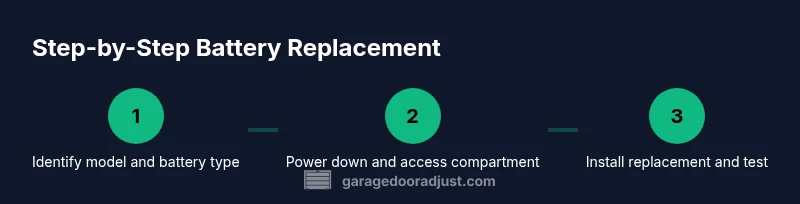
Power down and prepare
Unplug the opener or switch off the garage circuit to eliminate the risk of electric shock before touching any components. Gather your replacement battery and tools, and ensure the area is well-lit. This initial safety check protects you during the battery swap and helps you spot issues like corrosion.
Tip: Have a small flashlight ready to inspect dark battery compartments. - 2
Access the battery compartment
Locate the battery compartment on the opener or control panel, depending on the model. Remove any cover or panel screws carefully so you can view the battery and connectors. Take note of how the battery is seated for correct orientation when you install the new one.
Tip: Take a quick photo of connections before removal to aid reassembly. - 3
Remove the old battery
Gently disconnect any wires or clips and lift the old battery from its housing. If you encounter resistance, pause and recheck for hidden fasteners. Do not force connectors, as this can damage the opener’s internal circuitry.
Tip: Do not pull on wires; disconnect at the battery contacts instead. - 4
Install the replacement battery
Insert the new battery in the same orientation as the old one, reattach connectors securely, and reseal the housing. Ensure there’s no pinching of wires and that the battery sits snugly without wobble.
Tip: Check for a firm seating; a loose battery can cause intermittent failures. - 5
Restore power and test the system
Reconnect power, then test the door using the wall control and the remote from multiple distances. Confirm the door opens smoothly, and the safety sensors respond to obstructions. If anything feels off, re-check connections or consult the manual.
Tip: Run a quick power outage test by briefly cutting power and observing response from the wall switch. - 6
Dispose of the old battery responsibly
Place the old battery in a protected bag or container and recycle per local guidelines. Many communities require drop-off at approved facilities rather than trash disposal. Keeping a spare battery on hand can prevent future interruptions.
Tip: Never mix old and new batteries in the same container; dispose of them together only at approved sites.
Got Questions?
Do all garage door openers use the same battery types?
No. Battery type and size vary by model and manufacturer. Always check the manual or the manufacturer’s site to confirm compatibility before purchasing.
Battery compatibility varies by model, so check your manual before buying a replacement.
How often should I replace the garage door opener battery?
Replacement timing depends on usage and battery condition. Look for slower response, weak signaling, or frequent outages as signs to replace.
Watch for slower responses and weak signals as signs to replace the battery.
Is this a DIY-friendly task or should I hire a pro?
Most homeowners can safely replace garage door opener batteries following the manual. If you encounter unfamiliar wiring or leaks, consult a professional.
DIY is usually fine, but if you see leaks or aren’t comfortable with wiring, get a pro.
What safety steps should I take?
Always disconnect power, wear protective gear, and avoid touching metal terminals. Follow the manufacturer’s guidelines for your unit.
Power off first and wear protection; follow the manual for your model.
What are signs of a failing battery other than slow response?
Swelling, leakage, corrosion on terminals, or complete loss of function are indicators that the battery should be replaced.
Watch for swelling or leakage and replace if you notice any corrosion or failure.
Watch Video
Quick Summary
- Follow model-specific instructions for battery type
- Always cut power before starting work
- Test system after replacement to confirm operation
- Dispose of old batteries via recycling channels