Compare Garage Door Replacement Quotes: A Practical Guide
Learn how to compare garage door replacement quotes with a clear framework. This guide covers on-site measurements, material options, warranties, and negotiation tips to help homeowners secure the best price.


To compare garage door replacement quotes, collect at least three in-person estimates and a few online quotes. Compare scope (materials, labor, disposal), ensure on-site measurements, and verify warranties and timelines. A structured side-by-side helps you spot hidden costs and negotiate confidently. Also check installation date, access restrictions, and removal of old door.
How to Approach Garage Door Replacement Quotes
To compare garage door replacement quotes effectively, start by understanding your project scope and gathering multiple perspectives. According to GarageDoorAdjust, smart homeowners approach quotes as a mini-project: collect at least three in-person estimates and a handful of online quotes to establish a baseline. Set criteria in advance: required door type, insulation level, finish, opener compatibility, and disposal of the old door. When you evaluate quotes, insist on on-site measurements to avoid surprises later, and ask for a clear timeline and warranty details. A well-structured comparison reduces the risk of hidden costs and helps you negotiate from a position of knowledge. Keep records, compare apples to apples, and give each quote a rating based on scope clarity, itemization, and service commitments.
Understanding What Drives Quote Size and Value
Quotes are shaped by material choice, insulation, carriage of labor, site conditions, and whether removal of the old door is included. GarageDoorAdjust analysis shows that quotes vary significantly by material (steel, wood, aluminum) and by whether a steel track and opener upgrade are bundled. While regional labor rates influence totals, the biggest swings often come from door panel options, insulation level, and whether the installer includes à la carte components (weather seals, brackets, sensors). Aim for a detailed scope that lists every element so you can compare like-for-like across providers.
On-site Assessments vs Online Quotes: Pros and Cons
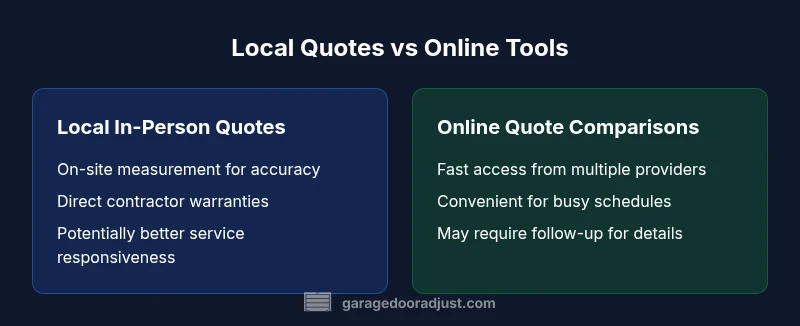
On-site assessments provide precise measurements, compatibility checks with existing openers, and a realistic timeline. They reduce the chance of measurement errors that lead to budget overruns. Online quote tools offer speed and convenience, letting you pull multiple quotes quickly and compare basic configurations. However, they may omit site-specific factors such as garage width, headroom, or permit requirements. A blended approach—start with online quotes for direction, then schedule on-site assessments with a shortlist—often yields the best balance of accuracy and efficiency.
Reading the Quote Line Items: Materials, Labor, and Disposal
A standard quote should break out line items for door panels (material and finish), insulation, tracks, springs, rollers, weather seals, and finish hardware. Labor hours, hourly rates, and crew size should be explicit. Look for disposal fees and any debris removal charges. Watch for optional add-ons such as upgraded openers, smart features, or higher-speed operations that can dramatically change the total. If a quote lumps several items into a single line item, ask for a detailed breakdown to ensure you understand exactly what you’re paying for.
Material Choices and Their Impact on Price and Longevity
The door material drives upfront cost and long-term value. Steel doors offer durability and lower maintenance, while wood doors can provide aesthetics at a premium price and maintenance burden. Aluminum doors are lightweight and resistant to corrosion but may dent more easily. Insulated doors reduce energy loss and sound transmission, which matters in attached garages. When evaluating quotes, request material samples or photos, and ask about long-term performance, maintenance needs, and repainting requirements. A higher initial investment can pay off with better durability and lower operating costs over time.
Insulation, Energy Efficiency, and Comfort
Energy-efficient doors improve climate control in attached garages, reducing heating and cooling loads for adjacent living spaces. Insulation choice (R-value) adds to initial cost but saves energy and may qualify you for rebates or tax credits in some regions. Compare quotes that specify door insulation thickness, foam density, and edge sealing. If your garage is used as a workshop or living area, prioritizing insulation can justify a higher upfront price due to ongoing energy savings and comfort gains.
Warranties, Service, and Maintenance Options
Different installers offer varied warranty lengths and coverage, from door components to the opener and labor. A strong warranty reduces long-term risk, but you should verify what is covered, for how long, and what conditions apply. Some quotes include maintenance plans or annual service visits; others leave maintenance to the homeowner. When comparing quotes, extract warranty terms verbatim and note any requirements for annual tune-ups that might impact long-term costs or service availability. A transparent warranty contributes significantly to total value.
Scheduling, Permits, and Timeline Considerations
Garage door replacement often requires scheduling around weather, crew availability, and permit processes in your municipality. Some regions mandate permits for structural changes or electrics, while others rely on installer certifications. Ask each provider about permit handling, typical lead times, and whether temporary garage access might be restricted during installation. A realistic timeline helps you coordinate with other home improvement plans and avoids conflicts that could delay the project or add costs.
Negotiation Strategies to Get Better Quotes
Use the quotes side-by-side to create leverage: ask for price reductions on high-margin line items, request price-matching with a competing quote, or negotiate bundled services that include disposal, weather seals, and opener upgrades. Don’t focus on price alone; emphasize scope clarity and warranty quality. If one quote lacks a critical component, use another quote as a reference to request its inclusion. A well-prepared comparison document strengthens your bargaining position and reduces the risk of after-sale surprises.
Red Flags and Hidden Fees to Watch For
Beware quotes that omit line-item details, include vague language, or promise unusually low prices without explaining how they’ll keep costs down. Common red flags include hidden disposal charges, mandatory maintenance contracts you didn’t ask for, or nonstandard hardware substitutions. Always confirm the exact door model, configuration, and opener compatibility. If the timeline seems rushed or the installer pressure-sells upgrades, take a step back and request a written scope before proceeding.
How to Build a Side-by-Side Comparison Chart
A robust comparison chart captures each quote’s scope, materials, labor, warranties, permits, and timeline. Start with a blank template, list the quotes, and fill in line items as precisely as possible. Use consistent units (e.g., door type, R-value, opener model) and color-code the differences to visualize where prices diverge. This structure not only clarifies the decision but also provides a solid basis for negotiations and final contract drafting.
Making the Final Decision: When to Choose Quality over Price
Strive for a balance: the lowest price isn’t always the best value if durability and warranty are weak. If a quote offers a superior door material, better insulation, and a longer warranty, the initial premium may pay off over time. Prioritize installers with strong reviews and on-site assessment capabilities. The goal is a solution that meets your needs now and reduces future risk and maintenance costs. In the end, a carefully curated mix of quotes—backed by a thorough comparison—delivers the most reliable outcome.
Conclusion and Next Steps
A thoughtful approach to compare garage door replacement quotes helps homeowners secure the best overall value. Gather multiple quotes, insist on on-site measurements, scrutinize line items, and verify warranties and permits. Use a side-by-side comparison to negotiate confidently and avoid common pitfalls. The GarageDoorAdjust team recommends combining local quotes with online comparison tools to achieve both accuracy and efficiency in your decision.
Comparison
| Feature | Local In-Person Quotes | Online Quote Comparisons |
|---|---|---|
| Scope clarity | Detailed on-site assessment provides precise scope | May rely on user input or templates; could miss site-specific factors |
| Cost transparency | Itemized line items with labor and materials | Often aggregated; require follow-up for breakdown |
| Accuracy of measurement | Very high due to on-site measurement | Variable; can be accurate if inputs are thorough |
| Warranties and service | Direct installer warranty and clear service terms | Platform-provided quotes may have limited warranty visibility |
| Time to obtain quotes | Typically 1-2 weeks depending on installers | Same-day to a few days depending on platform |
| Best for | Homeowners who want precise on-site assessment and local contractor relationships | Busy homeowners who want speed and convenience |
| Pricing risk | Higher potential for negotiated savings with direct quotes | Risk of inconsistent quotes; requires cross-checking |
Upsides
- Multiple quotes increase price discovery and leverage
- Clear comparison across scope and warranties
- Reduces risk of hidden fees with itemized quotes
- On-site assessments improve measurement accuracy
Disadvantages
- Time investment to collect and compare quotes
- Potential information overload from many options
- Online tools may yield less consistent service quality
- Coordination challenges if timelines conflict
Blend local quotes with online comparisons for best value
This approach provides precise on-site insight and broad price visibility. It minimizes hidden costs while maximizing negotiation power. The GarageDoorAdjust team recommends combining both methods for a thorough, reliable decision.
Got Questions?
What should be included in a garage door replacement quote?
A comprehensive quote should list door material, insulation level, opener details, hardware, labor hours and rate, disposal fees, and any warranty coverage. It should also specify permits, installation timeline, and post-install service terms.
A complete quote lists material, insulation, opener, labor, disposal, and warranty details, plus installation timeline and permits.
How many quotes should I collect?
Aim for at least three in-person quotes from local installers and a few online quotes to establish a baseline. More quotes improve your ability to compare scope and price, especially for custom door features.
Collect at least three in-person quotes and several online quotes to compare scope and price.
Is online quote comparison reliable?
Online quotes are fast and convenient but may lack site-specific details. Use them to seed your list, then verify with on-site assessments to confirm measurements and warranties.
Online quotes are convenient but verify with on-site assessments for accuracy.
Should I replace the opener with the door installation?
Not always required, but many upgrades pair a new door with a compatible opener for better performance and energy efficiency. Check compatibility and total cost before deciding.
Pairing a new opener with the door is common, but verify compatibility and cost.
How do warranties vary between installers and online quotes?
Installer warranties cover labor and parts for a defined period. Online quotes may reference third-party warranties or no coverage. Always confirm who backs the warranty and what it includes.
Warranties vary; verify who backs them and what is covered.
What if measurements differ between quotes?
If quotes differ due to measurements, request a re-measurement and a revised quote. Ensure the final scope matches your chosen door and includes exact dimensions.
Ask for a re-measurement and update quotes to match exact dimensions.
Quick Summary
- Collect at least three local quotes and a few online quotes
- Insist on itemized line items for all components
- Check warranties, permits, and timeline in writing
- Use a side-by-side chart to compare apples-to-apples
- Balance cost with quality and long-term value