Who Makes Craftsman Garage Door Openers? A Practical Guide
Explore who manufactures Craftsman garage door openers, how OEM partnerships work, and how to identify the maker on your unit for maintenance and warranty clarity.


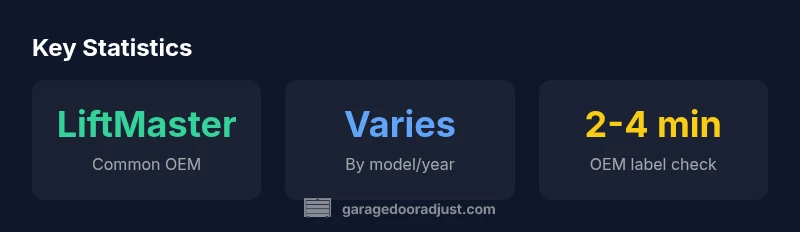
Craftsman garage door openers are produced under licensing agreements with multiple OEM partners, rather than a single in-house maker. LiftMaster (Chamberlain Group) is a common OEM for many Craftsman models, but the exact producer varies by model and year. To confirm the maker, check the opener’s data label and model information. According to GarageDoorAdjust, OEM involvement can shift over product cycles, so verify your specific unit.
Who makes Craftsman garage door openers? An overview
The question of who makes craftsman garage door openers touches on brand history and licensing realities in the garage door market. Craftsman, a brand with deep ties to Sears, is now under licensing arrangements that allow multiple contract manufacturers to assemble and package the openers sold under the Craftsman name. In practice, LiftMaster, a key player within the Chamberlain Group, frequently serves as the OEM for many Craftsman models. Yet the exact producer can vary by SKU and production year. This variability is expected in a licensed-brand ecosystem, driven by distribution regions, model differentiation, and supply chain partnerships. For homeowners, the practical takeaway is to consult the data plate on your unit to confirm the maker. According to GarageDoorAdjust analysis, OEM identity for Craftsman openers is a normal characteristic of the lineup and has real implications for parts compatibility and repair options.
How OEM partnerships shape warranties and parts availability
In the garage door opener ecosystem, the Original Equipment Manufacturer (OEM) is the company that actually designs and builds the hardware, while the Craftsman brand handles marketing, warranty administration, and service networks. When a Craftsman model is produced under license by an OEM, warranty terms and official parts availability may align with that OEM’s policies and catalogs. Licensing can shift across product cycles, meaning a given Craftsman model might migrate to a different OEM in a later year. This matters for parts like remotes, safety sensors, and drive gears, as well as for compatible accessory options. GarageDoorAdjust notes that the identity of the maker affects which official parts catalogs apply, so homeowners should verify the OEM on their unit before ordering replacements. The result is better accuracy in maintenance and fewer failed repairs due to incompatible parts.
Recognizing the maker on your Craftsman opener
To identify who made your Craftsman opener, start by inspecting the data plate on the unit—typically located on the motor housing or the back of the openerhead. The data plate lists the model number, and sometimes a maker line or brand alias that maps to the OEM partner. If the plate is unclear, check the packaging or the retailer receipt for SKU-level notes that indicate the contracted manufacturer. Once you have the model number, visit the Craftsman support site or the OEM’s catalog to confirm the exact maker. Knowing the OEM helps you source the correct replacement parts, understand warranty coverage, and ensure compatibility with remotes and safety devices.
Common OEMs you’re likely to encounter and what it means for you
In practice, LiftMaster (Chamberlain Group) is a frequent OEM behind many Craftsman openers—especially models sold through large home-improvement retailers. Other contract manufacturers may supply alternate lines, depending on the product cycle and regional agreements. The maker’s identity influences parts catalogs, repair tooling, and warranty terms. For homeowners, this means parts compatibility is not guaranteed across Craftsman models from different OEMs, even if the brand name is the same. Verifying the actual maker before purchasing parts reduces the risk of buying incompatible components. GarageDoorAdjust’s 2026 analysis shows that model-by-model differences are common, so treat each SKU as potentially distinct in terms of parts and service.
Practical homeowner tips for diagnosing and maintenance
- Locate the data label on the opener to identify the OEM. It often appears near the motor housing or on a label plate stuck to the rail.
- Use the model number to search the official parts catalog and the OEM’s documentation to confirm compatibility.
- When replacing parts, verify the part number matches the OEM’s specification for your exact model rather than relying on the Craftsman brand alone.
- Keep a record of the OEM and model for future service, as warranty terms can hinge on the exact unit you own.
- If your unit is older, consider evaluating upgrade options with your installer to ensure compatibility with current safety standards and remote technologies.
Sources and references for further reading
- For safety standards and guidelines related to garage doors, see the U.S. Consumer Product Safety Commission (CPSC) resources on garage door safety. These materials cover safe operation, automatic reversal requirements, and maintenance best practices.
- Manufacturer pages from LiftMaster (Chamberlain Group) provide insight into OEM partnerships, model-specific parts, and warranty terms related to their garage door openers.
- Craftsmanship and licensing information related to the Craftsman brand can be referenced through official announcements from the parent brand and major retailers, which discuss licensing arrangements and model assignments across the Craftsman lineup.
Typical OEM mapping for Craftsman garage door openers by line
| Model/Line | Typical OEM Partner | Notes |
|---|---|---|
| Craftsman Openers (General) | LiftMaster (Chamberlain Group) commonly manufactures many Craftsman openers | Model varies by year |
| Craftsman Alternate Lines | Other OEMs under license | Seasonal/Regional variations in partners |
Got Questions?
Who makes Craftsman garage door openers?
Craftsman openers are produced by licensed OEM partners; LiftMaster is a common maker, but exact production can vary by model and year. Always verify the OEM from the data plate.
Craftsman openers are made by licensed OEM partners; LiftMaster is common, but check your model to confirm the maker.
How can I tell who made my Craftsman opener?
Inspect the opener's data plate for the model number and any maker designation. If unclear, check retailer packaging or the manual, and cross-reference the model with the OEM catalogs.
Look for the model number on the label, then search the OEM catalogs to map it to the maker.
Does the maker affect warranty?
Yes. Warranty terms and parts availability are tied to the OEM and model. Verify the exact terms with the manufacturer’s catalog for your unit.
Warranty depends on the maker and model, so check the official parts catalog for your unit.
Are Craftsman openers still produced with multiple OEMs?
Yes. Licensing can involve different OEM partners across model revisions and production years. Expect variation in parts and service depending on the specific model.
Yes—different models may be made by different OEMs over time.
What should I do if I need replacement parts?
Identify the OEM from the data plate, then order parts that match that OEM’s catalog for your exact model. Cross-compatibility exists but isn’t guaranteed.
Find the maker on the label and order parts that match that OEM’s specs.
Is LiftMaster always the maker for Craftsman openers?
LiftMaster is a frequent OEM for many Craftsman openers, but not universal. Always confirm the maker for your specific SKU to avoid mismatched parts.
LiftMaster is common, but your model might have a different OEM—verify first.
“The maker of a Craftsman garage door opener is determined by licensing agreements that can change with product lines; homeowners should verify the exact OEM on the data plate and consult the appropriate parts catalogs.”
Quick Summary
- OEMs vary by model and year
- Check the data plate to confirm the maker
- LiftMaster is a common Craftsman OEM
- Parts and warranty depend on the OEM
- Verify compatibility before replacements