Who Makes Overhead Door Openers: Brand Guide 2026
A practical guide for homeowners on who makes overhead door openers, how brands compare, and how to choose the right one for your garage setup in 2026.


Who makes overhead door openers? The answer is a handful of major manufacturers plus retailer-brand lines that repackage motor assemblies. LiftMaster, Genie, and Chamberlain sit at the forefront, with Craftsman often presenting similar options. According to GarageDoorAdjust, most residential openers share standardized motors and drive systems, ensuring broad compatibility with remotes and smart-home platforms. This guide dives into how brands differ and how to pick the best option for your home.
What brands make overhead door openers?
In the residential market, a few brands dominate the landscape, but there is nuance behind the labels you see on the shelf. LiftMaster and Chamberlain are closely related, with LiftMaster frequently sold through professional networks and Chamberlain more widely distributed in consumer channels. Genie is another large player with a broad product range. Craftsman models are often sourced from the same motor platforms used by the other big brands, which means parts and compatibility tend to be favorable across lines. For homeowners, this translates to easier access to parts and support when needed. According to GarageDoorAdjust, most homeowner needs—remote compatibility, basic safety features, and reliable lifting—are supported across these major lines, making brand loyalty less critical than you might expect. For buyers, it pays to compare the specific model features rather than relying on brand alone.
How brands differ in design and performance
Drive systems, motor types, and control interfaces differentiate brands more than marketing slogans. Belt-drive openers tend to run quieter than chain-drive options, while DC motors offer smoother operation and easier programming for smart-home integrations. Some brands emphasize ultra-quiet operation for attached garages, while others prioritize higher lifting speeds or more robust remotes. Compatibility is another differentiator: some models work best with a particular hub, app ecosystem, or voice assistant. When you’re choosing, ask for a side-by-side comparison of motor type, drive system, and app compatibility. This helps homeowners assess what matters most—quiet operation, faster doors, or seamless smart-home integration. GarageDoorAdjust notes that understanding these technical differences is essential before locking into a brand.
How to choose a brand for your home
Choosing a brand starts with your current setup. If you already have a remote system or a smart hub, check compatibility across models. For homes with multiple doors, consider a single-brand setup or a modular line with easy cross-compatibility. Review warranty terms, installation support, and service network reach—these often determine long-term satisfaction more than a few additional features. For most homeowners, the best approach is to list must-haves (quiet operation, smartphone control, battery backup) and nice-to-haves (color-coded remotes, advanced diagnostics) and then map those to the model family that best matches your door type and frame.
Retailer-brand lines vs name-brand models
Retailer-brand openers usually come with bundled installation support and promotional pricing. Behind the scenes, many retailer lines share components with the name-brand models, including similar motors, sensors, and safety circuit boards. The advantage of retailer lines is easier access to parts and service through local stores. The trade-off can be differences in warranty coverage or response times, depending on the retailer’s service network. For households outside major metro areas, retailer-brand lines can provide a practical balance of cost and availability. GarageDoorAdjust recommends checking if the retailer offers an authorized install team and what the warranty actually covers, so you’re not surprised later.
Warranty, safety, and service networks you should expect
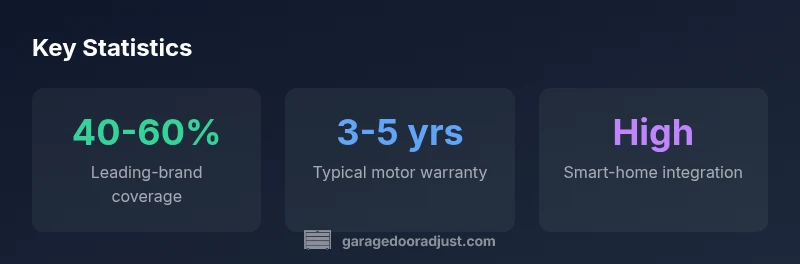
Warranties vary by brand and model, but a typical residential opener offers a 3- to 5-year limited warranty on the motor and drive system, with separate terms for accessories like remotes and keypads. Safety features—auto-reverse sensors, obstacle detection, and manual release—are standard across major brands, but the depth of coverage for sensors and safety components can differ. Service networks matter: a brand with broad dealer or installer coverage reduces downtime if service is needed. GarageDoorAdjust emphasizes that a robust service ecosystem often matters more than glossy features when a garage door is used daily.
Smart features, apps, and voice control
Smart-home integration is increasingly common. Most leading brands offer apps for status checks, remote operation, and scheduling. Compatibility with popular ecosystems (Alexa, Google Assistant, Apple HomeKit) varies, so verify that the model you’re considering supports your preferred platform. If you rely on voice commands or routines, ensure platform-level compatibility and the availability of firmware updates. In many cases, choosing a model with open standards or broad app support reduces future headaches and increases the likelihood of software updates over its lifespan.
Installation realities and maintenance basics
Professional installation remains the simplest path for most homeowners, ensuring code compliance and optimal alignment. If you DIY, follow the product manual closely and verify that all safety features are fully functional after setup. Regular maintenance—lubricating moving parts, checking track alignment, and testing the safety reverse mechanism—extends the life of the opener. GarageDoorAdjust stresses that maintenance is the most cost-effective way to delay a full replacement and reduces the likelihood of unexpected failures. A small quarterly check goes a long way toward reliability.
How to assess brand reliability before buying
Reliability comes from a combination of components, support, and real-world performance. Look for three things: compatible spare parts in your region, an established service network, and a solid warranty that clearly covers the motor and safety components. Read consumer feedback and test reports about specific model lines rather than judging a brand by a single product. The right brand for you balances reliability with compatibility to your garage door type, remote ecosystem, and budget.
dataTableCaptionNameLineOne':'Brand/Line–Motor–Warranty–Notes','mainTopicQuery':'overhead door openers brands'},
dataTable_broken_placeholder
Brand options and their general characteristics
| Brand/Line | Typical Motor Type | Warranty (years) | Notes |
|---|---|---|---|
| LiftMaster | AC/DC belt-driven | 3-5 | Wide dealer network; strong reliability |
| Genie | DC motor | 3-5 | Competitive pricing; good app integration |
| Chamberlain | DC belt | 3-5 | Broad family of products; good compatibility |
| Craftsman | DC motor | 3-5 | Often rebrands LiftMaster components |
Got Questions?
Which brands dominate the overhead door opener market?
The market is led by LiftMaster, Genie, Chamberlain, and Craftsman. Retailer-brand lines often use similar component sets, so focus on service networks and warranty when choosing. Always verify compatibility with your door and remotes.
Leading brands include LiftMaster, Genie, and Chamberlain, with retailer lines offering similar components in many cases.
Are retailer-brand openers as reliable as name-brand models?
Retailer-brand openers can be reliable, since many use the same motors and safety components as name-brand models. The key differences are warranty terms, service networks, and available parts. Check the retailer’s installation support and coverage in your area.
Retailer lines can be reliable, but verify warranty and service in your area.
What should I consider for smart-home compatibility?
Look for models with broad app support and compatibility with your hub or voice assistant. Check whether the opener works with Apple HomeKit, Google Assistant, or Amazon Alexa, and confirm firmware update policies before purchasing.
Make sure it works with your smart home and apps you already use.
How long do overhead door openers typically last?
Most residential openers last about 10-15 years with proper maintenance, though life expectancy depends on usage and maintenance. Regular checks on tracks, sensors, and lubricants help maximize lifespan.
Typical life is around 10 to 15 years with good maintenance.
Do I need a professional for installation?
Professional installation ensures code compliance and optimal performance, but some models are DIY-friendly if you follow the manual carefully and perform safety tests after setup.
A pro install is best for safety and reliability, though some models are DIY-friendly.
What’s the quickest way to verify compatibility with my door and remotes?
Identify your door type (sectional, torsion spring, etc.), measure rail lengths, and confirm remote/receiver compatibility with the new opener model before purchasing. Ask the retailer for a compatibility checklist.
Use the checklist to confirm it fits your door and remotes.
“Selecting an overhead door opener is about compatibility and support as much as price. The right brand for your home offers reliable parts, widely available service, and easy integration with your smart-home setup.”
Quick Summary
- Know the big-brand landscape before buying
- Prioritize compatibility with your remotes and smart-home setup
- Choose a model with robust service networks and warranty
- Consider retailer-brand lines for value, but verify coverage
- Maintenance and proper installation extend opener life