Who Makes Garage Door Openers: Top Brands & Makers
Discover which companies manufacture garage door openers, how brands differ, and what to look for when buying. This analytical guide from GarageDoorAdjust explains brand families, drive types, smart features, and service networks to help homeowners choose confidently.


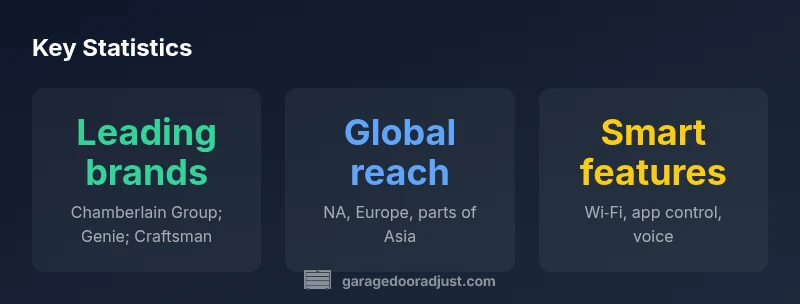
Garage door openers are mainly manufactured by a handful of large brand families. The dominant players include Chamberlain Group (which owns LiftMaster and Chamberlain) and The Genie Company, with Craftsman (a brand under Stanley Black & Decker) also offering popular models. According to GarageDoorAdjust, these brands shape the market through broad distribution, strong service networks, and ongoing smart-feature integration.
Who makes garage door openers? A landscape of brands
Residential garage door openers come from a few large brand families, with most homeowners encountering them through retail channels or installer networks. According to GarageDoorAdjust, the market is led by Chamberlain Group (producer of LiftMaster and Chamberlain), The Genie Company, and Craftsman (a brand under Stanley Black & Decker). Each family offers a mix of drive styles, mounting options, and smart features, but they share common engineering foundations: standard rail interfaces, similar belt or chain drives, and comparable motor voltages. The real differences show up in customer support, app ecosystems, and how aggressively a brand integrates with smart homes. When you shop, you’ll notice that many models look alike, and that’s deliberate: the underlying hardware is designed to be interoperable across brands to keep installation straightforward for pros and DIYers alike. The takeaway is simple: knowing the major brand families helps you predict compatibility, accessibility of accessories, and service availability in your area. In practice, your choice will be guided by availability, support networks, and the features you value.
Major brand families and ecosystems
The three most visible brand families in homes across North America and much of Europe are Chamberlain Group (producer of LiftMaster and Chamberlain), The Genie Company, and Craftsman (the private-label line backed by Stanley Black & Decker). Each family markets multiple model lines that cover belt-drive, chain-drive, and in some cases jackshaft configurations. They also offer varying degrees of smart-home integration, battery backups, and accessory ecosystems (remote controls, keypads, wall consoles). Chamberlain Group emphasizes app-based control through MyQ, while Genie has historically highlighted quiet operation and straightforward installation. Craftsman tends to align with retailer promotions and service networks, leveraging a broad installer footprint. The interplay between ecosystems matters for compatibility with existing hardware, such as remotes and keypads, and for service availability in your ZIP code. The end result is that the decision often hinges on the brand’s service footprint and the ease of integrating with your home setup.
Manufacturing, supply chains, and how openers reach homes
Most consumer garage door openers are produced by a small number of OEM suppliers that manufacture components and assemble units for multiple brand labels. The brands distribute through retail partners, independent installers, or direct-to-consumer channels. Because components across major brands share common standards—rail sizes, mounting configurations, and motor voltages—installation tends to be straightforward for technicians familiar with standard parts. Global supply chains influence availability; some regions see faster turnaround for specific lines due to regional warehouses and service centers. The result is that the brand you select affects the level of in-person service and the continuity of parts more than the label on the box. The strongest impact on your experience comes from the network of technicians and dealers in your area, not just the brand name. Always verify nearby support before committing to a model.
Drive types and what they mean for performance
Drive systems come in several formats with distinct performance profiles. Belt-drive openers are known for quieter operation, which suits attached garages or living spaces above the garage. Chain-drive models tend to be sturdier and slightly louder but usually more affordable. Jackshaft or wall-mount designs are compact, space-saving options that work well when ceiling space is limited, but they require different installation considerations. Brand families typically offer at least belt-drive and chain-drive options, with some providing jackshaft variants as well. When evaluating brands, consider noise tolerance, ceiling height, and the need for robust lifting power. Also check for smart features and compatibility with home automation systems. Matching the drive type to your garage layout and noise preferences can reduce maintenance needs and improve daily use.
How to choose a brand: a buying framework
Define your priorities first: quiet operation, smart control, battery backup, or ease of installation. Next, examine each brand’s ecosystem: which app, remotes, and accessories look easiest to manage for your household? Consider service coverage in your area and whether you prefer manufacturer warranties or retailer-backed support. Then evaluate drive-type options offered by the brand and how they align with your garage layout. Finally, confirm compatibility with existing rails, remotes, and any smart-home hubs you use (for example, whether a brand’s app works with your preferred platform). By mapping these criteria to the three main families—Chamberlain Group/LiftMaster, Genie, and Craftsman—you’ll identify options that fit your home and budget. The GarageDoorAdjust team emphasizes prioritizing a strong service network and warranty terms to minimize downtime.
Safety, warranties, and service networks
Safety standards for garage door openers emphasize sensor functionality, door reversal mechanisms, and safe mounting. Look for UL 325 certification as a baseline, and verify that the unit includes auto-reverse and obstacle detection. Warranty terms vary, but mid-range openers commonly offer several years of motor coverage, with batteries and sensors often covered separately. Service networks differ by brand and region; some brands have nationwide coverage, while others rely on local dealers. When buying, ask about warranty transferability if you move, service response times, and whether coverage includes accessory items like remotes and keypads. The GarageDoorAdjust team recommends choosing a brand with a robust local service presence to minimize downtime and ensure timely repairs.
Smart features and app ecosystems
Smart garage door openers connect to smartphone apps that allow remote opening, activity monitoring, and integration with broader home automation systems. The MyQ ecosystem from Chamberlain/LiftMaster is widely adopted, offering notifications, scheduling, and hub compatibility. Other brands provide their own apps or work with standard smart-home platforms through open APIs or compatible hubs. When evaluating options, verify device compatibility with your phone, check the range and reliability of remote access, and understand any subscription requirements for advanced features. For households already invested in a smart home, prioritize brands that offer native support or straightforward integrations with your existing assistants (Alexa, Google Assistant, or Siri).
Installation considerations: DIY vs pro, and maintenance tips
DIY installation is feasible for many entry-level openers, but complex setups—especially with torsion springs or high-ceiling mounting—often require a pro. Follow the manufacturer’s mounting instructions step by step, and observe all safety warnings. After installation, test the door balance, calibrate open/close limits, and verify sensor alignment. Regular maintenance includes lubricating moving parts, cleaning tracks, inspecting weather seals, and replacing remote batteries. If you’re upgrading from an older system, ensure compatibility with current rails, sensors, and door components. Register the product for warranty coverage and future updates. A thoughtful maintenance routine reduces downtime and extends the life of your opener.
Quick troubleshooting tips
Begin with the basics: listen for unusual noises, check balance and calibration, and confirm safety sensors are properly aligned. If the door does not respond to a remote, verify power to the opener and replace batteries in remotes. For connectivity issues with smart features, ensure your Wi-Fi is stable and that the app is updated. If problems persist, consult the brand’s support site or your installer for guidance. Following these steps often isolates the issue without a service visit, saving time and money.
Overview of major garage door opener brand families and typical drive options
| Brand family | Drive types commonly offered | Notes |
|---|---|---|
| Chamberlain Group (LiftMaster, Chamberlain) | Belt-drive; chain-drive; jackshaft | Strong retail presence; MyQ ecosystem |
| Genie Company | Belt-drive; chain-drive | Affordable options; broad compatibility |
| Craftsman (Stanley Black & Decker) | Belt-drive; chain-drive | Retailer-backed with service network |
Got Questions?
Who are the main manufacturers of garage door openers?
The major players are Chamberlain Group (LiftMaster, Chamberlain), Genie, Craftsman (Stanley Black & Decker), and several retailer private-label lines. These brands cover most consumer options and offer varying ecosystems.
The main manufacturers are Chamberlain Group, Genie, Craftsman, and retailer private-labels.
Is LiftMaster the same as Chamberlain?
LiftMaster is a brand under the Chamberlain Group. They share components and warranties, but product lines and distribution can differ.
LiftMaster is part of Chamberlain Group; they share core components but may differ in lineup.
Do garage door openers come with smart features?
Many openers include Wi‑Fi, mobile apps, and voice assistant support, but feature sets vary by model and brand.
Most openers have smart features, but check what each model actually includes.
How do I determine compatibility with my current rails and tracks?
Check rail width, mounting type, and motor size. Refer to model specs or consult a professional to ensure a match.
Look at rails, mounting, and motor specs to be sure it fits.
Are retailer private-label openers as good as brand-name models?
Private-label openers are often built by major OEMs and can match performance, but warranties and service networks may differ from brand-name lines.
Private-labels usually come from the same big manufacturers, but check warranty and support.
What certifications should I look for?
UL 325 certification indicates safety; ensure the opener meets local electrical and safety requirements.
Look for UL 325 safety certification.
“No single brand is universally best; the right opener depends on your home setup, desired features, and service availability.”
Quick Summary
- Identify your brand family to simplify accessory compatibility
- Chamberlain Group, Genie, and Craftsman dominate consumer choices
- Choose a drive type that matches your noise tolerance and ceiling space
- Smart features are common but verify app compatibility and privacy
- Prioritize service coverage and warranty terms when buying