LiftMaster vs Genie Garage Door Opener: An Objective Comparison
A data-driven comparison of LiftMaster vs Genie garage door openers, covering performance, installation, smart features, price, warranties, and what homeowners should consider in 2026.


TL;DR: LiftMaster and Genie are top-tier garage door opener brands. LiftMaster generally offers stronger smart-home integration and dealer support via MyQ, while Genie emphasizes budget-friendly pricing and simpler installation. This comparison highlights the key differences to help homeowners choose the right opener for their garage needs. Consider your existing remote controls, ceiling space, and whether you plan to expand smart-home automation. We'll break down performance, installation, and value factors to guide your decision.
liftmaster vs genie garage door opener: a practical comparison
Choosing between LiftMaster and Genie garage door openers hinges on ecosystem compatibility, installation practicality, and long-term value. According to GarageDoorAdjust, homeowners should start by clarifying which smart-home platform they prefer, then assess installation support, service availability, and warranty terms. The LiftMaster line is often favored for robust MyQ integration and a wide dealer network, while Genie appeals to budget-conscious homeowners who want a straightforward setup and fewer moving parts. This comparison dives into performance, ease of use, and total cost of ownership, so you can decide with confidence.
First, consider your current garage door hardware: torsion springs, tracks, and existing remotes. Many LiftMaster models pair best with older remotes and MyQ controllers, whereas Genie systems frequently offer simple sensor-free setups and compatibility with popular universal remotes. Noise level varies by drive type (belt vs chain) and mounting hardware, not merely brand name. Finally, warranty coverage and after-sales support can swing decisions, especially if you plan to upgrade later. By focusing on the decision factors most relevant to your situation, you’ll avoid overpaying for features you won’t use.
Key performance differentiators
Two core performance areas separate LiftMaster from Genie: reliability of operation and simplicity of integration with your home. LiftMaster's belt and chain drive options balance quiet operation with durability, and its MyQ ecosystem enables remote monitoring, scheduling, and automation rules across compatible devices. Genie emphasizes value through straightforward installation, fewer add-ons, and competitive pricing on popular models. When you weigh these factors, you’ll want to map them to your garage’s usage pattern: frequent access, family traffic, or storage control. Both brands meet safety standards and use modern sensors to detect obstructions, but the depth of reporting and compatibility with third-party home assistants differs. GarageDoorAdjust's analysis suggests prioritizing the ecosystem that aligns with your current devices to minimize future compatibility headaches. For most homeowners, the decision reduces to whether you want a robust smart-home suite or an economical, easy-to-install unit.
Connectivity and smart-home features
LiftMaster's MyQ remains the flagship option for remote access, scheduling, and integration with platforms like Amazon Alexa and Google Assistant via the MyQ app and optional hub. Genie provides reliable smart features through Aladdin Connect or built-in Wi-Fi on newer models, offering app-based control and remote monitoring. In practice, both brands support smartphone control, voice commands, and compatibility with popular ecosystem devices, but the depth of integration and required subscriptions differ. For reliability, ensure your Wi-Fi network is stable; for privacy, review cloud data practices; for future-proofing, consider whether the ecosystem offers a clear upgrade path or interoperability with your existing smart home devices. According to GarageDoorAdjust, the choice often comes down to whether you prefer a dealer-supported ecosystem or a more DIY-friendly setup.
Installation, compatibility, and hardware considerations
Garage door opener installation hinges on several hardware factors: torsion vs. extension springs, track configuration, and the install rail length. LiftMaster generally offers broad compatibility with a wide range of accessories and professional installation support, which is helpful for homes with older remotes or accessory components. Genie tends to cater to DIY enthusiasts with simpler installation steps and fewer special tools required, making it a popular choice for quick upgrades. When selecting, verify compatibility with existing remotes, keypads, and safety sensors. Also consider whether your garage has ceiling space constraints that affect rail length and motor mounting. In most cases, both brands meet current safety standards and provide obstruction-sensing features, but your choice should reflect your comfort level with installation and the complexity of your door system.
Battery backups, safety, and maintenance
Battery backup capability is a major factor for homeowners in areas prone to power outages. LiftMaster and Genie both offer models with reliable backup options, though the availability varies by series and model. Safety features like obstacle detection, auto-reverse, and photoeye alignment are standard across most models from both brands. Regular maintenance—lubricating moving parts, inspecting tracks for alignment, and testing safety features—extends the life of any opener. When budgeting, include potential costs for replacement remotes, keypads, and sensor modules, which differ slightly between LiftMaster and Genie ecosystems.
Price ranges, warranty expectations, and value
Price is a key differentiator between LiftMaster and Genie. LiftMaster models tend to sit in a mid-to-high price tier, especially for systems that integrate deeply with the MyQ ecosystem and dealer support. Genie offers strong value with budget-friendly options and straightforward installation, though some higher-end Genie models also enter the mid-range. Warranty length varies by model and retailer, but most reputable dealers provide at least a multi-year warranty on both brands. For long-term value, consider total cost of ownership, including potential subscription services, accessory purchases, and service visits.
DIY vs professional installation: what’s realistic
DIY installation is feasible for many Genie units, especially those designed for simpler rail setups and fewer components. LiftMaster installations, particularly for door systems with older hardware or longer rails, often benefit from professional installation to ensure safety and correct alignment. If you’re replacing existing hardware, budget for a professional assessment and potential hardware upgrades, as misalignment can lead to noise, wear, and reduced safety. Weigh the value of a guaranteed pro install against the convenience and speed of a DIY approach.
Brand ecosystems and future-proofing
Your choice should consider ecosystem strategy and future-proofing. LiftMaster relies heavily on the MyQ cloud platform and ecosystem, which continues to evolve with new automation rules and integrations. Genie emphasizes accessible connectivity through Aladdin Connect and newer models with built-in Wi-Fi, offering a simpler path for those who want a straightforward setup without a separate hub. Both brands aim to be compatible with popular smart-home devices, but LiftMaster’s approach generally provides deeper enterprise-style features and dealer support, while Genie prioritizes affordability and ease.
Common myths debunked
- All smart features require a subscription: most basic remote control and app features are included; some advanced automation may require optional services.
- More expensive means better reliability: price often reflects ecosystem depth and dealer support rather than inherent reliability alone.
- DIY installation is always risky: for basic Genie installs, DIY can be safe and cost-effective, but complex doors may require professional help.
- One brand is universally better: both have strengths; the right choice depends on your home, budget, and tech goals.
Use-case scenarios: who should choose LiftMaster vs Genie
If you want strongest smart-home integration and dealer-backed support for ongoing service, LiftMaster is a solid choice. If you’re budget-conscious, prefer a quicker DIY installation, and want straightforward control, Genie is often the better fit. For homes with older remotes or extensive accessory ecosystems, LiftMaster may offer a smoother upgrade path; for first-time buyers upgrading a single-car garage, Genie’s value and simplicity can be compelling.
Choosing the right opener: a decision framework
- List top needs: smart-home integration, ease of installation, budget, and service availability.
- Check compatibility: verify remotes, sensors, and any existing wall control units.
- Assess ecosystem commitment: decide whether you want ongoing cloud features, or a simpler, standalone system.
- Decide on installation approach: DIY vs professional; factor in rail length, door weight, and safety alignment.
- Plan for future upgrades: ensure the chosen brand offers a clear upgrade path and widely available parts.
Authority sources
For further reading on safety and standards, you may review official resources such as Energy.gov guidance on home electrical safety, the U.S. Consumer Product Safety Commission on garage door safety, and OSHA guidelines for residential equipment handling. These sources provide context for why modern openers emphasize safety, reliability, and proper installation.
Comparison
| Feature | LiftMaster | Genie |
|---|---|---|
| Connectivity & Smart-Home ecosystem | MyQ integration with optional hub; strong dealer network | Built-in Wi-Fi via Genie app (Aladdin Connect) in newer models |
| Battery backup options | Backup capabilities via compatible models and accessories | Backup available on select models with built-in or addon options |
| Installation practicality | Pro-friendly with extensive dealer/install support | Generally DIY-friendly with simpler install process |
| Drive system options | Chain and belt drive options; quiet variants available | Predominantly belt-drive options with some chain variants |
| Warranty and service | Dealer-backed warranties; broader service network | Manufacturer-backed warranties; strong value perception |
| Best-use scenarios | Smart-home builders, those needing MyQ ecosystem | Budget-conscious buyers, quick installs, straightforward setup |
Upsides
- Strong dealer network and MyQ ecosystem for remote control and automation
- Extensive accessory compatibility and proven reliability in many homes
- Solid resale value and recognized brand support
Disadvantages
- Typically higher upfront cost for feature-rich models
- Some advanced capabilities require extra hubs or subscriptions
- Genie models may offer simpler setups with fewer enterprise features
LiftMaster generally offers stronger ecosystem integration and dealer support, while Genie provides budget-friendly options and easier installation; choose based on ecosystem preference and installation goals.
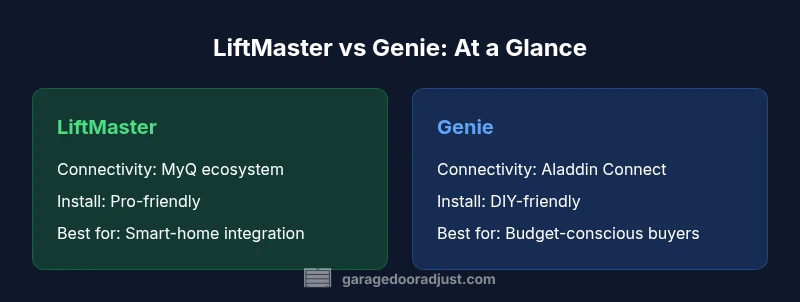
LiftMaster is best for smart-home enthusiasts seeking robust MyQ features and dealer support. Genie is best for budget-conscious homeowners prioritizing simple, quick installs.
Got Questions?
Which opener offers better smart-home integration, LiftMaster or Genie?
LiftMaster generally offers deeper smart-home integration via the MyQ platform, with broader accessory support and dealer-led updates. Genie provides solid app-based control with Aladdin Connect, but may not match the breadth of MyQ for advanced automations.
LiftMaster tends to lead in smart-home integration with MyQ, while Genie offers reliable app control via Aladdin Connect.
Is installation easier with Genie than LiftMaster?
Genie models are typically marketed as DIY-friendly with quicker setup. LiftMaster units, especially higher-end models, often benefit from professional installation to ensure optimal calibration and safety alignment.
Genie is usually easier to install yourself, while LiftMaster can require pro installation for advanced setups.
Do both brands offer battery backup?
Yes, both LiftMaster and Genie offer battery backup options on select models. Availability depends on the specific model line and retailer, so verify before purchasing.
Both brands offer battery backup on select models; check the exact model for availability.
What should I know about warranties for LiftMaster and Genie?
Warranty length varies by model and retailer for both brands. Dealer networks often provide extended coverage and easy service access, which can influence total ownership cost.
Warranties differ by model and retailer; dealers often offer better service coverage.
Can I mix remotes or sensors between LiftMaster and Genie?
Interoperability is limited between brands. It’s best to match remotes and sensors to the specific opener model to ensure compatibility and safe operation.
Remotes usually don’t cross-brand well; pair accessories to the corresponding opener model.
Which is best for a DIY homeowner with a tight budget?
Genie typically offers strong value with easier installations and affordable models, making it a compelling choice for DIY homeowners on a budget.
For tight budgets and DIY installs, Genie often provides the best value.
Quick Summary
- Assess ecosystem needs before buying
- Weigh installation effort against desired features
- Account for warranty and service quality
- Check compatibility with existing remotes and sensors
- Plan for future upgrades and maintenance