Chamberlain vs Genie Garage Door Openers: A Thorough Comparison
Compare Chamberlain and Genie garage door openers on noise, compatibility, smart features, installation, and value. This data-driven guide from GarageDoorAdjust helps homeowners pick the right opener.


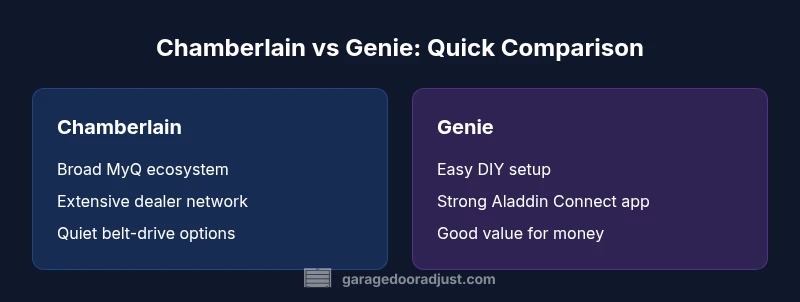
For the Chamberlain vs Genie garage door opener decision, Chamberlain generally offers broader compatibility and stronger dealer support, while Genie often prioritizes quieter operation and a consumer-friendly app experience. This quick comparison highlights the key differentiators in installation, noise, smart features, and long-term value, helping homeowners quickly decide which brand aligns with their needs.
Introduction to the Chamberlain or Genie Garage Door Opener Landscape
When homeowners begin evaluating a chamberlain or genie garage door opener, the goal is to find a reliable, compatible system that fits the garage’s size, usage, and smart-home setup. The exact choice often hinges on how you use your garage: daily access, interaction with a smart home, or integration with a vehicle’s built-in controls. According to GarageDoorAdjust, the most important factors are compatibility with existing remotes and rails, available support networks, and the ecosystem around smart features. The GarageDoorAdjust team found that most households benefit from focusing on three core criteria: ease of installation, noise level, and the breadth of support and accessories. As you read, keep in mind that the term “chamberlain or genie garage door opener” represents family-brand tier differences rather than a single model. In practice, homeowners should map their garage dimensions, ceiling height, and door type to the two ecosystems to avoid overpaying for features they will not use.
Quick Context: What Sets These Brands Apart
Both Chamberlain and Genie offer belt-drive and chain-drive options, a wide range of horsepower options, and app-based controls. Chamberlain’s MyQ ecosystem is widely adopted and often lauded for broad compatibility with third-party smart-home platforms, while Genie emphasizes user-friendly setup and robust app control through Aladdin Connect. Your choice may hinge on whether you prefer the MyQ or Aladdin Connect experience, the availability of local service, and the specific drive and sensor configurations your door requires. The GarageDoorAdjust analysis shows that installation complexity, sensor reliability, and warranty terms are frequently the deciding factors after brand familiarity.
The Intake: First-Hand Considerations for Homeowners
Before choosing, measure your door height, track type, and ceiling clearance. Confirm whether your current remote controls and keypads can be migrated or if a replacement kit is necessary. Consider whether you want built-in battery backup for power outages and how often you anticipate remote pairing or app usage. In many households, a belt-drive unit is the preferred balance of quiet operation and durability, but the door’s weight, track alignment, and existing hardware may favor a chain-drive option. Understanding these constraints helps translate abstract marketing claims into a practical, real-world setup.
Key Differences at a Glance: Drive Styles, Apps, and Accessibility
Drive style and noise have a material impact on daily use. Belt-drive models from both brands tend to be quieter than chain-drive equivalents, with Belt-drive variants commonly recommended for attached garages. App ecosystems are the next major differentiator: Chamberlain’s MyQ offers broad compatibility with smart-home ecosystems but can require a subscription tier for some advanced features, whereas Genie’s Aladdin Connect tends to emphasize straightforward setup and strong local control. Service network breadth also matters; Chamberlain typically benefits from a larger installation and service footprint, while Genie is known for specialized dealer networks and quick support in many regions.
Practical Scenarios: When to Choose Chamberlain
If you value widespread compatibility with smart-home assistants (Alexa, Google Assistant, and Apple HomeKit where supported), and you want access to an expansive accessories marketplace and dealer network, Chamberlain is often the safer default. It is also a solid choice if you plan to replace multiple components over time and want uniform parts availability. For households with busy routines, the MyQ ecosystem can offer straightforward scheduling, remote monitoring, and device automation that scales with your home’s needs. The trade-off for many users is the potential for subscription-based features and a slightly higher upfront cost in some configurations.
Practical Scenarios: When to Choose Genie
Genie’s strengths lie in user-friendly installation, solid app performance, and routinely quiet operation with belt-drive options. If you install the opener in a garage with frequent entry and exit and you want a quick setup that minimizes manual tinkering, Genie can deliver a smoother experience. Genie's app tends to be intuitive for first-time users, and the range of belt-drive options often appeals to those prioritizing low noise. In addition, Genie units can be a compelling value play for homeowners who want robust performance without the need for a large accessory ecosystem.
Compatibility, Sensors, and Safety Features
Both brands emphasize safety sensors to prevent door closure on objects, but compatibility with your door type can differ. Check whether the existing safety features—such as auto-reverse sensors, photoeye alignment, and corner brackets—are compatible with the model families you’re considering. If you operate a heavier door or a custom track system, verify that the chosen unit supports your door size and weight. Warranty coverage—typically a multi-year limited warranty on the motor and separate warranties on accessories—also factors into total value and long-term maintenance.
Installation, DIY vs Professionally Installed
Installation ease varies by model and prior DIY experience. In many markets, Chamberlain products benefit from a large installer ecosystem and widely available parts, which can shorten service timelines if issues arise. Genie may offer a more straightforward DIY path for some belt-drive models, but complex track configurations or tall ceilings may still require professional help. Review the included installation guide, measure door dimensions, and assess whether your garage ceiling height allows a safe motor mounting position. A misaligned track or miswired sensors can negate the performance advantages of either brand, so patience and careful alignment are essential.
Smart Home Integration and Voice Control
Smart-home integration is increasingly a deciding factor. MyQ integrates with popular ecosystems, but feature availability can depend on the region and the selected plan. Aladdin Connect offers robust local control and remote management with a strong emphasis on user-friendly setup. Consider whether you want voice commands, routine automation, or app-based monitoring and how each brand’s ecosystem aligns with other smart devices in your home. Balancing convenience with privacy and data-use is worth considering as you evaluate these options.
Reliability, Maintenance, and Long-Term Value
Reliability for both brands hinges on the motor’s build quality, the door’s total weight, and the track’s alignment. Regular maintenance—lubrication of rollers and tracks, sensor cleaning, and periodic balance checks—extends life and reduces noise. Garage doors experience wear that can affect performance, so plan for annual checks and occasional part replacements. From a long-term perspective, the brand with easier access to replacement parts in your region will generally yield lower maintenance costs and less downtime. A careful cost-benefit view often points toward choosing the system with the strongest local support network and most readily available replacement parts.
Price Range and Value Proposition
Price ranges for chamberlain or genie garage door opener systems vary with horsepower, drive type, and smart features. In broad terms, you can expect a spectrum from entry-level belt-drive models to high-end belt-drive or chain-drive configurations with battery backup and enhanced smart features. To avoid overpaying for features you don’t need, map your usage: frequent access, power outages in your area, and compatibility with your existing smart-home devices. The goal is to maximize long-term value with a setup that matches your garage usage, not simply the lowest upfront price. Remember that installation complexity can affect total cost, especially if professional installation is required.
Choosing Based on Use Case and Environment
If your garage doubles as a workshop or a high-traffic entry point, reliability and quiet operation become critical. For homes with a multi-vehicle setup or frequent remote access needs, the MyQ ecosystem may prove more useful, even if it adds a subscription factor in some configurations. Conversely, if you prize intuitive setup, local control, and straightforward troubleshooting, Genie’s app-driven approach can offer a quicker win. The best approach is to draft a short requirement list: door weight and size, ceiling height, preferred app ecosystem, and whether a backup power option is essential. Then compare models that meet those requirements.
Common Pitfalls and How to Avoid Them
Common missteps include selecting a model that is not compatible with your door’s weight or tracking, ignoring sensor alignment during installation, and overlooking maintenance needs that can affect performance. Another frequent issue is underestimating how much home-automation integration you want. Before purchasing, verify compatibility with your existing smart devices, confirm the correct rail length, and ensure the motor mount will fit your garage’s ceiling height. Finally, document your current remotes and keypad configuration to ensure a smooth upgrade with minimal control disruption.
Quick Reference Checklist for Your Decision
- Confirm door weight, height, and track type
- Decide on preferred app ecosystem (MyQ vs Aladdin Connect)
- Check for backup power capability and sensor setup
- Assess local support and replacement-part availability
- Compare warranty terms and service networks
- Consider installation logistics and potential professional help
- Evaluate noise levels based on belt-drive options
Actionable Next Steps: Quick Start for Homeowners
- Measure your door and track geometry accurately. 2) List your smart-home devices and decide which app ecosystem you prefer. 3) Check local dealer availability and potential installation costs. 4) Review warranty terms and the expected lifespan of consumables (sensors, remotes). 5) Compare sample configurations from Chamberlain and Genie and choose the one that best fits your usage pattern and budget. This structured approach helps you avoid overbuying and ensures a stable, long-term solution.
Comparison
| Feature | Chamberlain | Genie |
|---|---|---|
| Drive options and noise profile | Widely available belt-drive options with quiet performance | Mix of belt-drive and chain-drive; noise varies by model |
| Smart app ecosystem | MyQ with broad ecosystem integration (subscription where applicable) | Aladdin Connect with strong local control and intuitive setup |
| Compatibility and accessories | Broad accessory compatibility and dealer network | Focused accessories with streamlined setup |
| Backup power/battery option | Most models offer battery backup on select configurations | Battery backup available on select models |
| Installation ease | Strong installer network; parts widely available | Generally straightforward DIY-friendly options in many lines |
| Warranty range | Multi-year limited warranties common across motors and accessories | Multi-year limited warranties with emphasis on core components |
| Price positioning | Mid-range to premium depending on features | Mid-range with emphasis on value and user-friendly setup |
Upsides
- Broad compatibility with third-party smart-home products
- Extensive dealer networks and parts availability
- Robust range of belt-drive, quieter options
- Strong warranty coverage on motors and accessories
- Clear upgrade paths for future smart features
Disadvantages
- Potential subscription costs for some advanced features
- Price premium on higher-end configurations
- App experiences can vary by region and model
- Some setups may require professional installation for optimal results
Chamberlain is generally the safer default for broad compatibility and service, while Genie is ideal for quiet operation and straightforward app control
If you value ecosystem breadth and dealer support, choose Chamberlain. If you prioritize quiet operation and easy setup, Genie is a strong contender. Your decision should align with your garage usage, smart-home plans, and tolerance for potential subscription features.
Got Questions?
Which brand tends to be quieter, Chamberlain or Genie?
In general, belt-drive configurations from both brands are the quietest options. Chamberlain and Genie offer belt-drive models, with noise levels largely dependent on the specific model and installation quality. If quiet operation is a priority, focus on belt-drive variants and ensure proper installation alignment.
For quiet operation, look for belt-drive models from either brand and ensure proper installation alignment during setup.
Do Chamberlain MyQ and Genie Aladdin Connect work with HomeKit?
Both MyQ and Aladdin Connect offer smart integration, but HomeKit support varies by region and device. If HomeKit compatibility is essential, verify current compatibility with the exact model and confirm whether a bridge or hub is required. Always check the latest compatibility notes from the manufacturer.
HomeKit compatibility depends on your region and model. Check current details from the manufacturer for exact requirements.
Is installation easier with Chamberlain or Genie?
Installation ease varies by model and prior DIY experience. Genie often markets itself as DIY-friendly for certain belt-drive models, while Chamberlain relies on a broad installer network and standardized parts. For complex tracks or vaulted ceilings, professional installation is recommended regardless of brand.
Genie can be DIY-friendly for some models, but complex setups may need a pro. Check your track and ceiling height first.
Which brand offers better warranty coverage?
Both brands typically offer multi-year limited warranties on motors and separate warranties on accessories. Specific terms vary by model and region. Read the exact warranty language for the model you are considering to understand coverage and duration.
Both brands provide multi-year motor warranties; check your model’s exact terms for full coverage details.
Can I mix remotes or remotes with the two brands in one system?
Remotes and keypads are typically brand-specific, and cross-brand compatibility is limited unless a universal hub or compatible protocol is supported. If you plan to replace only one component, verify compatibility with your existing remote ecosystem and consider syncing with the new system during installation.
Remotes are usually brand-specific; confirm compatibility before mixing devices.
Quick Summary
- Prioritize compatibility with your smart home and existing remotes
- Consider drive type and noise level for attached garages
- Balance upfront cost with long-term maintenance and support
- Check warranty terms and local service availability
- Plan for installation complexity before purchasing