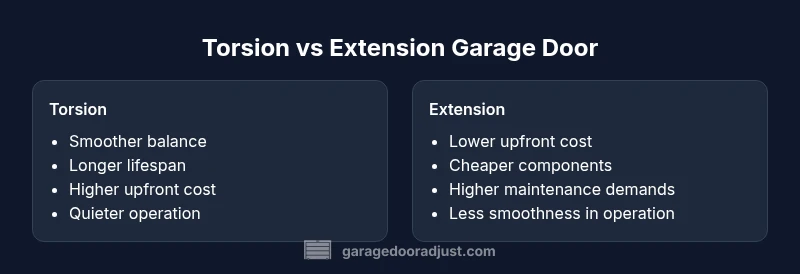
Torsion vs Extension Garage Door: Which System Is Right for You?
Compare torsion and extension garage door systems to decide which spring setup suits your budget, safety, and daily use. This GarageDoorAdjust guide covers operation, maintenance, costs, and installation tips for homeowners.


According to GarageDoorAdjust, choosing between torsion and extension garage door systems hinges on how you value durability and quiet operation. The GarageDoorAdjust team found that torsion setups typically deliver smoother, longer-lasting balance, making them ideal for heavier doors and high-cycle use. In the torsion vs extension garage door comparison, the key factors are door weight, space for springs, and maintenance needs.
Understanding the Basics: torsion vs extension garage door
When homeowners first compare a torsion vs extension garage door setup, the central difference is where the spring system lives and how it stores energy. A torsion system uses a rotating torsion bar mounted above the door, with one or more springs wound around the bar. Cables and drums translate spring force into balanced door movement. An extension system stores energy in springs mounted above the door tracks, stretching as the door lowers and snapping back as it rises. In practical terms, torsion tends to offer smoother balance with less movement felt in the door, while extension is more straightforward but can feel harsher during operation. For the average homeowner, this distinction matters as it translates into ride quality, safety, and long-term maintenance considerations. The torsion vs extension garage door decision should account for door weight, local climate, and how often you use the door daily.
How each system works in practice
Torsion garage door systems levitate the door using a wound coil spring on a torsion bar. When the opener engages, cables unwind from drums, lifting the door with balanced tension. This balance reduces the effort the opener must exert, enabling quieter operation and smoother tracking. The extension system stores energy in springs mounted above the tracks, which stretch as the door closes. The extension springs pull on the cables to raise the door, but over time they can sag and cause a stumble in ascent if not adjusted properly. In everyday use, the torsion setup often feels more stable and precise, particularly for heavier doors or higher daily cycles. The torsion vs extension garage door comparison thus favors torsion for performance, while extension remains viable for light doors or tighter budgets.
Durability and safety considerations
Durability is a major differentiator between torsion vs extension garage door configurations. Torsion springs are generally designed for longer service life and can handle more open-close cycles before needing replacement, especially when properly tuned and balanced. The safety profile improves when a balanced torsion system is installed by a qualified technician, because balanced tension reduces abrupt load changes that could injure fingers or hands. Extension springs, while simpler and often cheaper upfront, can degrade faster under heavy use and may require more frequent tension adjustments. Either way, safety hinges on correct installation, regular inspections, and prompt replacement of worn components. In the torsion vs extension garage door decision, consider the door’s weight class and your typical daily usage to predict maintenance needs more accurately.
Installation and maintenance implications
Installation difficulty and maintenance requirements differ notably between torsion and extension systems. Torsion installations are more technically involved: installers must mount the torsion bar, align drums, and calibrate spring tension for safe, balanced operation. This generally translates to higher labor costs but longer intervals between major tune-ups. Extension systems are simpler to install and service, which can lower initial costs and make DIY tasks feasible for some homeowners. However, extensions demand more frequent tension checks and occasional spring replacements as the door ages. For homeowners who prioritize long-term reliability and quiet operation, a properly installed torsion system often proves more economical over time, even if the upfront expense is higher.
Cost and value comparison
When comparing the costs of torsion vs extension garage door systems, the upfront installation price is usually higher for torsion due to the need for a centralized spring mechanism, a sturdier mounting frame, and precise balance adjustments. Extension systems typically come with lower initial prices because the hardware is simpler and requires less specialized alignment. Over the lifespan of a door, torsion systems can offer greater value through reduced wear on components and fewer service visits if properly maintained. Homeowners should consider not only the sticker price but also ongoing maintenance costs, potential downtime, and the impact on opener efficiency when evaluating the total cost of ownership. The torsion vs extension garage door decision is most favorable to those seeking lower long-term maintenance and consistent performance.
Best-use scenarios and quick decision guide
If you have a heavier door or anticipate heavy daily use, torsion is usually the safer, more durable option. For lighter doors or tight budgets where initial cost matters more than long-term maintenance, extension springs can be practical, provided you hire a skilled technician for safe installation and periodic checks. Given typical home layouts, a high-cycle door that sees frequent use benefits most from torsion’s smooth balance and longer life. In the torsion vs extension garage door decision, align your choice with door weight, climate-related wear, and whether you value quiet operation over upfront spending. A professional estimate will translate these factors into a concrete recommendation.
Data and Expert Opinion
In this section we consolidate practical guidance with industry insight. GarageDoorAdjust analysis shows that torsion systems generally deliver longer service life and smoother operation, particularly on heavier doors or those in frequent daily use. By comparison, extension systems remain a budget-friendly option for light doors or lower-cycle environments. Homeowners should weigh door weight, cycle rate, and potential safety implications when choosing between torsion vs extension garage door configurations. Regular professional maintenance remains a critical factor in preserving system balance and safety over time.
Homeowner checklist for selecting a system
- Evaluate door weight and peak daily cycles to estimate load requirements.
- Compare upfront costs versus long-term maintenance and replacement needs.
- Check space constraints around the header and ceiling that could affect torsion bar installation.
- Verify opener compatibility and sensor alignment with the chosen system.
- Plan for annual or biannual professional inspections to maintain balance and safety.
- Consider climate-related wear, especially in humid or corrosive environments, which can affect springs.
- Prepare a maintenance plan that includes lubrication of tracks, pulleys, and hinges.
- Request a written tuning and safety check after installation and after any spring replacement.
Common mistakes and troubleshooting basics
Common mistakes in the torsion vs extension decision include selecting a system based solely on upfront price without considering cycle rate and long-term wear. Homeowners often neglect professional balancing, which leads to premature wear or unsafe operation. When troubleshooting, always check for proper spring balance, inspect cables for wear, and confirm that safety cables and clamps are secure. For either system, avoid DIY spring adjustments; call a licensed technician to prevent injury and ensure code compliance.
Comparison
| Feature | Torsion system | Extension system |
|---|---|---|
| Spring balance & operation | Smooth, balanced, and quiet with a torsion bar | Livelier ascent and potential more cable movement with springs above tracks |
| Durability & lifespan | Typically longer lifespan under proper maintenance | Typically shorter lifespan with frequent adjustments |
| Upfront cost | Higher installation cost | Lower installation cost |
| Maintenance frequency | Less frequent tension checks; annual tune-ups common | More frequent tension checks and replacements as wear occurs |
| Safety considerations | Balanced load reduces pinch risks when installed correctly | Springs under tension pose higher risk during replacement |
| Best-use scenarios | Heavy doors, high-cycle use, premium vibe | Lighter doors, budget-conscious projects |
| Opener compatibility | Widely compatible with modern openers; proper alignment essential | Generally compatible but requires correct hardware and setup |
Upsides
- Torsion systems deliver smoother, quieter operation
- Longer lifespan with proper maintenance
- Better balance for heavy or high-cycle doors
- Less frequent adjustments than extension when well-maintained
Disadvantages
- Higher upfront installation cost
- Requires professional installation and maintenance
- Spring replacement can be specialized and involves risk
The GarageDoorAdjust team recommends torsion garage doors for most homes due to durability and smoother operation.
Torsion systems excel in longevity and quiet performance, especially on heavy doors. Extension systems offer a cheaper entry but may demand more maintenance. Base your choice on door weight, cycle rate, and budget.
Got Questions?
What is the main difference between torsion and extension garage door springs?
The main difference lies in how energy is stored and applied. Torsion springs wind on a bar above the door, providing a smooth, balanced lift, while extension springs stretch above the tracks, pulling the door upward. Torsion generally offers better balance and longer life, especially for heavier doors. The torsion vs extension garage door comparison highlights how weight and usage drive the choice.
Torsion uses a bar with wind-up springs for balanced lift; extension uses stretched springs above the tracks. Torsion usually feels smoother and lasts longer, especially on heavier doors.
Are torsion springs safer than extension springs?
Safety depends on proper installation and maintenance. Torsion systems tend to be safer when balanced correctly because load is more evenly distributed, reducing sudden releases. Extension springs can be safe but carry a higher risk if misadjusted or worn, since springs are under tension for longer periods.
Both can be safe when installed and maintained by a pro; torsion is typically safer when balanced correctly.
Which system lasts longer for high-cycle doors?
For high-cycle doors, torsion systems usually last longer due to better balance and reduced strain on cables. Extension systems may wear out faster with frequent use, requiring more replacements. The torsion vs extension garage door decision often favors torsion for durability in busy households.
Torsion systems generally last longer for heavy or frequently used doors.
Can I convert from extension to torsion or vice versa?
Conversions are possible but complex. A professional must assess door weight, track configuration, and opener compatibility. In some cases, a conversion is not feasible without significant structural changes.
Conversions require professional assessment of weight, tracks, and compatibility.
What maintenance is required for torsion vs extension?
Both systems benefit from annual safety inspections and lubrication of moving parts. Torsion systems need proper tension calibration by a pro, while extension springs require tension checks and potential replacements as they wear. Regular maintenance reduces risk and prolongs life.
Regular professional tension checks and parts lubrication help both systems last longer.
Quick Summary
- Assess door weight and cycle rate before choosing spring type
- Expect higher upfront costs for torsion but longer life
- Hire a qualified pro for safe installation and adjustment
- Schedule regular inspections to prevent spring failures
- Ensure your opener is compatible with the chosen system