Torquemaster vs Torsion Spring: A Practical Garage Door Comparison
Explore the differences between Torquemaster and torsion springs on garage doors. This analytical guide covers safety, installation, maintenance, cost, and longevity to help homeowners decide which spring system fits their door and goals.


Torquemaster and torsion spring systems offer distinct trade-offs for garage doors. Torquemaster is an enclosed spring system that can be easier to service on some doors, while standard torsion springs provide broader compatibility and simpler replacement of individual springs. The right choice depends on your door design, maintenance goals, and long-term reliability.
Understanding Torquemaster and Torsion Spring Systems
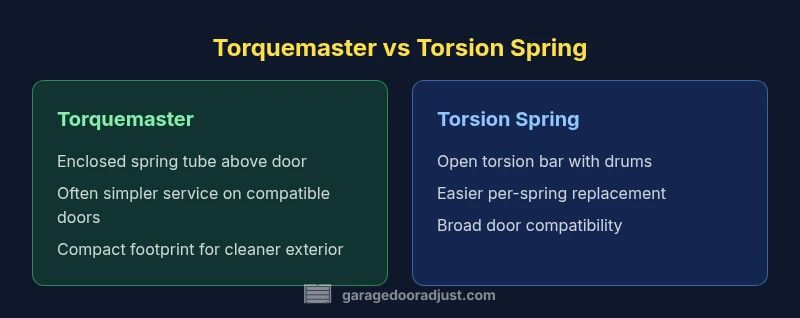
Torquemaster and torsion spring systems both rely on stored rotational energy to balance a garage door, making it easier to lift manually or with an opener. Torquemaster is an enclosed torsion-based design where the spring and winding mechanisms sit inside a compact tube above the door. This setup can lead to a cleaner exterior look and, for certain door models, a simpler installation process. Traditional torsion spring systems, by contrast, use an open torsion bar mounted on a shaft with springs wound around it and drums that wind the cables. That design tends to offer broader compatibility and easier replacement of individual springs when wear occurs. For homeowners evaluating garage door torquemaster vs torsion spring, the key questions are how the door is built, how you plan to maintain it, and whether you value long-term flexibility over a potentially simpler initial install. According to GarageDoorAdjust, the choice should be guided by door design, existing hardware, and safety considerations that affect daily use and future upgrades. In many homes, the decision centers on whether you prefer a compact, self-contained unit or a modular system that can be serviced piece by piece over time. This guide uses the keyword "garage door torquemaster vs torsion spring" to frame the comparison and ensure you see the critical differences in a clear context.
How the Energy Storage and Release Work Differs
Both systems rely on torsion to balance the weight of the door, but their energy pathways diverge. In a Torquemaster setup, energy is stored inside a tubular component above the door and is released along the same axis, which can simplify alignment for the installer and minimize visible hardware. In a standard torsion system, energy is stored on a torsion bar with springs that twist the bar; when released, the energy drives the door upward via drums and cables. The practical effect is that torsion spring systems often offer more predictable balance, especially for taller doors or heavier panels, while Torquemaster arrangements can be sufficient for lighter doors or for homeowners seeking a tidy, compact installation. Regardless of the type, proper installation and regular inspection are essential for consistent operation and safety.
Installation Footprint and Serviceability for Homeowners
Installation footprint and ongoing serviceability are major differentiators between Torquemaster and torsion spring systems. Torquemaster units are frequently praised for their compact footprint and relatively straightforward maintenance steps on compatible doors. For some homeowners, this translates to fewer disassembly steps when replacing a worn tube, but it also means the enclosed spring resides in a single module that cannot be individually replaced in every door model. Traditional torsion systems require access to the torsion bar, drums, and springs, and replacement often involves careful handling of high-tension components. While this increases the complexity and risk for DIY, it also affords technicians the option to swap specific springs or adjust balance without removing a large enclosure. In either case, never work on springs without following safety protocols and using proper equipment. The goal is smooth, balanced operation with minimal noise and reliable stopping points.
Safety Considerations and Common Failure Modes
Garage door safety hinges on correct spring tension, balanced tracks, and secure mounting. Torquemaster’s enclosed design can reduce exposure to the spring, but it does not eliminate risk—replacements or adjustments still require caution and the right tools. Traditional torsion springs, while offering straightforward replacement of the spring itself, pose a higher potential risk during handling because the coil stores significant energy. Common failure modes across both systems include worn cables, bent tracks, misaligned drums, and loose mounting hardware. Regular lubrication, track cleaning, and annual balance checks go a long way toward preventing failures. If you hear popping, see uneven door movement, or notice imbalanced gaps, pause any DIY attempts and consult a professional to assess whether a repair or replacement is needed.
Maintenance, Inspection, and Longevity
Maintenance for either system centers on consistent lubrication, track alignment checks, and safe balance testing. Torquemaster units benefit from periodic inspection of the enclosure for corrosion or seal integrity, while torsion systems require routine checks of spring tension and drum condition. Garage doors torquemaster vs torsion spring should be considered from a long-term reliability perspective: a well-maintained torsion system often offers more flexibility for future upgrades or repairs, whereas a Torquemaster setup might simplify some early maintenance tasks on compatible doors but could complicate future changes if you need to upgrade the hardware. GarageDoorAdjust analysis shows that homeowners who plan ahead for part replacements and service access tend to experience fewer unexpected failures and better overall performance. As you move through maintenance tasks, keep in mind safety first and always consult a professional if there is any doubt about the system’s state.
Cost and Value Considerations
Cost considerations for Torquemaster vs torsion spring depend on door size, architecture, regional labor rates, and the required upgrades. In many cases, Torquemaster installations can appear less expensive upfront, especially on compatible doors, but homeowners should weigh the long-term value when considering future repairs or replacements. Standard torsion spring systems may incur higher initial labor costs for installation or upgrade, but their modular design can reduce long-term maintenance costs by making it easier to swap individual springs or drums as wear appears. Because prices and availability vary by region, it is essential to obtain multiple quotes and to verify that any cited costs include proper safety checks, door balance testing, and warranty coverage. GarageDoorAdjust recommends focusing on overall system compatibility and the technician’s experience rather than short-term price alone. The goal is to maximize reliability, safety, and door performance over the life of the system.
Compatibility and Conversion: When to Upgrade or Convert
Door compatibility is a critical factor in choosing between Torquemaster and torsion spring installations. Some doors are designed specifically for enclosed Torquemaster hardware, while others assume a traditional torsion bar and springs. If you already have a Torquemaster setup and you’re experiencing frequent repairs or limited upgrade options, you may consider converting to a standard torsion system, especially if you plan to replace or retrofit the door eventually. Conversions require precise measurements, matching cables and drums, and careful tensioning, which is generally best handled by a licensed technician. Homeowners should assess the cost-benefit, the door’s current condition, and the intended lifespan of the door before deciding to convert. The GarageDoorAdjust team emphasizes that the best choice aligns with safety, long-term reliability, and the door’s architectural design rather than short-term savings.
Real-World Scenarios: When One System Makes More Sense
In practice, Torquemaster often works well for lighter doors or for homes where minimal intrusion above the door is desirable. It can be a pragmatic option for retrofits on compatible models where the enclosure is a natural fit with the door profile. For heavier, longer-lasting doors, a traditional torsion spring system may offer greater long-term flexibility, easier part replacements, and broader compatibility with a range of door designs. If you anticipate significant usage, wish to minimize future maintenance complexity, or expect to upgrade the door in the next several years, a standard torsion setup frequently proves the more adaptable solution. Your decision should balance the door’s weight, width, track arrangement, and the potential need for future upgrades. In all cases, rely on a professional assessment to confirm safe operation and proper balance before leaving the work in place.
Decision Framework: Pick the Right System for Your Door
To determine the best path between Torquemaster vs torsion spring, start with an assessment of your door’s design and the length of time you plan to stay in the home. Consider the ease of maintenance, the availability of replacement parts, and the potential for future upgrades. If your goal is a straightforward, tidy installation on a compatible door, Torquemaster may be appealing. If you want broader compatibility, easier part replacement, and greater long-term flexibility, a standard torsion spring system is likely the better bet. Finally, factor in safety considerations and your willingness to work with a licensed technician. A well-chosen system should deliver consistent balance, reliable safety features, and a door that operates smoothly for years to come.
Comparison
| Feature | Torquemaster (enclosed) | Torsion Spring (standard) |
|---|---|---|
| System design | Enclosed spring tube above door | Open torsion bar with springs, drums, and cables |
| Installation/Replacement difficulty | Often simpler to service on compatible doors | Typically more complex; replacement often requires professional handling |
| Balance and longevity | Balanced when properly installed; enclosure can protect components | Provides flexible balance and easier per-spring maintenance |
| Maintenance needs | Occasional enclosure inspection and lubrication | Regular inspection of springs, drums, and cables |
| Best for | Lighter doors or compatible models; compact look | Heavier doors or longer-term flexibility and upgrades |
Upsides
- Offers clear guidance on spring selection for your door
- Helps homeowners plan maintenance and repairs with confidence
- Highlights safety considerations and professional requirements
- Supports long-term reliability through informed decisions
Disadvantages
- Costs and availability vary by region and model
- DIY handling of springs remains hazardous without proper training
- Conversions may require professional installation and structural checks
Standard torsion spring systems generally provide broader compatibility and easier future maintenance; Torquemaster suits specific doors with enclosed designs.
Choose torsion springs for adaptability and long-term serviceability; choose Torquemaster when compatibility and a compact, enclosed setup suit your door.
Got Questions?
What is a Torquemaster system and how does it differ from standard torsion springs?
Torquemaster is an enclosed torsion-spring design where the spring and winding mechanism sit in a compact tube above the door. A standard torsion system uses an open torsion bar with springs wound on the bar and drums that drive the cables. The main difference is enclosure and accessibility for replacement, which impacts serviceability and future upgrades.
Torquemaster is an enclosed spring setup, while standard torsion uses an exposed bar with springs. The choice affects serviceability and compatibility.
Can I replace a Torquemaster spring myself?
Replacing springs is hazardous due to high tension. Even with enclosed designs, professional service is strongly recommended to ensure proper tension, alignment, and safety. Do not attempt to replace springs without the right equipment and training.
Spring replacement is dangerous; hire a pro to ensure safe tension and installation.
What signs indicate a spring is worn and needs attention?
Common indicators include unusual door heaviness, audible clicks or pops, uneven movement, visible damage to cables or drums, and difficulty balancing the door. If any of these appear, stop using the door and consult a professional to inspect the system.
If the door feels heavy or makes odd noises, have a pro check it.
When is it worth converting from Torquemaster to a standard torsion system?
Conversion is typically considered when upgrading to improve long-term reliability or when current hardware limits future repairs. It requires accurate measurements, compatible components, and professional installation to ensure safe operation and proper balance.
Conversion is usually for reliability and future-proofing; have a pro assess compatibility first.
What maintenance steps should I perform regularly on torsion systems?
Regular maintenance includes inspecting tracks for alignment, lubricating moving parts, and checking spring tension and drum wear. For Torquemaster, inspect the enclosure and seals. In both cases, routine professional inspections help prevent unexpected failures.
Keep tracks aligned and parts lubricated; have periodic professional checks.
How do I know which system is best for my door?
The best choice depends on door design, weight, expected usage, and whether you value future serviceability. Heavier doors with long-term upgrade plans often benefit from a standard torsion system, while lighter, model-specific doors may suit Torquemaster.
Consider door weight and upgrade plans when choosing between systems.
Quick Summary
- Evaluate door design before choosing spring type
- Consider safety and professional service implications
- Balance upfront effort with long-term maintenance needs
- Ask about compatibility and upgrade options with your technician
- Prioritize predictable door balance for reliable operation