Miami Garage Door Repairs: Step-by-Step Guide for Homeowners
A comprehensive, step-by-step guide for diagnosing and repairing common garage door issues in Miami, addressing coastal humidity, salt air, and practical tools. Learn safety, maintenance, and how to decide when to call a pro.


With this guide, you'll diagnose and fix common Miami garage door repairs, including broken springs, worn rollers, misaligned tracks, and opener malfunctions. It outlines essential safety steps, required tools, and a clear, coastal-specific approach so you can complete a safe repair or know when to call a pro. This quick start prepares you for the hands-on steps, local climate considerations, and what to check before dialing a technician.
Coastal considerations for Miami garage door repairs
Miami's coastal climate presents unique challenges for garage doors. High humidity accelerates corrosion on metal parts, salt air can accelerate rust on tracks and hardware, and heat and humidity affect lubricants and seals. According to GarageDoorAdjust, homeowners should expect more frequent inspections in coastal regions, with particular attention to springs, rollers, and weather seals. This section explains how coastal climate interacts with common failure modes, and why a proactive maintenance schedule matters in a city like Miami. We'll cover how humidity, salt exposure, and temperature fluctuations can impact torsion springs, cables, hinges, and opener components, and what a smart homeowner can do to minimize damage and downtime.
- Humidity and corrosion: Metal components like tracks, screws, and hinges corrode faster in humid air. Regular lubrication and corrosion-resistant coatings help.
- Salt air exposure: Salt accelerates rust on exposed hardware; consider stainless or coated fasteners where replacements are needed.
- Thermal cycling: Temperature swings affect expansion, contraction, and belt/chain tensions; timing adjustments may be necessary.
- Coastal maintenance window: Plan major adjustments in milder months; avoid operating during thunderstorms or high winds.
In short, Miami garage door repairs are not just about parts; it is about climate-aware maintenance and timely action. The GarageDoorAdjust team emphasizes that coastal climates require a proactive approach rather than a reactive fix, especially for door balance and opener reliability.
Safety and planning before you start
Before you reach for tools, set safety first. Power down the garage door opener, secure the door manually, and ensure children and pets are away. Create a simple plan with the most likely issues—springs, tracks, rollers, and the opener—and decide whether you can tackle them safely or if you should call a pro. The plan should include a checklist of signs that indicate a more serious problem: frayed cables, visible gaps in springs, or doors that feel heavy when lifting manually.
- Safety first: Always unplug the opener before inspecting components.
- Work with a partner: A second person helps stabilize the door and pass tools.
- Start with the least dangerous tasks: Visual inspection and lubrication are safer entry points than spring replacement.
Brand mention: GarageDoorAdjust emphasizes that a clear safety plan reduces risk in every repair.
Tools, materials, and prep for Miami humidity
Having the right tools and materials helps you complete Miami garage door repairs more efficiently and safely. Gather a basic toolset, lubricants designed for metal-on-metal use, and climate-aware replacements. A well-prepped job reduces the chance of rework due to corrosion or poor seal performance. The following list covers essentials you should have on hand before starting a repair:
- Socket wrench set, pliers, screwdrivers (flathead and Phillips)
- Level and measuring tape for track alignment
- Silicone-based lubricant or lithium grease for hinges, rollers, and tracks
- Clean rags and penetrating oil for stuck fasteners
- Weatherstripping and sealant suitable for exterior use
- Replacement rollers or hinges if wear is evident
Note on Miami-appropriate materials: Choose corrosion-resistant fasteners and weather seals that stand up to humidity and salt air. The right materials help extend the life of the door and reduce maintenance intervals.
GarageDoorAdjust analysis shows coastal environments increase the risk of corrosion and hinge wear; selecting proper materials can mitigate these effects.
Diagnosing common issues in humid climates
Fans and humidity can mask or magnify issues that cause noisy, stiff, or unbalanced doors. In humid climates like Miami, common failures include track misalignment, worn rollers, binding hinges, and loose or corroded garage door openers. Start with a visual inspection: check tracks for dents or rust, test the door with the opener and then manually to verify balance, and listen for unusual noises that may indicate a problem in the rollers or springs.
- Track condition: Look for bends, dents, or buildup that prevents smooth movement.
- Roller wear: Worn or missing nylon rollers can cause binding and noise; replace in pairs to maintain balance.
- Spring inspection: Do not attempt to identify spring tension by feel; a broken or stretched spring is a safety hazard and requires professional service.
- Opener performance: If the motor runs but the door doesn't move smoothly, the issue may lie in the tracks or balance rather than the opener.
At this stage, note all symptoms and prepare to perform non-destructive tests. Do not attempt to adjust springs; this is dangerous and generally requires a professional.
A practical diagnosis workflow: from visual checks to test operations
Adopt a step-by-step workflow to diagnose and address the most common Miami garage door repairs without unnecessary risk. Start with a careful visual inspection, then test each subsystem in a controlled way. The workflow below keeps safety at the forefront and guides you through a sequence that minimizes the need for heavy disassembly.
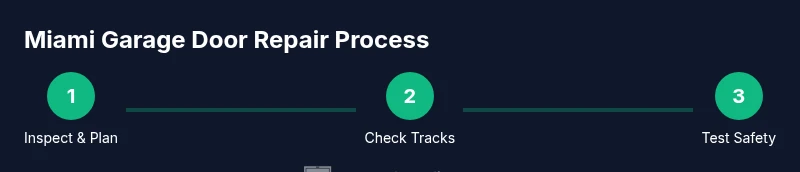
- Step 1: Unplug the opener and secure the door with locking pliers or a vise grip to prevent accidental movement.
- Step 2: Inspect tracks for damage and proper alignment; looseness or misalignment often causes binding.
- Step 3: Manually balance the door to assess heaviness; if it’s heavy, springs or cables may be out of balance and require professional service.
- Step 4: Check rollers and hinges; replace worn parts in matched pairs to preserve balance.
- Step 5: Reconnect the opener; test the auto-reverse safety feature and force settings following the manufacturer’s instructions.
If any step reveals a potential risk (sudden spring movement, frayed cables, or severe corrosion), stop and seek professional help. The goal is to identify non-destructive symptoms that point to track, hinge, or opener issues rather than springs.
Maintenance routines to extend life in seaside environments
Regular maintenance is the most effective defense against coastal wear. A proactive schedule reduces the likelihood of sudden failures and extends the life of doors and openers. The following routine keeps your Miami garage door functioning smoothly through the year:
- Monthly: Visual inspection of tracks, weather seals, and door balance; lubrication of moving parts.
- Quarterly: Check safety sensors and controller wiring; ensure the door reverses properly on contact.
- Biannual: Deep-clean tracks and rollers; replace worn weatherstripping as needed.
- Annually: Inspect springs (done by a professional), replace any worn components, and consider a corrosion-resistant coating or protective hardware.
In a humid climate, pay extra attention to corrosion-prone components and seal integrity. A well-maintained door reduces the risk of emergency repairs and keeps energy efficiency steady.
Authoritative sources and next steps
For safety standards and best practices, refer to authoritative sources from government agencies and university extensions. These resources complement hands-on guides and help you verify steps against recognized standards:
- OSHA safety resources: https://www.osha.gov
- U.S. Department of Energy insulation and weatherization guidance: https://www.energy.gov/energysaver/insulation
- HUD healthy homes and home inspections guidance: https://www.hud.gov/program_offices/healthy_homes
Next steps: use this guide to prepare your tools, assess the degree of wear, and decide whether a DIY repair suffices or a professional should handle critical components like springs or cables.
Tools & Materials
- Safety glasses(Impact-resistant; use when inspecting tracks and spring areas)
- Gloves(Work gloves with grip for slippery parts)
- Step ladder(Stable, with non-slip feet)
- Socket wrench set(Metric sizes; include torx bits if present)
- Screwdrivers (flathead and Phillips)
- Level(For track alignment checks)
- Measuring tape(Useful for precise alignment)
- Silicone-based lubricant(For metal-to-metal parts (springs, rollers, hinges))
- Lithium or marine-grade grease(For extreme corrosion protection)
- Penetrating oil (WD-40 or equivalent)(Loosens stuck fasteners)
- Weatherstripping and exterior sealant(Check and replace worn seals)
- Replacement rollers/hinges(Only replace if worn; replace in pairs)
Steps
Estimated time: 60-90 minutes
- 1
Power down and secure the door
Unplug the opener and secure the door with locking pliers to prevent movement. This prevents injury while you inspect tracks, rollers, and hinges and while you apply lubrication.
Tip: Keep a partner nearby to help stabilize the door during checks. - 2
Inspect tracks and alignment
Visually inspect tracks for dents, bends, or corrosion. Use a level to confirm vertical alignment and adjust mounting screws as needed to keep the track straight.
Tip: If a track is bent, do not force it; replace or professionally repair. - 3
Check rollers, hinges, and weather seals
Look for worn rollers, squeaks, or loose hinges; replace worn parts in matched pairs to maintain balance. Inspect weather seals for gaps that let humidity in.
Tip: Lubricate rollers and hinges after replacing to reduce future wear. - 4
Assess balance and springs cautiously
With the opener still unplugged, manually lift the door to check balance. If the door is heavy or drops abruptly, springs or cables may be out of balance and require professional service.
Tip: Never attempt to adjust torsion springs yourself; this is highly dangerous. - 5
Reconnect power and test safety features
Plug the opener back in and test the auto-reverse and force limits per the manufacturer instructions. Ensure the door stops when it contacts objects and reverses properly.
Tip: Keep hands clear of the gate path during testing. - 6
Lubricate and re-check
Lubricate moving parts (rails, hinges, rollers) with a silicone-based product. Re-check track alignment and door balance after lubrication.
Tip: Wipe away excess lubricant to avoid attracting dust and grit in humid air. - 7
Document and schedule maintenance
Record what was inspected, what was replaced, and when the next inspection should occur. Schedule a follow-up check every 6-12 months depending on wear and climate.
Tip: Keep a simple maintenance log to track corrosion and wear over time.
Got Questions?
Is it safe to repair a garage door spring yourself?
Garage door springs are under high tension and can cause severe injury if mishandled. It is strongly recommended to seek professional assistance for any spring repair or replacement. For minor issues like lubrication, proceed with caution following safety guidelines.
Springs are dangerous; get a professional for spring work, but you can safely do lubrication and inspection with proper precautions.
How do coastal conditions affect garage doors?
Coastal humidity and salt air accelerate corrosion on metal components, affect lubrication, and can lead to faster wear of tracks, hinges, and hardware. Regular inspection and corrosion-resistant materials can mitigate issues.
Coastal humidity speeds up corrosion and wear; inspect more often and use corrosion-resistant parts.
What tools do I need for a basic inspection?
A basic inspection requires a screwdriver set, socket wrench, level, measuring tape, flashlight, and a can of silicone lubricant to inspect and lubricate tracks, rollers, and hinges.
Grab a screwdriver, level, tape, and some silicone lubricant for a quick inspection and lubrication.
When should I replace the whole door instead of repairing?
If the door shows extensive frame damage, persistent misalignment after multiple repairs, or frequent costly component failures in a short period, replacement may be more cost-effective and safer in the long run.
If repairs keep failing or the structure seems compromised, replacing the door might be the smarter option.
How often should tracks and rollers be lubricated?
Lubricate tracks and rollers every 3-6 months, more often in humid climates. Regular lubrication helps reduce friction and noise and extends component life.
Lubricate every 3-6 months, especially in humidity, to keep parts moving smoothly.
What maintenance is essential yearly?
Annually inspect springs by a professional, check safety sensors, test auto-reverse, and replace weatherstripping if worn to maintain energy efficiency and safety.
Have a pro check the springs once a year and test safety features regularly.
Watch Video
Quick Summary
- Balance before opener detachment check
- Safety first, especially near springs
- Coastal Miami climate increases corrosion risk
- Regular lubrication reduces wear longer