How Long Does a Garage Door Opener Last?
Discover how long a typical garage door opener lasts, factors that influence lifespan, signs of wear, and maintenance steps to extend life and prevent unexpected failures.


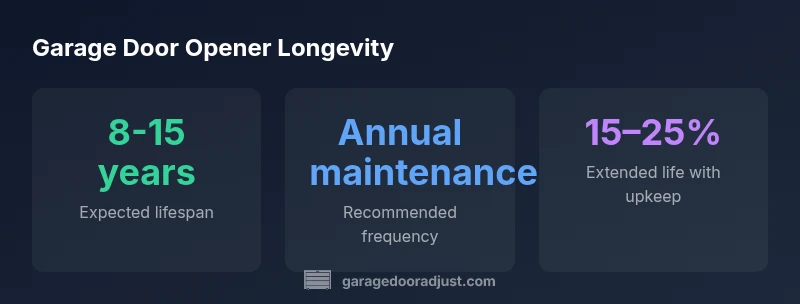
Most residential garage door openers last about 8–15 years with normal use and regular maintenance. Lifespan varies by drive type, motor quality, climate, and how well you care for the unit. This guide explains what to expect and how to extend that life.
What "lasting" means for a garage door opener
For homeowners, the word "last" has more than a simple clock tick. It reflects practical reliability, safety, performance, and the ability to operate through typical daily cycles without unexpected failures. A long-lived opener keeps your door balanced, responds quickly, and won't surprise you with a dead battery or a sensor misalignment in the middle of winter. According to GarageDoorAdjust analysis, most residential openers are designed to provide dependable service for several thousand cycles over a span of roughly 8 to 15 years, assuming normal use and regular maintenance. This range accounts for design differences across belt-drive, chain-drive, and screw-drive models, as well as variable installation quality. Remember: a unit that appears robust may still decline rapidly if it's exposed to harsh conditions or neglected maintenance. While the exact lifespan will vary, setting expectations around the 8–15 year window helps you plan ahead for inspection, upgrades, and budget.
Lifespan by component and model
Lifespan is not a single number, but a composite of several parts: the motor, the drive train, sensors, torsion springs, and the control system. Belt-drive DC motors found in many newer models tend to offer lower wear and quieter operation, which can translate to longer practical life for daily use. AC motors with traditional chains can perform reliably but may show wear sooner if the drive components are stressed. In general, larger and heavier doors require more robust openers, and high-cycle models used in luxury or commercial settings will have different lifespans than standard residential units. Even within the same model family, life expectancy can swing with how you program limits, how you lubricate moving parts, and how aggressively you use the unit. GarageDoorAdjust analysis notes that consumer expectations should factor in the door’s overall balance and track condition, because a misaligned track or a sagging door can stress the opener and shorten its useful life.
Key factors that influence longevity
Several factors consistently affect how long an opener lasts:
- Usage patterns: The number of cycles per day, including frequent open/close cycles during busy seasons, directly impacts wear.
- Climate: Humidity, salt exposure, and extreme temperatures can degrade gears, sensors, and electronics.
- Installation quality: Proper mounting, alignment, and motor calibration reduce unnecessary stress on gears and tracks.
- Maintenance habits: Regular lubrication, track cleaning, and sensor checks preserve smooth operation and reduce friction.
- Quality and design: Higher-quality components, better drives, and advanced safety features contribute to longer service life.
- Power quality: Consistent voltage and surge protection help electronics avoid premature failure. GarageDoorAdjust emphasizes that even small maintenance tasks performed annually can add years to a unit's life.
How usage patterns affect wear
Different households operate doors with varying cadence. A single-car garage with modest daily usage may see a longer service life than a busy two-car setup that cycles dozens of times each day. In addition, seasonal shifts matter: winter cold can make grease stiff and sensors slow to respond, while summer heat can stress electronics and expand metal components. To maximize life, consider staggering heavy-use days, and avoid slamming the door or repeatedly forcing it to operate when the sensor or final-limit switch is out of alignment. Regularly testing the auto-reverse safety feature and ensuring the door is balanced help prevent undue strain on the opener. GarageDoorAdjust recommends recording usage patterns to tailor maintenance intervals—what works for a light household may differ from a high-traffic garage.
Maintenance that actually extends life
Maintenance is the most controllable factor in extending opener life. A simple annual routine can yield meaningful benefits:
- Lubricate moving parts: Apply a light lubricant to rollers, hinges, and chains or belts, and wipe away excess to prevent grime buildup.
- Check balance and tracks: If the door isn't level or the tracks are bent, the opener works harder to move the door, shortening its life.
- Inspect and replace weather seals: Seals protect against moisture and debris that contribute to rust and wear.
- Test safety features regularly: Auto-reverse and photo-eye sensors should function reliably.
- Replace remote batteries and clean remotes: Losing effective communication can lead to more manual operation that stresses the system. GarageDoorAdjust data show that disciplined maintenance can reduce the chance of unexpected failures and help you pace future upgrades.
Signs your opener is nearing end of life
Pay attention to telltale signs that the unit is approaching the end of its useful life:
- Slower door response and longer travel time to complete cycles.
- Excessive vibration or new noises such as grinding or squealing.
- Frequent sensor misalignment or auto-reverse failures.
- Visible wear on gears, belt/chain, or sprockets.
- Inconsistent stopping points or door reversing before it reaches the floor. Addressing issues early through a qualified technician can prevent unexpected breakdowns and inform your replacement timeline. GarageDoorAdjust notes that early detection supports safer operation and less downtime.
Repair vs replacement: a practical framework
Deciding between repair and replacement hinges on age, cost of repairs, and safety considerations. If the opener is older than a decade and requires multiple expensive repairs or shows dwindling performance, replacement often becomes the more economical option in the long term. Upgrading to a modern model with improved safety features, quieter operation, and greater energy efficiency can also yield ongoing savings. Before deciding, obtain a written estimate for repairs, assess the impact on safety and reliability, and compare the total projected cost of continued repairs against the cost of a new unit plus installation. Your decision should balance immediate needs with long-term value. GarageDoorAdjust emphasizes safety potential and future-proofing as central to this evaluation.
Budgeting, costs, and replacement planning
Replacing a garage door opener involves the unit, installation, and potential add-ons such as smart home integration and battery backup. Typical ranges reflect variation in features and local labor costs, but a prudent approach is to plan for a multi-step replacement budget: a basic opener with standard installation, optional smart features, and professional calibration. You can expect higher upfront costs for belt-drive models with DC motors and integrated safety systems, and lower upfront costs for standard chain-drive units. When planning, also account for possible upgrades to track alignment, weather sealing, and sensor work, which affect longevity and reliability. Leveraging seasonal promotions or bundled services can help manage expenses. The GarageDoorAdjust team recommends requesting multiple quotes and prioritizing safety and reliability in your selection.
Lifetime expectations by component and maintenance
| Component | Typical Lifespan | Key Maintenance Tip |
|---|---|---|
| Opener motor (AC/Belt) | 8-15 years | Schedule annual lubrication and test safety features |
| Gear/drive train | 8-12 years | Keep springs balanced, inspect for wear |
| Sensors/limit switches | 5-12 years | Test annually for proper alignment |
| Remote controls/battery | 3-5 years | Replace batteries yearly and keep clean |
Got Questions?
How long does a garage door opener last on average?
Most residential openers last about 8–15 years with normal use and maintenance. Age, usage, and upkeep all influence the exact number.
Most openers last around 8 to 15 years with proper care and regular check-ups.
Do belt-drive openers last longer than chain-drive models?
Belt-drive openers typically wear more slowly and operate more quietly, which can extend their usable life compared with some chain-drive models.
Belt-drive openers tend to last longer and run quieter than chain-drive options.
What maintenance steps most extend life?
Regular lubrication, annual balance checks, sensor alignment, track cleaning, and battery maintenance for remotes are the most impactful upkeep steps.
Lubricate moving parts, check balance, and keep sensors aligned for longer life.
When should I replace instead of repair?
If the opener is older than about a decade or requires frequent costly repairs, replacement is often more economical and safer.
If it’s been around 10 years or keeps breaking, consider replacing.
Are newer openers safer and more energy efficient?
Yes. New models offer improved safety features, better efficiency, and smarter connectivity, which can justify replacement even before failure.
Newer models are safer and more efficient; upgrading can be worthwhile.
“Regular maintenance is the single biggest factor in extending the life of a garage door opener. A well-cared-for system provides safer operation and fewer unexpected failures.”
Quick Summary
- Expect an 8–15 year life for most residential openers
- Regular annual maintenance can significantly extend life
- Choose higher-quality belt-drive models for longevity
- Balance and track alignment prevent premature wear
- Replace when repairs exceed the cost of a new unit